
Science Fiction
Dictionary
A B C D E F G H I J K L M N O P Q R S T U V W X Y Z
Latest By
Category:
Armor
Artificial
Intelligence
Biology
Clothing
Communication
Computers
Culture
Data Storage
Displays
Engineering
Entertainment
Food
Input Devices
Lifestyle
Living Space
Manufacturing
Material
Media
Medical
Miscellaneous
Robotics
Security
Space Tech
Spacecraft
Surveillance
Transportation
Travel
Vehicle
Virtual
Person
Warfare
Weapon
Work
"I can't tell whether or not there's going to be a Singularity. I don't really believe the rapture of the nerds stereotype..."
- Charles Stross

 |
| Copseyes | ||
| A small floating "eye-in-the-sky" surveillance drone used by police in an extensive park. |

In this near-future story, areas are set aside as anarchy zones. Police use a special kind of remote surveillance drone to ensure that there is no physical violence, but are otherwise uninvolved.
| Someone at police headquarters had expected that. Twice the usual number of copseyes floated overhead, waiting. Gold dots against blue, basketball-sized, twelve feet up. Each a television eye and a sonic stunner, each a hookup to police headquarters, they were there to enforce the law of the Park...
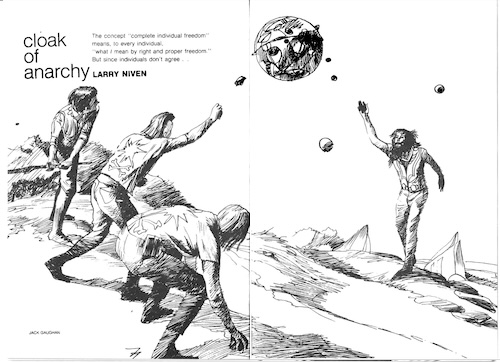 ('Cloak of Anarchy' by Larry Niven) Within King's Free Park was an orderly approximation of anarchy. People were searched at the entrances. There were no weapons inside. The copseyes, floating overhead and out of reach were the next best thing to no law at all. There was only one law to enforce. All acts of attempted violence carried the same penalty for attacker and victim. Let anyone raise his hand against his neighbor, and one of the golden basketballs would stun them both. They would wake separately, with copseyes watching. It was usually enough. No violence. |
| Technovelgy from Cloak of Anarchy,
by Larry Niven. Published by Analog in 1972 Additional resources -
|
Here are some more details:
It was impressively simple. I picked out the stunner by its parabolic reflector, the cameras, and a toroidal coil that had to be part of the floater device. No power source. I guessed that the shell itself was a power beam antenna.
For the first time ever, I looked into a copseye.
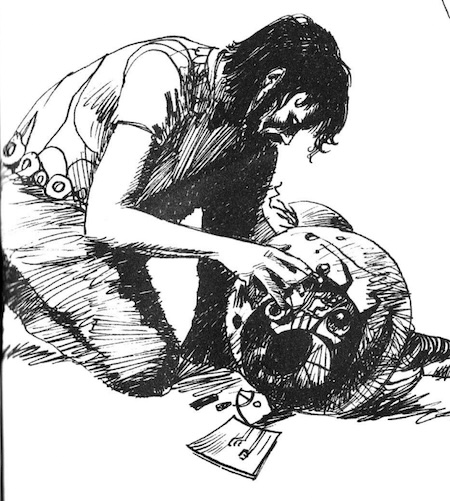
(Copseye from 'Cloak of Anarchy' by Larry Niven)
This story is an interesting exploration of the concept of anarchy in a real setting. Makes for an interesting contrast with the same kind of setting in Robert Heinlein's Coventry (if you did not agree to live up to the rules of society, you were given the choice to live with the asocials in a fenced-in environment).
Bruce Sterling wrote about this technology in his 1993 story Deep Eddy:
At 08:00 a police drone attempted to clear the park. It flew overhead, barking robotic threats in five languages. Everyone simply ignored the machine.
Remote drones are under development to serve a variety of purposes.
The Traffic Surveillance Drone project in Georgia has a ducted fan drone under development; it uses an aluminum chassis with a carbon composite body structure to provide stability.
You might also want to check out the endearing entry for little bird, from Darwin's Children by Greg Bear.
Compare to the raytron apparatus from Beyond the Stars (1928) by Ray Cummings, the scarab robot flying insect from The Scarab (1936) by Raymond Z. Gallun, the artificial eye drone from Glimpse (1938) by Manly Wade Wellman, the Ro-Eyes (robot eyes) from The Unforseen (1946) by Mark Champion, eyes from This Moment of the Storm (1966) by Roger Zelazny, the Ultraminiature Spy-Circuit from The Unknown (1972) by Christopher Anvil, the sky ball from A Day For Damnation (1985) by David Gerrold, the drone floater camera from Runaway (1985) by Michael Crichton, the aerostat monitor from The Diamond Age (1995) by Neal Stephenson, the loiter drone from The Algebraist (2004) by Iain Banks and the bee cam from City of Pearl (2004) by Karen Traviss.
Comment/Join this discussion ( 3 ) | RSS/XML | Blog This |
Additional
resources:
More Ideas
and Technology from Cloak of Anarchy
More Ideas
and Technology by Larry Niven
Tech news articles related to Cloak of Anarchy
Tech news articles related to works by Larry Niven
Copseyes-related
news articles:
- Eye Ball R1 Remote Surveillance Camera
- SkySeer UAV Drone Soars Over L.A.
- Small Robot Surveillance Balloons Like Niven's Copseye
- Hovering Crowd Control Beam
- Police iDrone UAVs With Tasers
- Miami-Dade Police First To Use UAV Drones?
- Spherical Flying Robot Hovers, Flies At 40 MPH
- CUPID Intercept Drone Like Niven's Copseye
- GimBall Indoor Search Drone From Flyability
- Pepper Spray Drones Do Crowd Control For Indian Police
- 3D Printed Spherical Flying Machine
- Armed Drone Opens Fire
- DIY Armed UAV (Toy)
- Kazahk Ironist Protester Arrested For Blank Sign Protest
- A Passing Drone Has Covid-19 Advice
- Portsmouth, OH Residents Don't All Favor Drone Surveillance
- Florida Man Felt Harassed By Drone, Shoots It Down
| Flock Stymied By 'Adversarial Fashion' |
| China's 'Magpie Drone' Ornithopter |
| FTC: Says Ring Employees Illegally Surveilled Customers |
| Perching Ambush Drones |
Want to Contribute an
Item?
It's easy:
Get the name of the item, a
quote, the book's name and the author's name, and Add
it here.
| <Previous | Next> |
|
|
|
Technovelgy (that's tech-novel-gee!) is devoted to the creative science inventions and ideas of sf authors. Look for the Invention Category that interests you, the Glossary, the Science Fiction Invention Timeline, or see what's New.
|

Science Fiction
Timeline
1600-1899
1900-1939
1940's 1950's
1960's 1970's
1980's 1990's
2000's 2010's
'Our study of your race has convinced us that you are not fitted to leave your planet in the present state of your civilization.'
'...the spreading beam of the deranging ray struck them, and Then one toppled and fell. Then another.'
'Within seconds the material was spread out over fifty yards, in a matter of hours it might occupy several cubic miles of space...'
'The men are dead, but their acquired wisdom lives on and I am the beneficiary.'
'Young people found the driverless car admirable for petting.'
'After twenty generations of shillyshallying...'

