
Science Fiction
Dictionary
A B C D E F G H I J K L M N O P Q R S T U V W X Y Z
Latest By
Category:
Armor
Artificial
Intelligence
Biology
Clothing
Communication
Computers
Culture
Data Storage
Displays
Engineering
Entertainment
Food
Input Devices
Lifestyle
Living Space
Manufacturing
Material
Media
Medical
Miscellaneous
Robotics
Security
Space Tech
Spacecraft
Surveillance
Transportation
Travel
Vehicle
Virtual
Person
Warfare
Weapon
Work
"SF is a controlled way to think and dream about the future."
- Gregory Benford

 |
| Automaton Chessplayer | ||
| The first chess-playing computer. |

This famous story was written by Ambrose Bierce in 1910. In it, you encounter the first chess playing automaton - a fully automated chess machine. You also first encounter the problems that humans have when they face superior machines.
| Moxon sat facing me at the farther side of a small table upon which a single candle made all the light that was in the room. Opposite him, his back toward me, sat another person. On the table between the two was a chessboard; the men were playing. I knew little about chess, but as only a few pieces were on the board it was obvious that the game was near its close. Moxon was intensely interested—not so much, it seemed to me, in the game as in his antagonist, upon whom he had fixed so intent a look that, standing though I did directly in the line of his vision, I was altogether unobserved. His face was ghastly white, and his eyes glittered like diamonds. Of his antagonist I had only a back view, but that was sufficient; I should not have cared to see his face.
He was apparently not more than five feet in height, with proportions suggesting those of a gorilla—tremendous breadth of shoulders, thick, short neck and broad, squat head, which had a tangled growth of black hair and was topped by a crimson fez. A tunic of the same color, belted tightly to the waist, reached the seat—apparently a box—upon which he sat; his legs and feet were not seen. His left forearm appeared to rest in his lap; he moved his pieces with his right hand, which seemed disproportionately long. I had shrunk back and now stood a little to one side of the doorway and in shadow. If Moxon had looked farther than the face of his opponent he could have observed nothing now, excepting that the door was open. Something forbade me either to enter or retire, a feeling—I know not how it came—that I was in the presence of imminent tragedy and might serve my friend by remaining. With a scarcely conscious rebellion against the indelicacy of the act I remained. The play was rapid. Moxon hardly glanced at the board before making his moves, and to my unskilled eye seemed to move the piece most convenient to his hand, his motions in doing so being quick, nervous and lacking in precision. The response of his antagonist, while equally prompt in the inception, was made with a slow, uniform, mechanical and, I thought, somewhat theatrical movement of the arm, that was a sore trial to my patience. There was something unearthly about it all, and I caught myself shuddering. But I was wet and cold. Two or three times after moving a piece the stranger slightly inclined his head, and each time I observed that Moxon shifted his king. All at once the thought came to me that the man was dumb. And then that he was a machine—an automaton chessplayer! Then I remembered that Moxon had once spoken to me of having invented such a piece of mechanism, though I did not understand that it had actually been constructed. Was all his talk about the consciousness and intelligence of machines merely a prelude to eventual exhibition of this device—only a trick to intensify the effect of its mechanical action upon me in my ignorance of its secret? |
| Technovelgy from Moxon's Master,
by Ambrose Bierce. Published by Neale Publishing Co. in 1910 Additional resources -
|
Read it if you like; Moxon's Master is available on the web (in the public domain).
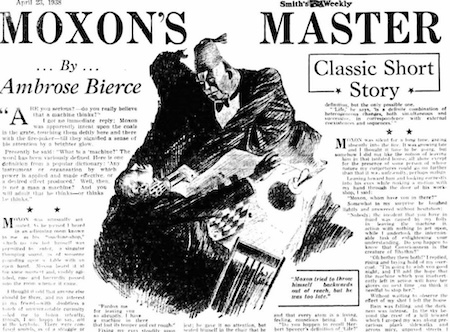
(1938 reprint of 'Moxon's Master' by Ambrose Bierce via SFFAudio)
Compare to the robotic chess expert from First He Died (Time and Again) (1951), by Clifford Simak. This is the first reference that I know of for the idea that machines are unbeatable by humans at chess.
This story may have been inspired by Wolfgang von Kempelen's remarkable mechanical chess player, which was created in 1770. Incredibly, it beat a number of chess experts in public matches. However, the real genius behind the automaton chess player was an assistant concealed inside the cabinet.
The first references to chess-playing computers by scientists were made by Konrad Zuse in the early 1940's and by Alan Turing in 1945. Zuse reputedly wrote a chess program in the early 1940's using PlanKalkuel, the first high-level computer language (also created by Zuse). Claude Shannon described in 1949 how to program a computer for chess, proposing basic strategies for limiting the number of possibilities to be considered ("trimming the tree"). Turing wrote a computer chess program in 1950 (Turing was a relatively weak player); this was the same year that he proposed what came to be known as the Turing Test for machine intelligence. Dietrich Prinz wrote a chess-playing program for a general purpose computer (the Manchester Ferranti) in 1951.
Computer chess was implemented on the Univac MANIAC I computer (80K storage, 2400 vacuum tubes, using a six-by-six chessboard and limited players (no bishops). The 11Khz processor (11,000 operations-per-second) took 12 minutes to search 4 moves deep.
The first chess program with a complete board and set of pieces was written in 1957 by Alex Bernstein at MIT on an IBM 704 (a 47Khz processor looked 4 moves deep in 8 minutes). Read more at Computer chess history.
Comment/Join this discussion ( 2 ) | RSS/XML | Blog This |
Additional
resources:
More Ideas
and Technology from Moxon's Master
More Ideas
and Technology by Ambrose Bierce
Tech news articles related to Moxon's Master
Tech news articles related to works by Ambrose Bierce
Automaton Chessplayer-related
news articles:
- Chess Computer Ties Kasparov
- REEM-A Chess-Playing Robot
- DIY Robochess Robot From Iran
- Robotic Arm Plays Chess In Our World
- Blitz Chess Terminator's Speedy Robot Arm
- AlphaGo AI Defeats Go champion Lee Sedol
- Tic-Tac-Toe Robot From Pollen Robotics
| Light Society: Simulates Earth-Scale Society With A Billion AI Agents |
| Collective Superintelligence Is At Hand! |
| AI Operates An Excavator |
| Grok And The City Fathers From 'Cities In Flight' By James Blish |
Want to Contribute an
Item?
It's easy:
Get the name of the item, a
quote, the book's name and the author's name, and Add
it here.
| <Previous | Next> |
|
|
|
Technovelgy (that's tech-novel-gee!) is devoted to the creative science inventions and ideas of sf authors. Look for the Invention Category that interests you, the Glossary, the Science Fiction Invention Timeline, or see what's New.
|

Science Fiction
Timeline
1600-1899
1900-1939
1940's 1950's
1960's 1970's
1980's 1990's
2000's 2010's
'Our study of your race has convinced us that you are not fitted to leave your planet in the present state of your civilization.'
'...the spreading beam of the deranging ray struck them, and Then one toppled and fell. Then another.'
'Within seconds the material was spread out over fifty yards, in a matter of hours it might occupy several cubic miles of space...'
'The men are dead, but their acquired wisdom lives on and I am the beneficiary.'
'Young people found the driverless car admirable for petting.'
'After twenty generations of shillyshallying...'

