
Science Fiction
Dictionary
A B C D E F G H I J K L M N O P Q R S T U V W X Y Z
Latest By
Category:
Armor
Artificial
Intelligence
Biology
Clothing
Communication
Computers
Culture
Data Storage
Displays
Engineering
Entertainment
Food
Input Devices
Lifestyle
Living Space
Manufacturing
Material
Media
Medical
Miscellaneous
Robotics
Security
Space Tech
Spacecraft
Surveillance
Transportation
Travel
Vehicle
Virtual
Person
Warfare
Weapon
Work
"What television does is rent us friends and relatives who are quite satisfactory. This is quite something, to rent artificial friends and relatives right inside the house."
- Kurt Vonnegut, Jr.

 |
| The Cosmic Express | ||
| A means of transmitting matter wirelessly. |

You might be surprised to learn that this is the earliest description that I know about of the idea behind 3D printers and stereolithography.
Mr. Eric Stokes-Harding wrote novels of high adventure - in a drab, boring era in the not-too-distant future, when the plodding of the scientific method had reduced all challenges to harmless trivialities. Ah, to escape to a more primitive world - Venus, perhaps? But how to get there...
| "The Cosmic Express?"
"A new invention. Just perfected a few weeks ago, I understand. By Ludwig Von der Valls, the German physicist... A new way to travel—by ether!" "...the method, in the new Cosmic Express, is simply to convert the matter to be carried into power, send it out as a radiant beam and focus the beam to convert it back into atoms at the destination." "...The beam is focused, just like the light that passes through a camera lens. The photographic lens, using light rays, picks up a picture and reproduces it again on the plate--just the same as the Express Ray picks up an object and sets it down on the other side of the world.
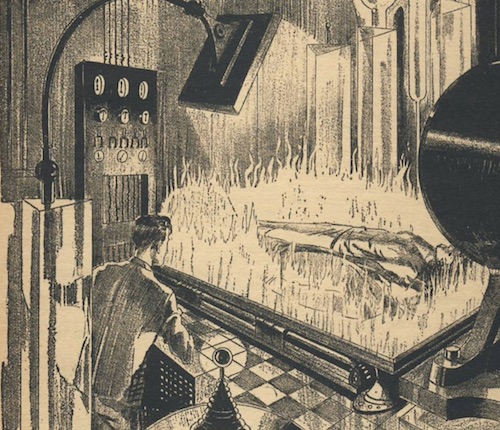 (The Cosmic Express by Jack Williamson) "An analogy from television might help. You know that by means of the scanning disc, the picture is transformed into mere rapid fluctuations in the brightness of a beam of light. In a parallel manner, the focal plane of the Express Ray moves slowly through the object, progressively, dissolving layers of the thickness of a single atom, which are accurately reproduced at the other focus of the instrument--which might be in Venus! "But the analogy of the lens is the better of the two. For no receiving instrument is required, as in television. The object is built up of an infinite series of plane layers, at the focus of the ray, no matter where that may be. Such a thing would be impossible with radio apparatus because even with the best beam transmission, all but a tiny fraction of the power is lost, and power is required to rebuild the atoms. Do you understand, dear?" |
| Technovelgy from The Cosmic Express,
by Jack Williamson. Published by Amazing Stories in 1930 Additional resources -
|
Here's a description of how it works:
Eric helped Nada to a place on the crystal, lay down at her side.
"I think the Express Ray is focused just at the surface of the crystal, from below," he said. "It dissolves our substance, to be transmitted by the beam. It would look as if we were melting into the crystal."
"Ready," called the youth.
A bell jangled. "So long," the youth called.
Nada and Eric felt themselves enveloped in fire. Sheets of white flame
seemed to lap up about them from the crystal block. Suddenly there was a
sharp tingling sensation where they touched the polished surface. Then
blackness, blankness.
Here's an interesting similar perspective from an essay by John Elfreth Watkins, Jr. - What May Happen in the Next Hundred Years, published in 1900:
Thanks to Jordan Bassior for suggesting this item.
Compare to Deposition (3D Printing) from Assassin (1978) by James P. Hogan and plastic constructor from Things Pass By (1945) by Murray Leinster. Also, the Biltong life-forms from Pay for the Printer (1956) by Philip K. Dick.
As a transportation device, compare it to the telepomp from The Man Without a Body (1877) by Edward Page Mitchell, the
displacement booth from Flash Crowd (1972) by Larry Niven, the
stepping discs from Ringworld (1970) by Larry Niven and the
trip box from Eye of Cat (1982) by Roger Zelazny.
Also, see the libra-transmitter from Into the Meteorite Orbit by Frank R. Kelly, Jaunte from The Stars My Destination, the Transo from Time is the Simplest Thing by Clifford Simak and the geofractor (1939) from One Against the Legion by Jack Williamson.
The little door had swung open again, and Eric led Nada through. They stepped into a little cell, completely surrounded with mirrors and vast prisms and lenses and electron tubes. In the center was a slab of transparent crystal, eight feet square and two inches thick, with an intricate mass of machinery below it.
Microscopes will lay bare the vital organs, through the living flesh, of men and animals. The living body will to all medical purposes by transparent. Not only will it be possible for a physician to actually see a living, throbbing heart inside the chest, but he will be able to magnify it and photograph any part of it. This will be done with rays of invisible light.
Comment/Join this discussion ( 0 ) | RSS/XML | Blog This |
Additional
resources:
More Ideas
and Technology from The Cosmic Express
More Ideas
and Technology by Jack Williamson
Tech news articles related to The Cosmic Express
Tech news articles related to works by Jack Williamson
The Cosmic Express-related
news articles:
- Fab@Home 'Fabber' Freeform Fabricator
- 3D Printed Replacement Tissue
- EXPLORER, The First Total-Body Scanner
| Biomimetic Tendons From Rochu Robotics |
| You Will Eat The Cookies Made From Plastic... |
| ICE Buys Shock Gloves Like Batman's |
| When Colds Threaten You Can't Do This - Or Can You? |
Want to Contribute an
Item?
It's easy:
Get the name of the item, a
quote, the book's name and the author's name, and Add
it here.
| <Previous | Next> |
|
|
|
Technovelgy (that's tech-novel-gee!) is devoted to the creative science inventions and ideas of sf authors. Look for the Invention Category that interests you, the Glossary, the Science Fiction Invention Timeline, or see what's New.
|

Science Fiction
Timeline
1600-1899
1900-1939
1940's 1950's
1960's 1970's
1980's 1990's
2000's 2010's
'Our study of your race has convinced us that you are not fitted to leave your planet in the present state of your civilization.'
'...the spreading beam of the deranging ray struck them, and Then one toppled and fell. Then another.'
'Within seconds the material was spread out over fifty yards, in a matter of hours it might occupy several cubic miles of space...'
'The men are dead, but their acquired wisdom lives on and I am the beneficiary.'
'Young people found the driverless car admirable for petting.'
'After twenty generations of shillyshallying...'

