
Science Fiction
Dictionary
A B C D E F G H I J K L M N O P Q R S T U V W X Y Z
Latest By
Category:
Armor
Artificial
Intelligence
Biology
Clothing
Communication
Computers
Culture
Data Storage
Displays
Engineering
Entertainment
Food
Input Devices
Lifestyle
Living Space
Manufacturing
Material
Media
Medical
Miscellaneous
Robotics
Security
Space Tech
Spacecraft
Surveillance
Transportation
Travel
Vehicle
Virtual
Person
Warfare
Weapon
Work
"I wrote many novels which … contained the element of the projected collective unconscious, which made them simply incomprehensible to anyone who read them, because they required the reader to accept my premise that each of us lives in a unique world."
- Philip K. Dick

 |
| Photoelectric Telescope (Photoelectric Eyes) | ||
| An astronomical telescope that uses the photoelectric effect to gather light, and then to present the finished image on a screen. |

The first electrical detection of starlight was made by William Monck in Dublin in 1892, using a photovoltaic cell. However, the photoelectric potassium hydride cells made by Julius Elster and Hans Geitel in Germany marks the beginning of stellar photoelectric photometry in 1912.
| "Perhaps it's a comet." Still frowning, Bob Star swung back toward the observatory. "It looked like one - it was a short streak of that queer, misty green, instead of the point a star would show..."
Inside the chilly gloom of the observatory, Bob sat down at the telescope. Its mechanisms whirred softly, in swift response to his touch. The great barrel swung to search space with its photoelectric eyes, and the pale beam of the projector flashed across to the concave screen.
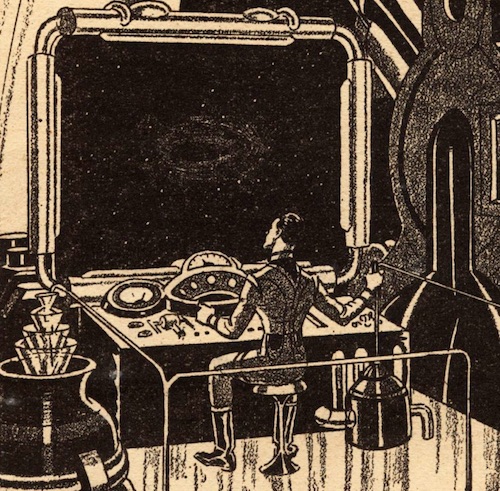 (The Photoelectric Telescope from 'The Cometeers' by Jack Williamson) ...He stepped up the electronic magnification. Vindemiatrix and the fainter stars slipped out of the field. The comet hung alone, and swiftly grew. Its shape was puzzling - a strangely perfect ellipsoid. A greenish football, he thought, kicked at the System out of the night of space - by what? ...Using ray filters and spectroscope, with the full power of the circuits, he strove to pierce that dull green veil, and failed." |
| Technovelgy from The Cometeers,
by Jack Williamson. Published by Street and Smith in 1936 Additional resources -
|
The idea of projecting the light from a telescope onto a screen is a commonplace way to conduct solar observations; however, this is an actual projection from the optical components of the telescope. The telescope described here is projecting an actual picture (in color!) of the distant objects based on photoelectric data. When were usable pictures created electronically? I'm thinking that this didn't happen until the development of CCD (charged couple device) image sensors, which started in the early 1960's.
So, I still think Williamson was one step ahead of the day's astronomers. Anyone?
Thanks to an anonymous reader who put me on the right track with star meridian transit devices. Also, take a look at Photoelectric Photometry.
Compare to the
Liquid Mirror Telescope from Old Faithful (1934) by Raymond Z. Gallun, the
electro-telescope from Blood of the Moon (1936) by Ray Cummings, the
ultra-telescope ray from The Moon Weed (1931) by Harl Vincent, the
hyperspace beacon from The Repairman (1959) by Harry Harrison, and the robot observatory from Space Rating (1939) by John Berryman.
Comment/Join this discussion ( 3 ) | RSS/XML | Blog This |
Additional
resources:
More Ideas
and Technology from The Cometeers
More Ideas
and Technology by Jack Williamson
Tech news articles related to The Cometeers
Tech news articles related to works by Jack Williamson
| 'If Anyone Is Watching Earth...' |
| Cloud Of Space Rubbish From China's Long March Rocket |
| ESA's Draco To Study Heat Of Reentry |
| The United States Space Academy Is Official |
Want to Contribute an
Item?
It's easy:
Get the name of the item, a
quote, the book's name and the author's name, and Add
it here.
| <Previous | Next> |
|
|
|
Technovelgy (that's tech-novel-gee!) is devoted to the creative science inventions and ideas of sf authors. Look for the Invention Category that interests you, the Glossary, the Science Fiction Invention Timeline, or see what's New.
|

Science Fiction
Timeline
1600-1899
1900-1939
1940's 1950's
1960's 1970's
1980's 1990's
2000's 2010's
'Our study of your race has convinced us that you are not fitted to leave your planet in the present state of your civilization.'
'...the spreading beam of the deranging ray struck them, and Then one toppled and fell. Then another.'
'Within seconds the material was spread out over fifty yards, in a matter of hours it might occupy several cubic miles of space...'
'The men are dead, but their acquired wisdom lives on and I am the beneficiary.'
'Young people found the driverless car admirable for petting.'
'After twenty generations of shillyshallying...'

