
Science Fiction
Dictionary
A B C D E F G H I J K L M N O P Q R S T U V W X Y Z

 |
Liquid Mirror Telescope For Moon Studied By NASA

A Lunar Liquid Mirror Telescope (LLMT) is under study thanks to a grant from NASA. J. Roger Angel, a regents professor at the University of Arizona, is leading a project to study the feasibility of a 100 meter LLMT at the moon's south pole.
Why liquid mirrors? Ever since 1668, when Isaac Newton built the first reflector telescope with a one-inch diameter mirror made of metal, astronomers have longed for bigger parabolic mirrors. Opticians expend a great deal of effort to grind larger and larger pieces of glass to just this shape.
Liquid Mirror Telescopes were first talked about several hundred years ago. Imagine a bowl of mercury at the center of a lazy susan. When you give it a spin, the surface of the liquid forms that highly prized shape - a parabola. The bigger the bowl, the bigger the resulting mirror.
The first serious attempts to actually build a LMT took place in the early twentieth century. Robert W. Wood, a physicist at Johns Hopkins University, built a working telescope, but could not accurately control the speed of the turntable, resulting in a mirror with a variable focal length. (The rotation must be controlled to less than one part in 100,000 during exposure.) Pictures of star trails were focused in some places, but blurry in others.
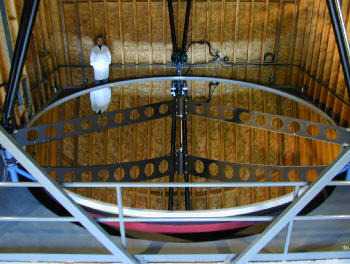
(The Large Zenith Telescope mirror)
The LMT concept has been made to work. The Large Zenith Telescope at the University of British Columbia uses a 6-meter mirror, making it the third largest optical telescope in North America. It was built at a cost of approximately $1 million. A telescope with a conventional glass mirror of the same size would cost $100 million.
It is hoped that similar savings might apply when constructing telescopes on the moon. In addition, the moon is completely free from atmospheric absorptions and distortion.
The only disadvantage of the LMT is that you cannot tilt it; it must remain perpendicular to the local gravitational field. You can only use it to look at what is directly above the telescope; however, a mirror of this size could take a very penetrating look at its patch of sky.
"You would be seeing things farther back in time than anyone has ever seen any galaxy or star or quasar," [Angel] explained. "It could give you a chance to see what was happening at a very early time."
(From J. Roger Angel and the LLMT)
Obviously, for such a project to be attempted, there would need to be substantial infrastructure already im place on the moon. As Dr. Angel remarked, "You could not justify that kind of infrastructure (just) to build this kind of telescope, but if the infrastructure already were there, this is something that looks feasible to do."
There is a very early reference to a large liquid mirror telescope in science fiction; but this LMT is on Mars, not the moon. In his excellent 1934 novella Old Faithful, author Raymond Z. Gallun writes about a Martian named 774, who has a desperate need to contact Earth:
Piercing the dome, opposite the upper end of the cylinder, was a circular opening through which a portion of the starlit sky was visible; and at the base of the cylinder a great bowl rotated rapidly, like a huge wheel... The bowl contained mercury. As the container spun on its perfectly balanced axis, centrifugal force caused the mercury to spread in a thin, precisely distributed layer over the inside of the bowl, forming a concave surface that acted admirably as a mirror for Number 774's gigantic reflecting telescope. It's area, and its consequent light-gathering capacity, was many times greater than any rigid mirror that could have been constructed without flaws.
(Gallun appears to err in his use of the LMT; read more about the Martian LMT)
Read more about J. Roger Angel and the LLMT, read more about LMTs at Space.com or take a look at the Large Zenith Telescope. Thanks to Winchell Chung for the tip and the sf for this story.
Scroll down for more stories in the same category. (Story submitted 2/5/2006)
Follow this kind of news @Technovelgy.| Email | RSS | Blog It | Stumble | del.icio.us | Digg | Reddit |
Would
you like to contribute a story tip?
It's easy:
Get the URL of the story, and the related sf author, and add
it here.
Comment/Join discussion ( 23 )
Related News Stories - (" Space Tech ")
'If Anyone Is Watching Earth...'
'Our study of your race has convinced us that you are not fitted to leave your planet in the present state of your civilization.' - Arthur C. Clarke, 1946.
Cloud Of Space Rubbish From China's Long March Rocket
'Within seconds the material was spread out over fifty yards, in a matter of hours it might occupy several cubic miles of space...'
ESA's Draco To Study Heat Of Reentry
'...a synthetic which air-friction would erode.' - EE Doc Smith, 1934.
The United States Space Academy Is Official
'Is our orbit to Space Academy clear?' - Carey Rockwell
Technovelgy (that's tech-novel-gee!) is devoted to the creative science inventions and ideas of sf authors. Look for the Invention Category that interests you, the Glossary, the Invention Timeline, or see what's New.

Science Fiction
Timeline
1600-1899
1900-1939
1940's 1950's
1960's 1970's
1980's 1990's
2000's 2010's
Current News
'If Anyone Is Watching Earth...'
'Our study of your race has convinced us that you are not fitted to leave your planet in the present state of your civilization.'
Epirus High-Power Microwave Defeats Drones
'...the spreading beam of the deranging ray struck them, and Then one toppled and fell. Then another.'
Cloud Of Space Rubbish From China's Long March Rocket
'Within seconds the material was spread out over fifty yards, in a matter of hours it might occupy several cubic miles of space...'
Biomimetic Tendons From Rochu Robotics
'... the curious parallelism to animal motions.'
Living Human Neuron Biological Compute Rack
'The men are dead, but their acquired wisdom lives on and I am the beneficiary.'
Martha Stewart Approves Ojai 'Living Room On Wheels'
'Young people found the driverless car admirable for petting.'
ESA's Draco To Study Heat Of Reentry
'...a synthetic which air-friction would erode.'
Buy A Galaxy? Maybe Start Smaller
'The sky is the limit' just got higher.
The United States Space Academy Is Official
'Is our orbit to Space Academy clear?'
Is There A Global Problem With Who Is Having Children?
'After twenty generations of shillyshallying...'
You Will Eat The Cookies Made From Plastic...
'Our planes are going to start bringing in bales of discarded plastics...'
It's A Giant Robot! You Reporters Have Been Warned!
'... completely forgetting the ship at sight of the awesome figure and great head of the giant Gaut...'
Birds Learn To Sing Pictures ala Frank Herbert's Distrans
'We will fight in the time of fighting.'
ElectionSim: China's 'Ender's Game' Battle Sim, Or Lem's 'Kingdom In A Box'?
'So, Ender, we will now begin your education.'
Tactile Skin Supplier Map
'What strange sensitivity! What an amazing development of science was manifested in every move and act and word of this Robot!'
Flock Stymied By 'Adversarial Fashion'
'Forget the head atop it, the legs below, feet, arms, hands. It compels erasure.'

