
Science Fiction
Dictionary
A B C D E F G H I J K L M N O P Q R S T U V W X Y Z

 |
Map Of World Happiness - A Global Projection of Subjective Well-Being

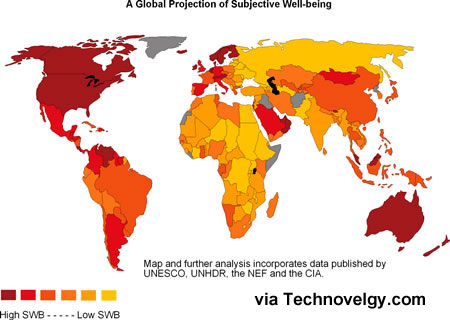
The first World Map of Happiness has been published by scholars from the University of Leicester. The map is a global projection of subjective well-being (SWB), taken from a variety of recent sources, and compared with related data from UNESCO, the UN and even the CIA.
(Map of World Happiness)
Adrian G. White, of the University of Leicester in the UK, points out in his study that the search for happiness is somewhat intangible, but very important. He notes that the US Declaration of Independence clearly points out "certain inalienable Rights, that among these are Life, Liberty and the Pursuit of Happiness." Philosophers like Jeremy Bentham pointed out in the eighteenth century that the purpose of politics was to bring the greatest happiness to the greatest number of people.
A recent survey in the UK found that 81% of the UK population agreed that the Government's primary objective should be the creation of happiness rather than wealth. One prominent UK politician argued this past year "It’s time we admitted that there’s more to life than money, and it’s time we focused not just on GDP, but on GWB – general well-being."
So how do you quantify and research subjective well-being (SWB)? It's true that temporary moods can sway a given individual's response on a particular day; however, levels of SWB can be changed by circumstances (countering the idea that SWB is biologically determined).
The map is drawn with data extracted from a meta-analysis by Marks, Abdallah, Simms and Thompson, who published the Happy Planet Index in 2006. An overall satisfaction with life scale (SWLS) is extracted from their study, which calculates happiness based on life satisfaction, life expectancy and ecological footprint. That is, it reflects the average years of happy life per unit of planetary resources consumed.
Adrian White's analysis seems to correlate well with data from other studies:
It is immediately evident that there is an effect of poverty on levels of SWB. The map itself mirrors other projection of poverty and GDP. This data on SWB was compared with data on access to education (UNESCO, 2005), health (United Nations, 2005), and poverty (CIA, 2006). It was found that SWB correlated most strongly with health (.7) closely followed by wealth (.6) and access to basic education (.6). This adds to the evidence that from a global perspective the biggest causes of SWB are poverty and associated variables.
It turns out that people in Denmark and Switzerland have the highest overall satisfaction with life; these results were published in a recent New York Times article.
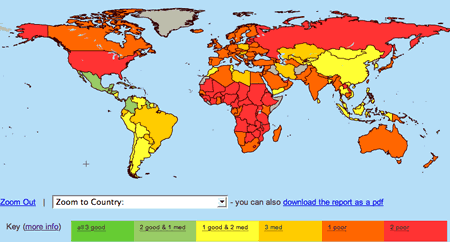
The Happy Planet Index site also has a world happiness index map - remember, their index includes the impact of their material lifestyle on the environment. The link below the map takes you to their very nicely implemented interactive map.
(Map showing the happy planet index - interactive!)
Read more about A global projection of subjective well-being and the Happy Planet Index. The Happy Planet site has a nifty survey that you can take to determine your own HPI; it takes about 5 minutes and is completely anonymous.
Scroll down for more stories in the same category. (Story submitted 1/9/2007)
Follow this kind of news @Technovelgy.| Email | RSS | Blog It | Stumble | del.icio.us | Digg | Reddit |
Would
you like to contribute a story tip?
It's easy:
Get the URL of the story, and the related sf author, and add
it here.
Comment/Join discussion ( 12 )
Related News Stories - (" Culture ")
Buy A Galaxy? Maybe Start Smaller
'The sky is the limit' just got higher.
Is There A Global Problem With Who Is Having Children?
'After twenty generations of shillyshallying...' - CM Kornbluth, 1950.
Warfare Goes Underground In Ukraine
'Once in the very first weeks of the war, before everyone had been evacuated from the surface...' - Philip K. Dick,
The Wind Phone Calls Those Who Have Passed On
'Only I heard that!' - John Brunner, 1975.
Technovelgy (that's tech-novel-gee!) is devoted to the creative science inventions and ideas of sf authors. Look for the Invention Category that interests you, the Glossary, the Invention Timeline, or see what's New.

Science Fiction
Timeline
1600-1899
1900-1939
1940's 1950's
1960's 1970's
1980's 1990's
2000's 2010's
Current News
'If Anyone Is Watching Earth...'
'Our study of your race has convinced us that you are not fitted to leave your planet in the present state of your civilization.'
Epirus High-Power Microwave Defeats Drones
'...the spreading beam of the deranging ray struck them, and Then one toppled and fell. Then another.'
Cloud Of Space Rubbish From China's Long March Rocket
'Within seconds the material was spread out over fifty yards, in a matter of hours it might occupy several cubic miles of space...'
Biomimetic Tendons From Rochu Robotics
'... the curious parallelism to animal motions.'
Living Human Neuron Biological Compute Rack
'The men are dead, but their acquired wisdom lives on and I am the beneficiary.'
Martha Stewart Approves Ojai 'Living Room On Wheels'
'Young people found the driverless car admirable for petting.'
ESA's Draco To Study Heat Of Reentry
'...a synthetic which air-friction would erode.'
Buy A Galaxy? Maybe Start Smaller
'The sky is the limit' just got higher.
The United States Space Academy Is Official
'Is our orbit to Space Academy clear?'
Is There A Global Problem With Who Is Having Children?
'After twenty generations of shillyshallying...'
You Will Eat The Cookies Made From Plastic...
'Our planes are going to start bringing in bales of discarded plastics...'
It's A Giant Robot! You Reporters Have Been Warned!
'... completely forgetting the ship at sight of the awesome figure and great head of the giant Gaut...'
Birds Learn To Sing Pictures ala Frank Herbert's Distrans
'We will fight in the time of fighting.'
ElectionSim: China's 'Ender's Game' Battle Sim, Or Lem's 'Kingdom In A Box'?
'So, Ender, we will now begin your education.'
Tactile Skin Supplier Map
'What strange sensitivity! What an amazing development of science was manifested in every move and act and word of this Robot!'
Flock Stymied By 'Adversarial Fashion'
'Forget the head atop it, the legs below, feet, arms, hands. It compels erasure.'

