
Science Fiction
Dictionary
A B C D E F G H I J K L M N O P Q R S T U V W X Y Z

 |
PLATO Spacecraft, Hunter Of Habitable Planets, Now Ready

The ESA's Plato (PLAnetary Transits and Oscillations of stars) spacecraft has been completed, and is undergoing final testing.
By fitting its sunshield and solar panels, engineers recently completed the construction of Plato, the European Space Agency’s mission to discover Earth-like exoplanets.In space, special mechanisms will automatically release the panels from their folded position. For this test, the array was released manually by an engineer. The opening of the left and right wings was executed separately. Their deployment went as expected...
“With this operation, we have completed the Plato spacecraft. The combined sunshield and solar array module was the last remaining essential part,” comments Thomas Walloschek, ESA’s Plato Project Manager.
“Plato has a distinctive design, conceived to efficiently integrate its advanced cameras within the spacecraft. Its overall layout is optimised to monitor more than 150 000 bright stars at the same time, with high precision. This will enable scientists to hunt for terrestrial planets orbiting stars similar to our Sun.”
To spot exoplanets, Plato carries 26 advanced cameras tasked with capturing the tiniest variations in the intensity of a star’s light. To achieve the necessary high sensitivity, the cameras must be kept cool, so that each camera is kept at its best-focus temperature around -80° C.
Protected from sunlight by the sunshield and facing deep space, Plato’s scientific instruments will cool down and stay at the required frigid temperature throughout the mission’s lifetime.
Once in orbit, the solar array will catch light from the Sun to power the spacecraft electronics. The sunshield will keep the scientific equipment in shadow, protecting it from the Sun’s glare.
(Via esa.)
Golden Age great EE 'Doc" Smith described a manual search for habitable planets in his 1934 novel Skylark of Valeron, but it's just too slow for science fiction fans.
Science fiction writer Edmond Hamilton nailed down the automated solution eighty years ago in his exciting 1936 short story Cosmic Quest:
I was near enough it now to set my automatic astronomical instruments to searching it for a habitable planet.These instruments were the wonderful ones our astronomers had perfected. With super-telescopic eyes each one scanned a part of the star field before them. And each mechanical eye, when it found planetary systems in its field, automatically shifted upon them a higher powered telespectroscope which recorded on permanent film the size, mean temperature and atmospheric conditions of these worlds.
(Read more about Hamilton's search for habitable planets)
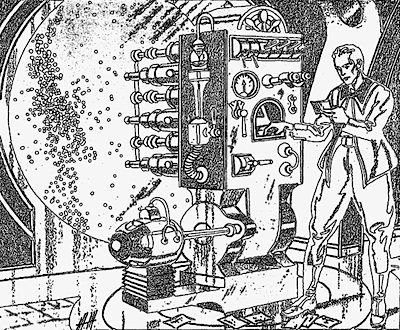
(The telespectroscope recorded the conditions of these other worlds)
It's amazing that, a century after the essential insights and ideas were published to the world in science fiction magazines, the reality unfolds before us!
Scroll down for more stories in the same category. (Story submitted 10/11/2025)
Follow this kind of news @Technovelgy.| Email | RSS | Blog It | Stumble | del.icio.us | Digg | Reddit |
Would
you like to contribute a story tip?
It's easy:
Get the URL of the story, and the related sf author, and add
it here.
Comment/Join discussion ( 0 )
Related News Stories - (" Engineering ")
Biomimetic Tendons From Rochu Robotics
'... the curious parallelism to animal motions.' - HG Wells, 1898.
You Will Eat The Cookies Made From Plastic...
'Our planes are going to start bringing in bales of discarded plastics...' - Rick Shelley, 1989.
ICE Buys Shock Gloves Like Batman's
What else is the Caped Crusader using?
When Colds Threaten You Can't Do This - Or Can You?
'...a hemispherical force field enclosing his head.' - FL Wallace, 1955.
Technovelgy (that's tech-novel-gee!) is devoted to the creative science inventions and ideas of sf authors. Look for the Invention Category that interests you, the Glossary, the Invention Timeline, or see what's New.

Science Fiction
Timeline
1600-1899
1900-1939
1940's 1950's
1960's 1970's
1980's 1990's
2000's 2010's
Current News
'If Anyone Is Watching Earth...'
'Our study of your race has convinced us that you are not fitted to leave your planet in the present state of your civilization.'
Epirus High-Power Microwave Defeats Drones
'...the spreading beam of the deranging ray struck them, and Then one toppled and fell. Then another.'
Cloud Of Space Rubbish From China's Long March Rocket
'Within seconds the material was spread out over fifty yards, in a matter of hours it might occupy several cubic miles of space...'
Biomimetic Tendons From Rochu Robotics
'... the curious parallelism to animal motions.'
Living Human Neuron Biological Compute Rack
'The men are dead, but their acquired wisdom lives on and I am the beneficiary.'
Martha Stewart Approves Ojai 'Living Room On Wheels'
'Young people found the driverless car admirable for petting.'
ESA's Draco To Study Heat Of Reentry
'...a synthetic which air-friction would erode.'
Buy A Galaxy? Maybe Start Smaller
'The sky is the limit' just got higher.
The United States Space Academy Is Official
'Is our orbit to Space Academy clear?'
Is There A Global Problem With Who Is Having Children?
'After twenty generations of shillyshallying...'
You Will Eat The Cookies Made From Plastic...
'Our planes are going to start bringing in bales of discarded plastics...'
It's A Giant Robot! You Reporters Have Been Warned!
'... completely forgetting the ship at sight of the awesome figure and great head of the giant Gaut...'
Birds Learn To Sing Pictures ala Frank Herbert's Distrans
'We will fight in the time of fighting.'
ElectionSim: China's 'Ender's Game' Battle Sim, Or Lem's 'Kingdom In A Box'?
'So, Ender, we will now begin your education.'
Tactile Skin Supplier Map
'What strange sensitivity! What an amazing development of science was manifested in every move and act and word of this Robot!'
Flock Stymied By 'Adversarial Fashion'
'Forget the head atop it, the legs below, feet, arms, hands. It compels erasure.'

