
Science Fiction
Dictionary
A B C D E F G H I J K L M N O P Q R S T U V W X Y Z

 |
NASA's X1 Robotic Exoskeleton For Astronauts

X1 is a robotic exoskeleton intended for use by astronauts. The device was developed by NASA using technology from Robonaut 2, its teleoperated space station robot.
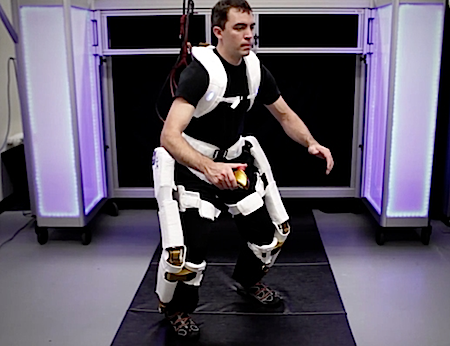
(X1 exoskeleton from NASA)
The 57-pound, ten-degrees-of-freedom X1 exoskeleton is a joint venture between NASA and the Florida Institute for Human and Machine Cognition (IHMC) that you strap to the sides of both legs like a pair of giant, flexible splints and secure to your body with a harness that runs up the back and over the shoulders. NASA says it has four motorized joints at the hips and knees and six more motor-free that allow wearers to turn, step sideways or flex their feet.The X1 suit owes a debt to Robonaut 2, the second-gen iteration of NASA “dexterous humanoid robot” project, a 330-pound automaton harboring a whopping 350 sensors and 38 PowerPC processors that’s capable of moving four times faster and with much greater dexterity than the original 410-pound Robonaut.
Get a closer look at the X1 exoskeleton in the following video.
(X1 exoskeleton video)
X1 is a ten degree of freedom robotic exoskeleton designed and built as a collaboration between the NASA Johnson Space Center and the Florida Institute for Human and Machine Cognition (IHMC).Like other exoskeletons on the market, the potential of X1 extends to other applications such as rehabilitation, gait modification and offloading large amounts of weight from the wearer. Preliminary studies by IHMC have shown the X1 to be more comfortable and easier to adjust and put on than their previous exoskeletons.
Science fiction writers evolved the idea of robotic exoskeletons from the needs of space explorers to stand up and move around in heavy gravity. In his 1932 classic A Conquest of Two Worlds, Edmond Hamilton described an early version of the exoskeleton idea:
The greatest difficulty, Crane saw, was Jupiter's gravitation... Earth's scientists solved the problem to some extent by devising rigid metallic clothing not unlike armor which would support the interior human structure against Jupiter's pull.
(Read more about rigid metallic clothing)
John W. Campbell extended this idea in his 1938 story The Brain Pirates, describing special lifting suits:
"We have those new suits rigged with atomic-powered lifting gadgets, so that'll protect us from the weight, if what our instruments say about that world's true...""I'll go check up on those suits and make some adjustments. I hadn't thought they'd have to handle any double-gravity worlds."
"... may I suggest that you make sure you don't get those drive-units in the suits backward? I'd hate to have them sit on me as well as a doubled gravity..."
(Read more about Campbell's atomic-powered lifting suits)
I'd also like to point out that I've turned comments back on and the contact form is also open.
Via Techland.
Scroll down for more stories in the same category. (Story submitted 10/15/2012)
Follow this kind of news @Technovelgy.| Email | RSS | Blog It | Stumble | del.icio.us | Digg | Reddit |
Would
you like to contribute a story tip?
It's easy:
Get the URL of the story, and the related sf author, and add
it here.
Comment/Join discussion ( 2 )
Related News Stories - (" Space Tech ")
'If Anyone Is Watching Earth...'
'Our study of your race has convinced us that you are not fitted to leave your planet in the present state of your civilization.' - Arthur C. Clarke, 1946.
Cloud Of Space Rubbish From China's Long March Rocket
'Within seconds the material was spread out over fifty yards, in a matter of hours it might occupy several cubic miles of space...'
ESA's Draco To Study Heat Of Reentry
'...a synthetic which air-friction would erode.' - EE Doc Smith, 1934.
The United States Space Academy Is Official
'Is our orbit to Space Academy clear?' - Carey Rockwell
Technovelgy (that's tech-novel-gee!) is devoted to the creative science inventions and ideas of sf authors. Look for the Invention Category that interests you, the Glossary, the Invention Timeline, or see what's New.

Science Fiction
Timeline
1600-1899
1900-1939
1940's 1950's
1960's 1970's
1980's 1990's
2000's 2010's
Current News
'If Anyone Is Watching Earth...'
'Our study of your race has convinced us that you are not fitted to leave your planet in the present state of your civilization.'
Epirus High-Power Microwave Defeats Drones
'...the spreading beam of the deranging ray struck them, and Then one toppled and fell. Then another.'
Cloud Of Space Rubbish From China's Long March Rocket
'Within seconds the material was spread out over fifty yards, in a matter of hours it might occupy several cubic miles of space...'
Biomimetic Tendons From Rochu Robotics
'... the curious parallelism to animal motions.'
Living Human Neuron Biological Compute Rack
'The men are dead, but their acquired wisdom lives on and I am the beneficiary.'
Martha Stewart Approves Ojai 'Living Room On Wheels'
'Young people found the driverless car admirable for petting.'
ESA's Draco To Study Heat Of Reentry
'...a synthetic which air-friction would erode.'
Buy A Galaxy? Maybe Start Smaller
'The sky is the limit' just got higher.
The United States Space Academy Is Official
'Is our orbit to Space Academy clear?'
Is There A Global Problem With Who Is Having Children?
'After twenty generations of shillyshallying...'
You Will Eat The Cookies Made From Plastic...
'Our planes are going to start bringing in bales of discarded plastics...'
It's A Giant Robot! You Reporters Have Been Warned!
'... completely forgetting the ship at sight of the awesome figure and great head of the giant Gaut...'
Birds Learn To Sing Pictures ala Frank Herbert's Distrans
'We will fight in the time of fighting.'
ElectionSim: China's 'Ender's Game' Battle Sim, Or Lem's 'Kingdom In A Box'?
'So, Ender, we will now begin your education.'
Tactile Skin Supplier Map
'What strange sensitivity! What an amazing development of science was manifested in every move and act and word of this Robot!'
Flock Stymied By 'Adversarial Fashion'
'Forget the head atop it, the legs below, feet, arms, hands. It compels erasure.'

