
Science Fiction
Dictionary
A B C D E F G H I J K L M N O P Q R S T U V W X Y Z

 |
Underpant's Amperometric Biosensors Don't Chafe SF Fans

Nifty thick-film textile-based amperometric biosensors may sneak into your underpants thanks to a new process for printing electrochemical sensors directly into elastic bands like those used in underwear.
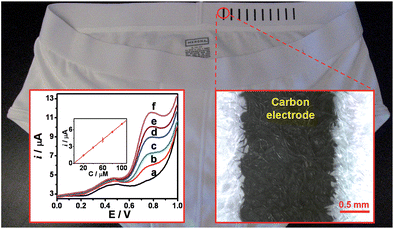
Image of the screen-printed carbon electrodes
on the underwear (MERONA Ultimate Briefs brand)
(background) along with the morphology of a single
electrode (right inset) and linear-scan voltammetric response
for increasing NADH concentrations over the
0–100 M range (left inset).
As the focus on healthcare shifts from centralized hospital-based treatment to home-based management, there are growing needs for developing reliable, wearable healthcare monitoring systems.1,2 Such on-body (non-invasive or minimally-invasive) physiological monitoring devices are also of considerable interest for defense or sport applications. Integrating sensors and biosensors directly into clothing should thus have major advantages for future healthcare and soldier monitoring systems...We have illustrated the direct screen-printing of amperometric carbon sensors onto clothing and the favorable electrochemical behavior of such textile-based sensors. Convenient measurements of hydrogen peroxide and NADH have been documented. Mechanical stress studies, relevant to the wearer's daily activity, have indicated that textile-based printed sensors survive large deformations. Both bending and stretching of the textile substrate have minimal detrimental effect upon the electrochemical measurements, and in some instances (e.g., for measurements of hydrogen peroxide) even lead to enhanced signals...
Future efforts in this direction will also include the incorporation of a chemically-selective layer (e.g., permselective coating or enzyme layer) and assessment of the role of the clothing deformation upon the performance and stability of such layers towards textile-based healthcare and soldier monitoring systems. Particularly attractive will be dehydrogenase- and oxidase-based enzyme sensors for ethanol and lactate, respectively, in connection with monitoring alcohol consumption in drivers or performance/stress of soldiers/athletes. Unlike glucose sweat levels, the concentration of alcohol or lactate in sweat has a significant clinical relevance. The large surface area of clothing could be used for integrating the necessary supporting electronic, display, power and communication functions (without external devices) and hence for communicating relevant health parameters. While clothing-integrated electrochemical sensors hold considerable promise for future healthcare, military or sport applications, such non-invasive textile-based sensing requires proper attention to key challenges of sample delivery to the electrode surface and of sensor calibration and interconnection.
SF fans are already used to the idea of underwear and clothing that monitors the physical characteristics of the wearer. In his 1988 novel Wetware, Rudy Rucker introduces the heartshirt:
Della's first present was an imipolex sweatshirt called a heartshirt…The heartshirt was an even dark blue, except for a few staticky red spots drifting about."It can feel your heartbeat … look." Sure enough there was a big red spot on the plastic shirt just over her heart..."
(Read more about the heartshirt)
Update 01-Jun-2020: An even better reference has turned up; take a look at the electric diaper from the classic 1928 story The Psychotronic Nurse by Dr. David Keller:
In every diaper there is a fine copper wire. When that becomes wet a delicate current is sent - you understand I mean an electrical current, not a watery one - to an amplifier and a certain sound is made...
(Read more about the Dr. David Keller's electric diaper)
End update.
From Thick-film textile-based amperometric sensors and biosensors via MedGadget.
Scroll down for more stories in the same category. (Story submitted 4/21/2010)
Follow this kind of news @Technovelgy.| Email | RSS | Blog It | Stumble | del.icio.us | Digg | Reddit |
Would
you like to contribute a story tip?
It's easy:
Get the URL of the story, and the related sf author, and add
it here.
Comment/Join discussion ( 4 )
Related News Stories - (" Medical ")
3D Printed Organs From Space
'For a while your colonists will have to come up to the [orbital] Hospital...'
Health Kiosk Has No Human Doctor
'The electronic body analyzer had been developed...' - Michael Crichton, 1969.
NEO Brain Computer Interface (BCI)
'The remains of the lace took on the rough shape of a brain...' - Iain Banks, 2010.
MIT Computerized Bionic Leg Is Part Of The User
'The leg was to function, in a way, as a servo-mechanism operated by Larry’s brain, through the mediation of the electronic brain in the leg.' - Charles Recour, 1949.
Technovelgy (that's tech-novel-gee!) is devoted to the creative science inventions and ideas of sf authors. Look for the Invention Category that interests you, the Glossary, the Invention Timeline, or see what's New.

Science Fiction
Timeline
1600-1899
1900-1939
1940's 1950's
1960's 1970's
1980's 1990's
2000's 2010's
Current News
'If Anyone Is Watching Earth...'
'Our study of your race has convinced us that you are not fitted to leave your planet in the present state of your civilization.'
Epirus High-Power Microwave Defeats Drones
'...the spreading beam of the deranging ray struck them, and Then one toppled and fell. Then another.'
Cloud Of Space Rubbish From China's Long March Rocket
'Within seconds the material was spread out over fifty yards, in a matter of hours it might occupy several cubic miles of space...'
Biomimetic Tendons From Rochu Robotics
'... the curious parallelism to animal motions.'
Living Human Neuron Biological Compute Rack
'The men are dead, but their acquired wisdom lives on and I am the beneficiary.'
Martha Stewart Approves Ojai 'Living Room On Wheels'
'Young people found the driverless car admirable for petting.'
ESA's Draco To Study Heat Of Reentry
'...a synthetic which air-friction would erode.'
Buy A Galaxy? Maybe Start Smaller
'The sky is the limit' just got higher.
The United States Space Academy Is Official
'Is our orbit to Space Academy clear?'
Is There A Global Problem With Who Is Having Children?
'After twenty generations of shillyshallying...'
You Will Eat The Cookies Made From Plastic...
'Our planes are going to start bringing in bales of discarded plastics...'
It's A Giant Robot! You Reporters Have Been Warned!
'... completely forgetting the ship at sight of the awesome figure and great head of the giant Gaut...'
Birds Learn To Sing Pictures ala Frank Herbert's Distrans
'We will fight in the time of fighting.'
ElectionSim: China's 'Ender's Game' Battle Sim, Or Lem's 'Kingdom In A Box'?
'So, Ender, we will now begin your education.'
Tactile Skin Supplier Map
'What strange sensitivity! What an amazing development of science was manifested in every move and act and word of this Robot!'
Flock Stymied By 'Adversarial Fashion'
'Forget the head atop it, the legs below, feet, arms, hands. It compels erasure.'

