
Science Fiction
Dictionary
A B C D E F G H I J K L M N O P Q R S T U V W X Y Z

 |
Future Face - The Principal Eigenface?

Future Face, an exhibition at London's Science Museum, asks this question: Will the widespread use of digital enhancement to "improve" faces in photographs suggest the kind of face that people will have in the future?
Sandra Kemp, the exhibit curator, is a leading academic in visual culture. She notes that many people no longer have "sticky photo albums" - that is, they no longer have hard copy output of their pictures. Instead, pictures are held in digital format and viewed on computer screens or televisions. She points out that these pictures can be photoshopped at will and "people are enhancing their faces all the time." She states:
"We are subtly being conditioned by the digital face and heading towards a face which no human being could have been born with. This face is smooth and narrow, with a small jaw, big lips and manga Japanese eyes for the females."
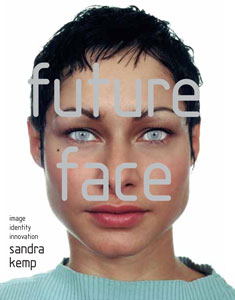
(From Future Face Book)
It is an odd coincedence that we should have the technology to alter this most important of human identifiers at exactly the same time that we are working hard to develop face recognition technologies. After all, your face is your most frequently used ID - you show it everywhere you go. We are hardwired for biometric face recognition. Newborn infants have been shown to track faces immediately.
Face recognition software typically works by using a set of eigenfaces, which are essentially standardized facial features derived from a statistical analysis of many pictures of faces. A large sample of digital images of human faces, lined up at the eyes and mouths, is sampled at the same pixel resolution. The principal eigenface in a set looks like a fuzzy averaged androgenous human face. The others add the necessary variations.
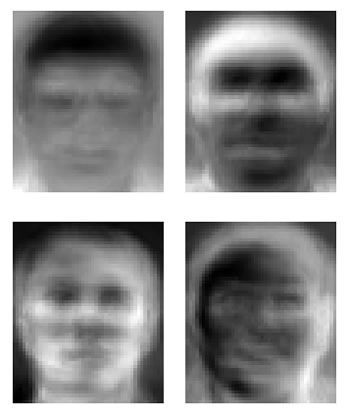
(From Eigenface)
Many of us who have digital photo albums with simple photo-editing software have done "clean-up jobs" on our faces, or those of our loved ones. People who have plastic surgery done are just "photoshopping" their actual face. What happens when more and more people seek an idealized look, an average of the most beautiful faces? You would get a generic beautiful face for everyone - and a lot of useless face recognition software (which has a high rate of failure even now, with all of our different, imperfect faces).
Science fiction writer William Gibson, in his novel Count Zero, had a pretty good handle on this idea in 1986 when he refers to a sort of statistical beauty; an average of pretty faces:
"He would have expected a routine beauty, bred out of cheap elective surgery and the relentless Darwinism of fashion, an archetype cooked down from the major media faces of the previous five years...Early work on computerized face recognition was done in the 1960's; the first work on eigenfaces was done in 1989. A number of face recognition products exist today; you may see some of them at Customs desks around the world.The faces ... were like God's own hood ornaments."
Read more about the Future Face exhibit and article; thanks to ratchet up for the pointer; read more about eigenfaces and face recognition.
Scroll down for more stories in the same category. (Story submitted 10/22/2004)
Follow this kind of news @Technovelgy.| Email | RSS | Blog It | Stumble | del.icio.us | Digg | Reddit |
Would
you like to contribute a story tip?
It's easy:
Get the URL of the story, and the related sf author, and add
it here.
Comment/Join discussion ( 1 )
Index of related articles:
Biometric security overview
Biometrics Glossary
Characteristics of successful biometric identification methods
Biometric identification systems
Biometric technology on the leading edge
Biometric identification - advantages
Biometric security and business ethics
Biometric authentication: what method works best?
Iris Recognition
Iris Scan
Related News Stories - (" Culture ")
Buy A Galaxy? Maybe Start Smaller
'The sky is the limit' just got higher.
Is There A Global Problem With Who Is Having Children?
'After twenty generations of shillyshallying...' - CM Kornbluth, 1950.
Warfare Goes Underground In Ukraine
'Once in the very first weeks of the war, before everyone had been evacuated from the surface...' - Philip K. Dick,
The Wind Phone Calls Those Who Have Passed On
'Only I heard that!' - John Brunner, 1975.
Technovelgy (that's tech-novel-gee!) is devoted to the creative science inventions and ideas of sf authors. Look for the Invention Category that interests you, the Glossary, the Invention Timeline, or see what's New.

Science Fiction
Timeline
1600-1899
1900-1939
1940's 1950's
1960's 1970's
1980's 1990's
2000's 2010's
Current News
'If Anyone Is Watching Earth...'
'Our study of your race has convinced us that you are not fitted to leave your planet in the present state of your civilization.'
Epirus High-Power Microwave Defeats Drones
'...the spreading beam of the deranging ray struck them, and Then one toppled and fell. Then another.'
Cloud Of Space Rubbish From China's Long March Rocket
'Within seconds the material was spread out over fifty yards, in a matter of hours it might occupy several cubic miles of space...'
Biomimetic Tendons From Rochu Robotics
'... the curious parallelism to animal motions.'
Living Human Neuron Biological Compute Rack
'The men are dead, but their acquired wisdom lives on and I am the beneficiary.'
Martha Stewart Approves Ojai 'Living Room On Wheels'
'Young people found the driverless car admirable for petting.'
ESA's Draco To Study Heat Of Reentry
'...a synthetic which air-friction would erode.'
Buy A Galaxy? Maybe Start Smaller
'The sky is the limit' just got higher.
The United States Space Academy Is Official
'Is our orbit to Space Academy clear?'
Is There A Global Problem With Who Is Having Children?
'After twenty generations of shillyshallying...'
You Will Eat The Cookies Made From Plastic...
'Our planes are going to start bringing in bales of discarded plastics...'
It's A Giant Robot! You Reporters Have Been Warned!
'... completely forgetting the ship at sight of the awesome figure and great head of the giant Gaut...'
Birds Learn To Sing Pictures ala Frank Herbert's Distrans
'We will fight in the time of fighting.'
ElectionSim: China's 'Ender's Game' Battle Sim, Or Lem's 'Kingdom In A Box'?
'So, Ender, we will now begin your education.'
Tactile Skin Supplier Map
'What strange sensitivity! What an amazing development of science was manifested in every move and act and word of this Robot!'
Flock Stymied By 'Adversarial Fashion'
'Forget the head atop it, the legs below, feet, arms, hands. It compels erasure.'

