
Science Fiction
Dictionary
A B C D E F G H I J K L M N O P Q R S T U V W X Y Z
Latest By
Category:
Armor
Artificial
Intelligence
Biology
Clothing
Communication
Computers
Culture
Data Storage
Displays
Engineering
Entertainment
Food
Input Devices
Lifestyle
Living Space
Manufacturing
Material
Media
Medical
Miscellaneous
Robotics
Security
Space Tech
Spacecraft
Surveillance
Transportation
Travel
Vehicle
Virtual
Person
Warfare
Weapon
Work
"On-line gaming environments are completely different things... Essentially it's massive global role-playing."
- Peter Watts

 |
| Implanted Transceiver Disc | ||
| A transceiver inserted into the brain of the operator. |

| There upon the gleaming black ladroxite bench-top was a thing of silvery beauty, of exquisitely delicate workmanship, and of utterly strange character!
Its central portion was a silver metal disc, about five inches across and half an inch thick. From its outer rim a number of tapering tentacular appendages snaked out for lengths varying from a few inches to over a foot. The disc itself was a hollow case, with its surface curved as though to fit just inside the top of a human skull. Ramsey had cut away the top of the case, revealing an interior filled with a maze of tiny coils and other mechanism of almost microscopic fineness. In the center of the coils was a little blue globe the size of a small marble...
“There,” he said, “is a sending and receiving set that is the most marvelously conceived piece of apparatus I have ever seen!”
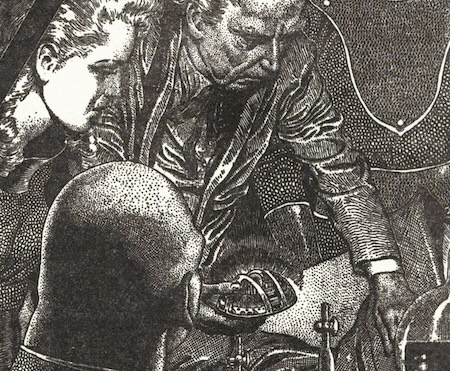 ('the most marvelously conceived piece of apparatus I have ever seen')
THOSE wires,” Ramsey said, “were connected with every vital part of the carrier’s brain. Some of them ran to the optic and auditory nerves, picking up sight and sound which the mechanism in the disc transmitted to the distant operator. Others were connected with the areas of voluntary muscular movement. They received impulses from the operator and moved corresponding parts of the carrier’s body in response.”
|
| Technovelgy from Blood on the Sun,
by Hal K. Wells. Published by Startling Stories in 1942 Additional resources -
|
Compare to necap from The Human Blend (2010) by Alan Dean Foster, neural lace from Surface Detail (2010) by Iain Banks and the cranial amplified cap from Killing Titan (2015) by Greg Bear.
Comment/Join this discussion ( 0 ) | RSS/XML | Blog This |
Additional
resources:
More Ideas
and Technology from Blood on the Sun
More Ideas
and Technology by Hal K. Wells
Tech news articles related to Blood on the Sun
Tech news articles related to works by Hal K. Wells
Implanted Transceiver Disc-related
news articles:
- Neuralink Will Land A Chip In Your Brain
| Birds Learn To Sing Pictures ala Frank Herbert's Distrans |
| Polish Turns Your Nail Into A Stylus |
| Huawei Pura X Folding Phattie Phone |
| Positioned Cybertrucks With Free Starlinks WiFi In LA |
Want to Contribute an
Item?
It's easy:
Get the name of the item, a
quote, the book's name and the author's name, and Add
it here.
| <Previous | Next> |
|
|
|
Technovelgy (that's tech-novel-gee!) is devoted to the creative science inventions and ideas of sf authors. Look for the Invention Category that interests you, the Glossary, the Science Fiction Invention Timeline, or see what's New.
|

Science Fiction
Timeline
1600-1899
1900-1939
1940's 1950's
1960's 1970's
1980's 1990's
2000's 2010's
'Our study of your race has convinced us that you are not fitted to leave your planet in the present state of your civilization.'
'...the spreading beam of the deranging ray struck them, and Then one toppled and fell. Then another.'
'Within seconds the material was spread out over fifty yards, in a matter of hours it might occupy several cubic miles of space...'
'The men are dead, but their acquired wisdom lives on and I am the beneficiary.'
'Young people found the driverless car admirable for petting.'
'After twenty generations of shillyshallying...'

