
Science Fiction
Dictionary
A B C D E F G H I J K L M N O P Q R S T U V W X Y Z

 |
Skin Cells Genetically Modified To Fight Infection

Genetically modified skin cells added to cultured skin substitutes may fight potentially lethal infections in patients with severe burns.
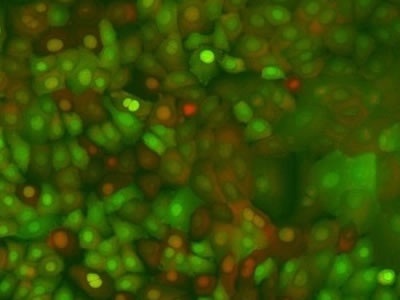
(Genetically modified skin cell may protect from infection)
Dorothy Supp, PhD, and her team discovered that skin cells genetically altered to produce higher levels of human beta defensin (HBD4 - a protein) killed more bacteria than ordinary skin cells. She remarks
“If we can add these genetically modified cells to bioengineered skin substitutes, it would provide an important defense system boost during the initial grafting period, when the skin is most susceptible to infection."In a three-year study, Supp isolated the HBD4 gene from donated tissue samples, and transferred it to surface skin cells to enhance the skin's infection-fighting abilities. The test cells were then infected with a type of bacteria commonly found in hospitals and allowed to incubate. Analysis demonstrated that the genetically altered cells with HBD4 were more resistant to microbial infection.
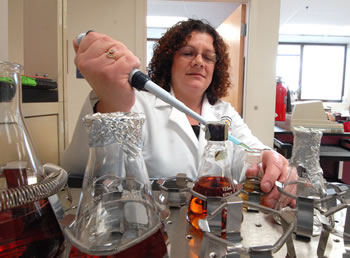
(Researcher Dorothy Supp looks for better ways to control burn infections)
Dr. Supp is a University of Cincinnati (UC) faculty member and researcher at Cincinnati Shriners Hospital for Children. She believes that defensins could become an effective alternative method for burn care and infection control.
This research is being announced in the January issue of the Journal of Burn Care and Research.
The use of cultured skin substitutes for patients with large-scale burns has been in use since the 1980's. Patients with burns covering large areas of their bodies are especially prone to serious infections, often resulting in death.
Cultured skin substitutes are actually grown apart from the patient in the laboratory, using cells from the patient's own skin to guard against rejection by the body. The cells multiply and are combined with a collagen matrix consisting of a spongy sheet and gel. The resulting "skin" is grafted directly onto the patient.
Science fiction writers have used the idea of artificial skin since the 1970's. Frank Herbert used the idea in his 1977 novel The Dosadi Experiment, calling it uniflesh. John Varley expanded on the concept in 1984, combining the idea of a skin substitute with a data screen - creating the idea of readout skin:
I'm the only report I know who still uses his handwriter except to take notes… I snapped the fingers of my left hand… Three rows of four colored dots appeared on the heel of my left hand. By pressing the dots in different combinations with my fingertips I was able to write the story in shorthand, and watch the loops and lines scrawl themselves on a strip of readout skin on my wrist...
(Read more about Varley's readout skin)
If you are interested in futuristic forms of skin substitutes, read on:
- Dattoos Personal Skinprint Technology Concept
Dattoos, DNA-based tattoos, may one day create seamless connectivity. - Robot Skin Soft Like Yours
If you hate being touched by your robot because of its cold metallic skin, take heart.
Scroll down for more stories in the same category. (Story submitted 1/9/2007)
Follow this kind of news @Technovelgy.| Email | RSS | Blog It | Stumble | del.icio.us | Digg | Reddit |
Would
you like to contribute a story tip?
It's easy:
Get the URL of the story, and the related sf author, and add
it here.
Comment/Join discussion ( 0 )
Related News Stories - (" Medical ")
3D Printed Organs From Space
'For a while your colonists will have to come up to the [orbital] Hospital...'
Health Kiosk Has No Human Doctor
'The electronic body analyzer had been developed...' - Michael Crichton, 1969.
NEO Brain Computer Interface (BCI)
'The remains of the lace took on the rough shape of a brain...' - Iain Banks, 2010.
MIT Computerized Bionic Leg Is Part Of The User
'The leg was to function, in a way, as a servo-mechanism operated by Larry’s brain, through the mediation of the electronic brain in the leg.' - Charles Recour, 1949.
Technovelgy (that's tech-novel-gee!) is devoted to the creative science inventions and ideas of sf authors. Look for the Invention Category that interests you, the Glossary, the Invention Timeline, or see what's New.

Science Fiction
Timeline
1600-1899
1900-1939
1940's 1950's
1960's 1970's
1980's 1990's
2000's 2010's
Current News
'If Anyone Is Watching Earth...'
'Our study of your race has convinced us that you are not fitted to leave your planet in the present state of your civilization.'
Epirus High-Power Microwave Defeats Drones
'...the spreading beam of the deranging ray struck them, and Then one toppled and fell. Then another.'
Cloud Of Space Rubbish From China's Long March Rocket
'Within seconds the material was spread out over fifty yards, in a matter of hours it might occupy several cubic miles of space...'
Biomimetic Tendons From Rochu Robotics
'... the curious parallelism to animal motions.'
Living Human Neuron Biological Compute Rack
'The men are dead, but their acquired wisdom lives on and I am the beneficiary.'
Martha Stewart Approves Ojai 'Living Room On Wheels'
'Young people found the driverless car admirable for petting.'
ESA's Draco To Study Heat Of Reentry
'...a synthetic which air-friction would erode.'
Buy A Galaxy? Maybe Start Smaller
'The sky is the limit' just got higher.
The United States Space Academy Is Official
'Is our orbit to Space Academy clear?'
Is There A Global Problem With Who Is Having Children?
'After twenty generations of shillyshallying...'
You Will Eat The Cookies Made From Plastic...
'Our planes are going to start bringing in bales of discarded plastics...'
It's A Giant Robot! You Reporters Have Been Warned!
'... completely forgetting the ship at sight of the awesome figure and great head of the giant Gaut...'
Birds Learn To Sing Pictures ala Frank Herbert's Distrans
'We will fight in the time of fighting.'
ElectionSim: China's 'Ender's Game' Battle Sim, Or Lem's 'Kingdom In A Box'?
'So, Ender, we will now begin your education.'
Tactile Skin Supplier Map
'What strange sensitivity! What an amazing development of science was manifested in every move and act and word of this Robot!'
Flock Stymied By 'Adversarial Fashion'
'Forget the head atop it, the legs below, feet, arms, hands. It compels erasure.'

