
Science Fiction
Dictionary
A B C D E F G H I J K L M N O P Q R S T U V W X Y Z

 |
Boeing Thermal Protection System For Orion

NASA has awarded the Thermal Protection System design and development contract to the Boeing Company; Fiber Materials Inc. will be the principal subcontractor. The new TPS design will be used with the Orion crew exploration vehicle - the spacecraft that will take astronauts back to the moon.
NASA Ames Research Center has awarded the $14 million contract for the development of a phenolic impregnated carbon ablator (PICA) heat shield. The PICA shield was first used on the Stardust interplanetary spacecraft launched February 7, 1999 to study the composition of the Wild 2 comet. It successfully reentered Earth's atmosphere January 15, 2006. The capsule was traveling at 28,900 miles per hour, the fastest reentry speed ever achieved by a man-made object. FMI fabricated the heat shield for the Stardust sample return capsule.
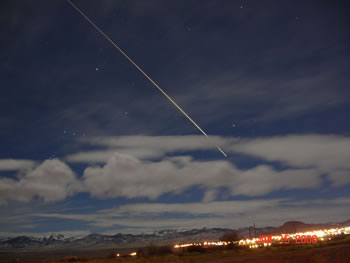
(Stardust reentry as seen from Wendover, Utah airport
[photo by Patrick Wiggins])
The ability to survive high speed reentry is an important consideration for the Orion spacecraft. Orion is intended to perform lunar-direct returns, which result in considerably higher speeds; the spacecraft will need to withstand about five times more heat than experienced by spacecraft returning from the International Space Station.
The best protection against high heat flux is an ablative heat shield. The extreme heat of reentry causes the material to pyrolize - the chemical decomposition of a material by heating in the absence of oxygen. As the PICA chars, melts and sublimates, it creates a cool boundary layer through blowing, protecting the spacecraft.
The first work on the technology of reentry was done in the early stages of the cold war. Intercontinental missile warheads would evaporate during reentry unless a protective technique could be found. Work that began at Douglas Aircraft Company's Project RAND in 1952 suggested that ablation cooling would be the best technique.
There is an interesting science fiction precursor to the idea of ablative cooling. In his 1934 novel Triplanetary, E.E. 'Doc' Smith wrote about a technique for jumping out of a supersonic plane traveling at 2,000 miles per hour in near vacuum.
...He rolled the ball out onto the hatch, where he opened it: two hinged hemispheres, each heavily padded with molded composition resembling sponge rubber...
...He curled up into one half of the ball; the other half closed over him and locked. The hatch opened. Ball and closely-prisoned man plummeted downward..
And as the ball bulleted downward on a screaming slant, it shrank!
...a synthetic which air-friction would erode away, molecule by molecule, so rapidly that no perceptible fragment of it would reach ground.
(Read more about Doc Smith's ablative heat shield)
Edward Elmer Smith had a doctorate in Chemical Engineering; that's a good place to start in writing hard science fiction.
The first reference to the idea that a body returning from space should be wrapped in an ablative material is probably Robert Goddard, writing to the Smithsonian in 1920.
Take a look at more ideas from 'Doc' Smiths Triplanetary. Find out more about Boeing To Develop Heat Shield; learn more about Atmospheric reentry.
Scroll down for more stories in the same category. (Story submitted 9/21/2006)
Follow this kind of news @Technovelgy.| Email | RSS | Blog It | Stumble | del.icio.us | Digg | Reddit |
Would
you like to contribute a story tip?
It's easy:
Get the URL of the story, and the related sf author, and add
it here.
Comment/Join discussion ( 1 )
Related News Stories - (" Space Tech ")
'If Anyone Is Watching Earth...'
'Our study of your race has convinced us that you are not fitted to leave your planet in the present state of your civilization.' - Arthur C. Clarke, 1946.
Cloud Of Space Rubbish From China's Long March Rocket
'Within seconds the material was spread out over fifty yards, in a matter of hours it might occupy several cubic miles of space...'
ESA's Draco To Study Heat Of Reentry
'...a synthetic which air-friction would erode.' - EE Doc Smith, 1934.
The United States Space Academy Is Official
'Is our orbit to Space Academy clear?' - Carey Rockwell
Technovelgy (that's tech-novel-gee!) is devoted to the creative science inventions and ideas of sf authors. Look for the Invention Category that interests you, the Glossary, the Invention Timeline, or see what's New.

Science Fiction
Timeline
1600-1899
1900-1939
1940's 1950's
1960's 1970's
1980's 1990's
2000's 2010's
Current News
'If Anyone Is Watching Earth...'
'Our study of your race has convinced us that you are not fitted to leave your planet in the present state of your civilization.'
Epirus High-Power Microwave Defeats Drones
'...the spreading beam of the deranging ray struck them, and Then one toppled and fell. Then another.'
Cloud Of Space Rubbish From China's Long March Rocket
'Within seconds the material was spread out over fifty yards, in a matter of hours it might occupy several cubic miles of space...'
Biomimetic Tendons From Rochu Robotics
'... the curious parallelism to animal motions.'
Living Human Neuron Biological Compute Rack
'The men are dead, but their acquired wisdom lives on and I am the beneficiary.'
Martha Stewart Approves Ojai 'Living Room On Wheels'
'Young people found the driverless car admirable for petting.'
ESA's Draco To Study Heat Of Reentry
'...a synthetic which air-friction would erode.'
Buy A Galaxy? Maybe Start Smaller
'The sky is the limit' just got higher.
The United States Space Academy Is Official
'Is our orbit to Space Academy clear?'
Is There A Global Problem With Who Is Having Children?
'After twenty generations of shillyshallying...'
You Will Eat The Cookies Made From Plastic...
'Our planes are going to start bringing in bales of discarded plastics...'
It's A Giant Robot! You Reporters Have Been Warned!
'... completely forgetting the ship at sight of the awesome figure and great head of the giant Gaut...'
Birds Learn To Sing Pictures ala Frank Herbert's Distrans
'We will fight in the time of fighting.'
ElectionSim: China's 'Ender's Game' Battle Sim, Or Lem's 'Kingdom In A Box'?
'So, Ender, we will now begin your education.'
Tactile Skin Supplier Map
'What strange sensitivity! What an amazing development of science was manifested in every move and act and word of this Robot!'
Flock Stymied By 'Adversarial Fashion'
'Forget the head atop it, the legs below, feet, arms, hands. It compels erasure.'

