
Science Fiction
Dictionary
A B C D E F G H I J K L M N O P Q R S T U V W X Y Z

 |
'Protonic Storms' Unleashed On DNA In Space

In his 1937 classic Menace in Miniature, Raymond Z. Gallun writes (in classic pulp sci-fi style) about the effects of proton pistols:
It turns out that Gallun was right about the effects of these "protonic storms" on living cells. In deep space, protons are the most abundant type of charged particle. Scientists at the NASA Space Radiation Laboratory at DOE's Brookhaven National Laboratory have recently discovered that proton radiation is more damaging to cells that was previously supposed.
This means that future space missions, particularly lengthy missions to Mars, must take additional precautions.
Their proton beams flared out, lashing the subtle particles into violent motion, and reducing them to fragments too fine to be visible, even if magnified a thousand diameters. The entire atmosphere within the war turret was submitted to the sterilizing action of the beams. Any living thing in the paths of the protonic storms from the pistols, must surely have been destroyed.
(Read more about proton pistols)
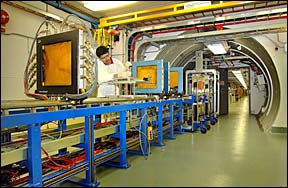
(From NASA Space Radiation Laboratory beamline)
"Scientists have been assuming that protons damage cells in a way similar to x-rays, but our results indicate that these assumptions have been wrong. The new data show that protons produce more potentially lethal double-strand breaks, a type of severe DNA damage, than other kinds of DNA damages,” said Brookhaven biologist Betsy Sutherland, the study’s lead researcher. “This means that scientists don’t really know how human DNA is affected by the most numerous particles in space and, as a result, do not know how to design the proper protection for astronauts."
(From Proton radiation more dangerous than once thought)
Sutherland and her group are now working with human cells irradiated by the same beams. Their research has shown that the use of low-energy protons in cancer treatment may need to be reexamined; improvements in cancer therapy could follow.
One local source of energetic protons is our own Sun; read about how solar activity has been shown to affect space missions throughout the solar system in Solar-Powered Interplanetary Shock Tracked To Saturn. Take a look at a "new" idea for shielding spacecraft in NASA's New Radiation Shielding First Proposed By John W. Campbell In 1936. Read more about Proton radiation more dangerous than once thought.
Scroll down for more stories in the same category. (Story submitted 2/22/2006)
Follow this kind of news @Technovelgy.| Email | RSS | Blog It | Stumble | del.icio.us | Digg | Reddit |
Would
you like to contribute a story tip?
It's easy:
Get the URL of the story, and the related sf author, and add
it here.
Comment/Join discussion ( 0 )
Related News Stories - (" Space Tech ")
'If Anyone Is Watching Earth...'
'Our study of your race has convinced us that you are not fitted to leave your planet in the present state of your civilization.' - Arthur C. Clarke, 1946.
Cloud Of Space Rubbish From China's Long March Rocket
'Within seconds the material was spread out over fifty yards, in a matter of hours it might occupy several cubic miles of space...'
ESA's Draco To Study Heat Of Reentry
'...a synthetic which air-friction would erode.' - EE Doc Smith, 1934.
The United States Space Academy Is Official
'Is our orbit to Space Academy clear?' - Carey Rockwell
Technovelgy (that's tech-novel-gee!) is devoted to the creative science inventions and ideas of sf authors. Look for the Invention Category that interests you, the Glossary, the Invention Timeline, or see what's New.

Science Fiction
Timeline
1600-1899
1900-1939
1940's 1950's
1960's 1970's
1980's 1990's
2000's 2010's
Current News
'If Anyone Is Watching Earth...'
'Our study of your race has convinced us that you are not fitted to leave your planet in the present state of your civilization.'
Epirus High-Power Microwave Defeats Drones
'...the spreading beam of the deranging ray struck them, and Then one toppled and fell. Then another.'
Cloud Of Space Rubbish From China's Long March Rocket
'Within seconds the material was spread out over fifty yards, in a matter of hours it might occupy several cubic miles of space...'
Biomimetic Tendons From Rochu Robotics
'... the curious parallelism to animal motions.'
Living Human Neuron Biological Compute Rack
'The men are dead, but their acquired wisdom lives on and I am the beneficiary.'
Martha Stewart Approves Ojai 'Living Room On Wheels'
'Young people found the driverless car admirable for petting.'
ESA's Draco To Study Heat Of Reentry
'...a synthetic which air-friction would erode.'
Buy A Galaxy? Maybe Start Smaller
'The sky is the limit' just got higher.
The United States Space Academy Is Official
'Is our orbit to Space Academy clear?'
Is There A Global Problem With Who Is Having Children?
'After twenty generations of shillyshallying...'
You Will Eat The Cookies Made From Plastic...
'Our planes are going to start bringing in bales of discarded plastics...'
It's A Giant Robot! You Reporters Have Been Warned!
'... completely forgetting the ship at sight of the awesome figure and great head of the giant Gaut...'
Birds Learn To Sing Pictures ala Frank Herbert's Distrans
'We will fight in the time of fighting.'
ElectionSim: China's 'Ender's Game' Battle Sim, Or Lem's 'Kingdom In A Box'?
'So, Ender, we will now begin your education.'
Tactile Skin Supplier Map
'What strange sensitivity! What an amazing development of science was manifested in every move and act and word of this Robot!'
Flock Stymied By 'Adversarial Fashion'
'Forget the head atop it, the legs below, feet, arms, hands. It compels erasure.'

