
Science Fiction
Dictionary
A B C D E F G H I J K L M N O P Q R S T U V W X Y Z

 |
Asteroid To Orbit Moon?

A plan to find a small nearby asteroid and move into orbit around the Moon is now being talked about in the halls of NASA. The study, from the Keck Institute for Space Studies, examines the feasibility of carrying out the project in the next decade.
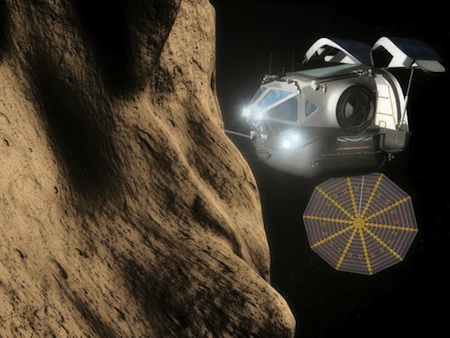
(Multi-Mission Space Exploration Vehicle approaches an asteroid [NASA])
The two major conclusions from the KISS study are: 1) that it appears feasible to identify, capture and return an entire ~7-m diameter, ~500,000-kg near-Earth asteroid to a high lunar orbit using technology that is or could be available in this decade, and 2) that such an endeavor may be essential technically and programmatically for the success of both near-term and long-term human exploration beyond low-Earth orbit. One of the key challenges – the discovery and characterization of a sufficiently large number of small asteroids of the right type, size, spin state and orbital characteristics – could be addressed by a low-cost, ground-based observation campaign identified in the study. To be an attractive target for return the asteroid must be a C-type approximately 7 m in diameter, have a synodic period of approximately 10 years, and require a ∆V for return of less than ~200 m/s. Implementation of the observation campaign could enable the discovery of a few thousand small asteroids per year and the characterization of a fraction of these resulting in a likelihood of finding about five good targets per year that meet the criteria for return.Proof-of-concept trajectory analysis based on asteroid 2008 HU4 (which is approximately the right size, but of an unknown spectral type) suggest that a robotic spacecraft with a 40-kW solar electric propulsion system could return this asteroid to a high-lunar orbit in a total flight time of 6 to 10 years assuming the asteroid has a mass in the range of 250,000 to 1,000,000 kg (with the shorter flight times corresponding to the lower asteroid mass). Significantly, these proof-of-concept trajectories baseline a single Atlas V-class launch to low-Earth orbit.
The study also considered an alternative concept in which the spacecraft picks up a ~7-m diameter rock from the surface of a much larger asteroid (> 100-m diameter). The advantage of this approach is that asteroids 100-m in diameter or greater are much easier to discover and characterize. This advantage is somewhat offset by the added complexity of trying to pick up a large 7-m diameter rock from the surface, and the fact that there are far fewer 100-m class NEAs than smaller ones making it more difficult to find ones with the desired orbital characteristics. This mission approach would seek to return approximately the same mass of asteroid material – of order 500,000 kg – as the approach that returns an entire small NEA.
(Asteroid Retrieval Feasibility Study)
Update: See also this material on the AsterAnts: A Concept for Large-Scale Meteoroid Return and Processing, a proposal that dates from the late 1990's. (Thanks to Ashley for pointing this one out.) End update.
Robert Heinlein wrote about capturing an asteroid and changing its orbit in his still excellent 1939 short story Misfit:
Eighty-eight swung some millions of miles further around the sun. The pock-marks on her face grew deeper, and were lined with durite, that strange close-packed laboratory product which (usually) would confine even atomic disintegration. Then Eighty-eight received a series of gentle pats, always on the side headed along her course. In a few weeks' time the rocket blasts had their effect and Eighty-eight was plunging in an orbit toward the sun.When she reached her station one and three-tenths the distance from the sun of Earth's orbit, she would have to be coaxed by another series of pats into a circular orbit. Thereafter she was to be known as E-M3, Earth-Mars Space Station Spot Three.
(moving an asteroid)
Via Yahoo.
Scroll down for more stories in the same category. (Story submitted 1/8/2013)
Follow this kind of news @Technovelgy.| Email | RSS | Blog It | Stumble | del.icio.us | Digg | Reddit |
Would
you like to contribute a story tip?
It's easy:
Get the URL of the story, and the related sf author, and add
it here.
Comment/Join discussion ( 3 )
Related News Stories - (" Space Tech ")
'If Anyone Is Watching Earth...'
'Our study of your race has convinced us that you are not fitted to leave your planet in the present state of your civilization.' - Arthur C. Clarke, 1946.
Cloud Of Space Rubbish From China's Long March Rocket
'Within seconds the material was spread out over fifty yards, in a matter of hours it might occupy several cubic miles of space...'
ESA's Draco To Study Heat Of Reentry
'...a synthetic which air-friction would erode.' - EE Doc Smith, 1934.
The United States Space Academy Is Official
'Is our orbit to Space Academy clear?' - Carey Rockwell
Technovelgy (that's tech-novel-gee!) is devoted to the creative science inventions and ideas of sf authors. Look for the Invention Category that interests you, the Glossary, the Invention Timeline, or see what's New.

Science Fiction
Timeline
1600-1899
1900-1939
1940's 1950's
1960's 1970's
1980's 1990's
2000's 2010's
Current News
'If Anyone Is Watching Earth...'
'Our study of your race has convinced us that you are not fitted to leave your planet in the present state of your civilization.'
Epirus High-Power Microwave Defeats Drones
'...the spreading beam of the deranging ray struck them, and Then one toppled and fell. Then another.'
Cloud Of Space Rubbish From China's Long March Rocket
'Within seconds the material was spread out over fifty yards, in a matter of hours it might occupy several cubic miles of space...'
Biomimetic Tendons From Rochu Robotics
'... the curious parallelism to animal motions.'
Living Human Neuron Biological Compute Rack
'The men are dead, but their acquired wisdom lives on and I am the beneficiary.'
Martha Stewart Approves Ojai 'Living Room On Wheels'
'Young people found the driverless car admirable for petting.'
ESA's Draco To Study Heat Of Reentry
'...a synthetic which air-friction would erode.'
Buy A Galaxy? Maybe Start Smaller
'The sky is the limit' just got higher.
The United States Space Academy Is Official
'Is our orbit to Space Academy clear?'
Is There A Global Problem With Who Is Having Children?
'After twenty generations of shillyshallying...'
You Will Eat The Cookies Made From Plastic...
'Our planes are going to start bringing in bales of discarded plastics...'
It's A Giant Robot! You Reporters Have Been Warned!
'... completely forgetting the ship at sight of the awesome figure and great head of the giant Gaut...'
Birds Learn To Sing Pictures ala Frank Herbert's Distrans
'We will fight in the time of fighting.'
ElectionSim: China's 'Ender's Game' Battle Sim, Or Lem's 'Kingdom In A Box'?
'So, Ender, we will now begin your education.'
Tactile Skin Supplier Map
'What strange sensitivity! What an amazing development of science was manifested in every move and act and word of this Robot!'
Flock Stymied By 'Adversarial Fashion'
'Forget the head atop it, the legs below, feet, arms, hands. It compels erasure.'

