
Science Fiction
Dictionary
A B C D E F G H I J K L M N O P Q R S T U V W X Y Z

 |
Pioneer Space Probes Unexpectedly Slow Down In Deep Space

Pioneer 10 and 11 were launched in 1972 to explore Jupiter and Saturn; these remarkably successful and durable spacecraft fulfilled the expectations of their designers. The last bits of data from Pioneer 10 were received in early 2003 following over 30 years of continuous operation; the spacecraft was 12 billion kilometers from the sun.
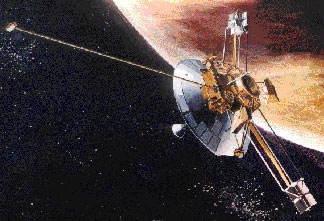
(From Aerospace Analysis Helps Confirm)
However, once they passed beyond the orbit of Uranus, the radio signals sent back by the aging craft have been shifted to progressively shorter wavelengths. This implies that they are decelerating slightly; no one knows why this is happening.
Some space scientists are calling for a deep-space mission to try to understand this behavior - called the Pioneer anomaly. Mundane reasons for this effect have been brought forward; it could be due to leakage of gaseous fuel from the thrusters, for example. However, some scientists wonder if the Pioneer anomaly may be due to some previously unknown forces that are only noticed outside the solar system.
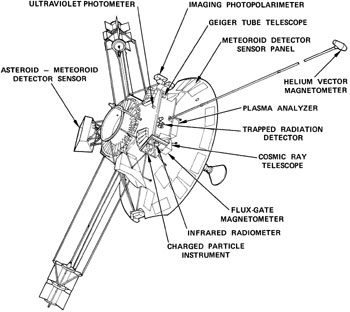
(From Pioneer 10 aerospace physics)
A number of possible causes have been ruled out by Philip Laing and Anthony Liu, working under a NASA Office of Space Science grant:
- Errors in JPL's orbital determination software
- Gravity of the Kuiper belt and gravity from the galaxy
- Errors in the planetary ephemeris
- Errors in the values of the Earth's orientation, precession, and nutation
- Nongravitational effects from solar pressure and attitude control maneuvers
- Solar wind and interplanetary medium
- Nominal thermal radiation and plutonium half-life
- Drifting clocks, general relativity, and the speed of gravity
- Hardware problems at the tracking stations.
Slava Turyshev of NASA's JPL in Pasadena thinks that the issue is worth exploring even if it turns out to be a gas leak, which is considered the most likely cause. Working on this problem forces space engineers to rethink their methods for very precise navigation in space. There is a possibility that upcoming space missions may be modified to try to verify (or disprove) the idea that unknown physical forces are behind the Pioneer anomaly.
However, no explanation based on conventional physics has been found; the effect is so persistent that it could indicate some physical principle not yet considered in previous explanations of the motions of the planets. Meanwhile, Pioneer 10 is on its way to the giant red star Aldebaran. Estimated time of arrival - 2 million years from now.
As soon as I read this story, I thought about the classic 1950 sf novel Brain Wave by Poul Anderson. At the time of the story, the sun moves out of a field that pervades a huge area of space, one which depresses electrochemical and electromagnetic phenomena - including human neural function. The result of the solar system leaving this field is that everyone on Earth immediately gains about one hundred IQ points due to increased synaptic speed.
Read more at Following in Pioneer's Footsteps and Aerospace analysis helps confirm unexplained pull on spacecraft.
Scroll down for more stories in the same category. (Story submitted 11/23/2004)
Follow this kind of news @Technovelgy.| Email | RSS | Blog It | Stumble | del.icio.us | Digg | Reddit |
Would
you like to contribute a story tip?
It's easy:
Get the URL of the story, and the related sf author, and add
it here.
Comment/Join discussion ( 41 )
Related News Stories - (" Spacecraft ")
Europa Clipper Plate Carries A Special Message
'...a universal cryptogram — yet it is one which can be interpreted by any intelligent creature on any planet in the Solar System!' -
China Wants To Build Mega Space Ships
'Don't do anything to endanger our shipping privileges...' - Frank Herbert, 1965.
Dream Of Building Your Own Rocket?
Fiorello Bodoni, you inspire all of us.
Used Dragon Cargo Spacecraft Will Fly Again
'the overstrained meters made the smaller craft skittish as a young horse...' - Robert Heinlein
Technovelgy (that's tech-novel-gee!) is devoted to the creative science inventions and ideas of sf authors. Look for the Invention Category that interests you, the Glossary, the Invention Timeline, or see what's New.

Science Fiction
Timeline
1600-1899
1900-1939
1940's 1950's
1960's 1970's
1980's 1990's
2000's 2010's
Current News
'If Anyone Is Watching Earth...'
'Our study of your race has convinced us that you are not fitted to leave your planet in the present state of your civilization.'
Epirus High-Power Microwave Defeats Drones
'...the spreading beam of the deranging ray struck them, and Then one toppled and fell. Then another.'
Cloud Of Space Rubbish From China's Long March Rocket
'Within seconds the material was spread out over fifty yards, in a matter of hours it might occupy several cubic miles of space...'
Biomimetic Tendons From Rochu Robotics
'... the curious parallelism to animal motions.'
Living Human Neuron Biological Compute Rack
'The men are dead, but their acquired wisdom lives on and I am the beneficiary.'
Martha Stewart Approves Ojai 'Living Room On Wheels'
'Young people found the driverless car admirable for petting.'
ESA's Draco To Study Heat Of Reentry
'...a synthetic which air-friction would erode.'
Buy A Galaxy? Maybe Start Smaller
'The sky is the limit' just got higher.
The United States Space Academy Is Official
'Is our orbit to Space Academy clear?'
Is There A Global Problem With Who Is Having Children?
'After twenty generations of shillyshallying...'
You Will Eat The Cookies Made From Plastic...
'Our planes are going to start bringing in bales of discarded plastics...'
It's A Giant Robot! You Reporters Have Been Warned!
'... completely forgetting the ship at sight of the awesome figure and great head of the giant Gaut...'
Birds Learn To Sing Pictures ala Frank Herbert's Distrans
'We will fight in the time of fighting.'
ElectionSim: China's 'Ender's Game' Battle Sim, Or Lem's 'Kingdom In A Box'?
'So, Ender, we will now begin your education.'
Tactile Skin Supplier Map
'What strange sensitivity! What an amazing development of science was manifested in every move and act and word of this Robot!'
Flock Stymied By 'Adversarial Fashion'
'Forget the head atop it, the legs below, feet, arms, hands. It compels erasure.'

