
Science Fiction
Dictionary
A B C D E F G H I J K L M N O P Q R S T U V W X Y Z

 |
Eureqa Artificially Intelligent Computer Scientist

Eureqa is an artificial intelligence program that autonomously seeks working equations to describe data from experiments. Eureqa is the direct descendent of the marvelous introspective starfish robot developed by Dr. Hod Lipson and others at the Computational Synthesis Lab at Cornell University.
Even more remarkable is the ability to actively modify experiments already underway. Dr John Wikswo of Vanderbilt University is using Eureqa to study the effects of cocaine on white blood cells. He believes that the biology is too complicated for human beings to fully understand. Using other devices created by Lipson and his team, Eureqa can adjust valves that control the administration of toxins and nutrients
Eureqa reminds me of Dr. Theopolis the intelligent computer from the NBC television series Buck Rogers in the 25th Century. Dr. Theopolis, an artificial intelligence, was regarded one of Earth's leading scientists and often gave scientific advice. He took the form of a large, clock-like medallion usually carried around by Twiki, the little android robot.
The program begins by examining the data for numbers that appear to be connected, and then suggests equations that fit the connections. Of the proposed equations most fail, but some are less wrong than others, and these are selected and modified and then repeatedly re-tested against the data and tweaked until a workable equation is identified.
In some cases there is not enough data to enable Eureqa to find equations, but in these cases the latest version of the program may identify the gaps in the data and even recommend experiments to supply the missing data.
Eureqa was able to calculate in hours equations that Newton took years to find, and Lipson hopes it can do the same for data such as the interactions between proteins, genomes and cell signals, which are so complicated that describing the interactions mathematically has so far been impossible. While Lipson envisaged the program as having application mainly in biological fields, it will analyze any data that can be presented in a spreadsheet.
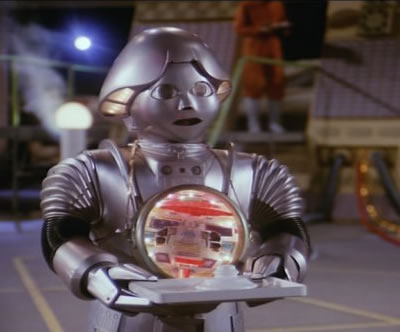
(Dr. Theopolis from Buck Rogers in the 25th Century)
See also this article on Adam, the original robot scientist created by scientists at Aberystwyth University and the University of Cambridge.
From Physorg; download the software from Cornell University's Eureqa site.
Scroll down for more stories in the same category. (Story submitted 12/7/2009)
Follow this kind of news @Technovelgy.| Email | RSS | Blog It | Stumble | del.icio.us | Digg | Reddit |
Would
you like to contribute a story tip?
It's easy:
Get the URL of the story, and the related sf author, and add
it here.
Comment/Join discussion ( 0 )
Related News Stories - (" Artificial Intelligence ")
Light Society: Simulates Earth-Scale Society With A Billion AI Agents
'The king, an old hand in the running of tyrannies, instantly grasped the directions...' - Stanislaw Lem, 1965.
Collective Superintelligence Is At Hand!
'Maybe the individual intelligence of each Cubic pools into a group intelligence...' - Edmond Hamilton, 1942.
AI Operates An Excavator
'So far as I could see, the thing was without a directing Martian at all.' - HG Wells, 1898.
Grok And The City Fathers From 'Cities In Flight' By James Blish
'Chris, the City Fathers are not interested in your welfare; I suppose you know that. They're interested in only one thing: the survival of the city.' - James Blish, 1957.
Technovelgy (that's tech-novel-gee!) is devoted to the creative science inventions and ideas of sf authors. Look for the Invention Category that interests you, the Glossary, the Invention Timeline, or see what's New.

Science Fiction
Timeline
1600-1899
1900-1939
1940's 1950's
1960's 1970's
1980's 1990's
2000's 2010's
Current News
'If Anyone Is Watching Earth...'
'Our study of your race has convinced us that you are not fitted to leave your planet in the present state of your civilization.'
Epirus High-Power Microwave Defeats Drones
'...the spreading beam of the deranging ray struck them, and Then one toppled and fell. Then another.'
Cloud Of Space Rubbish From China's Long March Rocket
'Within seconds the material was spread out over fifty yards, in a matter of hours it might occupy several cubic miles of space...'
Biomimetic Tendons From Rochu Robotics
'... the curious parallelism to animal motions.'
Living Human Neuron Biological Compute Rack
'The men are dead, but their acquired wisdom lives on and I am the beneficiary.'
Martha Stewart Approves Ojai 'Living Room On Wheels'
'Young people found the driverless car admirable for petting.'
ESA's Draco To Study Heat Of Reentry
'...a synthetic which air-friction would erode.'
Buy A Galaxy? Maybe Start Smaller
'The sky is the limit' just got higher.
The United States Space Academy Is Official
'Is our orbit to Space Academy clear?'
Is There A Global Problem With Who Is Having Children?
'After twenty generations of shillyshallying...'
You Will Eat The Cookies Made From Plastic...
'Our planes are going to start bringing in bales of discarded plastics...'
It's A Giant Robot! You Reporters Have Been Warned!
'... completely forgetting the ship at sight of the awesome figure and great head of the giant Gaut...'
Birds Learn To Sing Pictures ala Frank Herbert's Distrans
'We will fight in the time of fighting.'
ElectionSim: China's 'Ender's Game' Battle Sim, Or Lem's 'Kingdom In A Box'?
'So, Ender, we will now begin your education.'
Tactile Skin Supplier Map
'What strange sensitivity! What an amazing development of science was manifested in every move and act and word of this Robot!'
Flock Stymied By 'Adversarial Fashion'
'Forget the head atop it, the legs below, feet, arms, hands. It compels erasure.'

