
Science Fiction
Dictionary
A B C D E F G H I J K L M N O P Q R S T U V W X Y Z

 |
The Blind May See - In The Dark

A number of companies and research laboratories are working on optical prostheses; devices that are actually implanted in the eye of a person who is unable to see. Diseases like macular degeneration, in which ise retina starts to peel away from the back of the eye, may be ameliorated by implanted devices that stimulate the retina electronically.
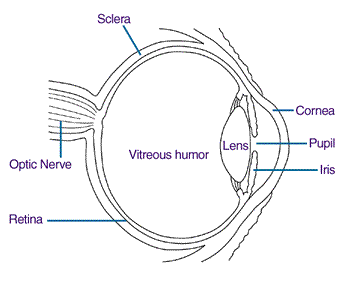
(From Diagram of the Eye - NIH)
A serious limitation of the devices used so far, which rely on a video signal translated into a small matrix of dots, is that it is difficult for patients to "see" reliably with the devices. They see shapes far better than fine details, like the print of a newspaper.
One optical prosthesis makes use of microbolometers that are able to detect far-infrared radation. Recent advances allow such devices to work at room temperatures. This sensor responds to heat energy; its information is combined with visible light picked up by sensors in a special pair of glasses worn by the patient.
The advantage of bringing far-infrared radiation into the device for the patient is that it works in very low light conditions where contrast is poor. Objects of different temperatures would stand out clearly.
In a two-hour operation, the patient's intraocular lens is removed, and the light sensing device is put in its place. This light sensor is about twice the size of a match head. The back of the sensor is connected to a polymer filament embedded with wires. The filament terminates at a small disk with controls and an array of electrodes, which translate the information from the sensors into electrical signals which are perceived by the retina.
The end result is that a blind person with this device could actually see a black cat in a coal cellar at midnight, using the cat's body heat.
Science fiction author Bruce Sterling wrote about optic television in his 1984 story Twenty Evocations:
"It was astonishing how much room there was in an eye socket, when you stopped to think about it... Nikolai had some other devices installed: a clock, a biofeedback monitor..." (More)
See Vision Quest for more details.
Note: I had one reader object to this article, implying that this just gives false hope to people who have a real disease. This story was not intended to be funny, or cute. (Yes, it does have a striking - but true - title.) It is about a real company that is using solid science to solve a real problem. This story was taken primarily from a reputable online magazine. It is true that this magazine is not a peer-reviewed medical journal. However, I checked out the company quoted as using far-infrared technology; they do have a website representing an incorporated business. The company is Advanced Medical Electronics Corporation. Their website includes full contact information, including the names, phone numbers and email addresses of people you can talk with in their company. The website also states that their technologies were developed with support from the National Institute of Health.
On my site, I have lots of fun with science fiction, which can be irreverent or serious at the whim of the writer. I think I'm usually pretty serious about science, though - and I don't joke about subjects like this. -ed..
Scroll down for more stories in the same category. (Story submitted 5/12/2004)
Follow this kind of news @Technovelgy.| Email | RSS | Blog It | Stumble | del.icio.us | Digg | Reddit |
Would
you like to contribute a story tip?
It's easy:
Get the URL of the story, and the related sf author, and add
it here.
Comment/Join discussion ( 9 )
Related News Stories - (" Medical ")
3D Printed Organs From Space
'For a while your colonists will have to come up to the [orbital] Hospital...'
Health Kiosk Has No Human Doctor
'The electronic body analyzer had been developed...' - Michael Crichton, 1969.
NEO Brain Computer Interface (BCI)
'The remains of the lace took on the rough shape of a brain...' - Iain Banks, 2010.
MIT Computerized Bionic Leg Is Part Of The User
'The leg was to function, in a way, as a servo-mechanism operated by Larry’s brain, through the mediation of the electronic brain in the leg.' - Charles Recour, 1949.
Technovelgy (that's tech-novel-gee!) is devoted to the creative science inventions and ideas of sf authors. Look for the Invention Category that interests you, the Glossary, the Invention Timeline, or see what's New.

Science Fiction
Timeline
1600-1899
1900-1939
1940's 1950's
1960's 1970's
1980's 1990's
2000's 2010's
Current News
'If Anyone Is Watching Earth...'
'Our study of your race has convinced us that you are not fitted to leave your planet in the present state of your civilization.'
Epirus High-Power Microwave Defeats Drones
'...the spreading beam of the deranging ray struck them, and Then one toppled and fell. Then another.'
Cloud Of Space Rubbish From China's Long March Rocket
'Within seconds the material was spread out over fifty yards, in a matter of hours it might occupy several cubic miles of space...'
Biomimetic Tendons From Rochu Robotics
'... the curious parallelism to animal motions.'
Living Human Neuron Biological Compute Rack
'The men are dead, but their acquired wisdom lives on and I am the beneficiary.'
Martha Stewart Approves Ojai 'Living Room On Wheels'
'Young people found the driverless car admirable for petting.'
ESA's Draco To Study Heat Of Reentry
'...a synthetic which air-friction would erode.'
Buy A Galaxy? Maybe Start Smaller
'The sky is the limit' just got higher.
The United States Space Academy Is Official
'Is our orbit to Space Academy clear?'
Is There A Global Problem With Who Is Having Children?
'After twenty generations of shillyshallying...'
You Will Eat The Cookies Made From Plastic...
'Our planes are going to start bringing in bales of discarded plastics...'
It's A Giant Robot! You Reporters Have Been Warned!
'... completely forgetting the ship at sight of the awesome figure and great head of the giant Gaut...'
Birds Learn To Sing Pictures ala Frank Herbert's Distrans
'We will fight in the time of fighting.'
ElectionSim: China's 'Ender's Game' Battle Sim, Or Lem's 'Kingdom In A Box'?
'So, Ender, we will now begin your education.'
Tactile Skin Supplier Map
'What strange sensitivity! What an amazing development of science was manifested in every move and act and word of this Robot!'
Flock Stymied By 'Adversarial Fashion'
'Forget the head atop it, the legs below, feet, arms, hands. It compels erasure.'

