
Science Fiction
Dictionary
A B C D E F G H I J K L M N O P Q R S T U V W X Y Z

 |
Robotic Ankle Exoskeleton Helps Users Regain Limb Function

A robotic ankle exoskeleton developed at the University of Michigan helps people regain limb function; it is controlled by the wearer's own nervous system.
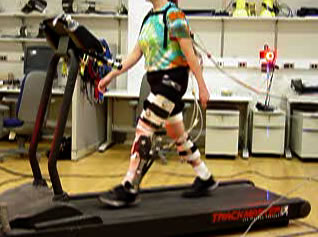
(Robotic ankle exoskeleton)
As the subject attempts to walk forward, electrical impulses from the brain tell muscles how to move. People with spinal injuries, as well as some neurological disorders, may have problems walking because these impulses do not arrive in a coordinated fashion, or because the impulses are too weak.
The robotic ankle exoskeleton uses the brain's electrical signals to know what to do and how to move. Electromyography (EMG) signals are processed in real time by a computer; the signals are used to control air pressure supplied to the artificial pneumatic muscle.
"This could benefit stroke patients or patients with incomplete injuries of the spinal cord," said Daniel Ferris, associate professor in movement science at U-M. "For patients that can walk slowly, a brace like this may help them walk faster and more effectively."
Science fiction fans have long been familiar with the idea of a powered suit that responds directly to the user's muscles and amplifies their function. In a sense, the UM invention is the opposite; it provides simple assistance so that the wearer can strengthen or regain lost function. I'm also fascinated by the sense in which the robotic ankle exoskeleton's computer system helps to interpret and strengthen the signals produced by the wearer's nervous system.
As the science fiction example of an exoskeleton, I've chosen the titanium exoskeleton from Fritz Lieber's excellent 1968 novel A Specter is Haunting Texas. In the story, a man who had grown up in weak gravity comes to Earth and needs support just to stand up.
This truly magnificent, romantically handsome, rather lean man was standing on two corrugated-soled titanium footplates. From the outer edge of each rose a narrow titanium T-beam that followed the line of his leg, with a joint (locked now) at the knee, up to another joint with a titanium pelvic girdle and shallow belly support. From the back of this girdle a T-spine rose to support a shoulder yoke and rib cage, all of the same metal. The rib cage was artistically slotted to save weight, so that curving strips followed the line of each of his very prominent ribs.
(Read more about the titanium exoskeleton)
There are other examples of this kind of strengthening exoskeleton in the real world (as opposed to the science-fictional one). The Robotics and Mechatronics Laboratory of Northeastern University developed the AKROD v2 - Active Knee Rehabilitation Device . This device uses a computer-controlled knee joint filled with magneto-rheological fluid to provided graded resistance to help patients regain function. See also a new device to help people with manual dexterity problems following a stroke - the HOWARD Hand-Wrist Assisting Robotic Device.
Read more about the UM's Robotic exoskeleton (with short videos); this research provides a real basis for applications in rehab and physical therapy.
Scroll down for more stories in the same category. (Story submitted 2/12/2007)
Follow this kind of news @Technovelgy.| Email | RSS | Blog It | Stumble | del.icio.us | Digg | Reddit |
Would
you like to contribute a story tip?
It's easy:
Get the URL of the story, and the related sf author, and add
it here.
Comment/Join discussion ( 0 )
Related News Stories - (" Robotics ")
Epirus High-Power Microwave Defeats Drones
'...the spreading beam of the deranging ray struck them, and Then one toppled and fell. Then another.' - Ray Cummings, 1931.
It's A Giant Robot! You Reporters Have Been Warned!
'... completely forgetting the ship at sight of the awesome figure and great head of the giant Gaut...'
Tactile Skin Supplier Map
'What strange sensitivity! What an amazing development of science was manifested in every move and act and word of this Robot!' - Ray Cummings, 1931.
Robot Bees 3D Printed By Festo
'At first I was struck by the large size of these bees..' - Ernst Junger, 1957.
Technovelgy (that's tech-novel-gee!) is devoted to the creative science inventions and ideas of sf authors. Look for the Invention Category that interests you, the Glossary, the Invention Timeline, or see what's New.

Science Fiction
Timeline
1600-1899
1900-1939
1940's 1950's
1960's 1970's
1980's 1990's
2000's 2010's
Current News
'If Anyone Is Watching Earth...'
'Our study of your race has convinced us that you are not fitted to leave your planet in the present state of your civilization.'
Epirus High-Power Microwave Defeats Drones
'...the spreading beam of the deranging ray struck them, and Then one toppled and fell. Then another.'
Cloud Of Space Rubbish From China's Long March Rocket
'Within seconds the material was spread out over fifty yards, in a matter of hours it might occupy several cubic miles of space...'
Biomimetic Tendons From Rochu Robotics
'... the curious parallelism to animal motions.'
Living Human Neuron Biological Compute Rack
'The men are dead, but their acquired wisdom lives on and I am the beneficiary.'
Martha Stewart Approves Ojai 'Living Room On Wheels'
'Young people found the driverless car admirable for petting.'
ESA's Draco To Study Heat Of Reentry
'...a synthetic which air-friction would erode.'
Buy A Galaxy? Maybe Start Smaller
'The sky is the limit' just got higher.
The United States Space Academy Is Official
'Is our orbit to Space Academy clear?'
Is There A Global Problem With Who Is Having Children?
'After twenty generations of shillyshallying...'
You Will Eat The Cookies Made From Plastic...
'Our planes are going to start bringing in bales of discarded plastics...'
It's A Giant Robot! You Reporters Have Been Warned!
'... completely forgetting the ship at sight of the awesome figure and great head of the giant Gaut...'
Birds Learn To Sing Pictures ala Frank Herbert's Distrans
'We will fight in the time of fighting.'
ElectionSim: China's 'Ender's Game' Battle Sim, Or Lem's 'Kingdom In A Box'?
'So, Ender, we will now begin your education.'
Tactile Skin Supplier Map
'What strange sensitivity! What an amazing development of science was manifested in every move and act and word of this Robot!'
Flock Stymied By 'Adversarial Fashion'
'Forget the head atop it, the legs below, feet, arms, hands. It compels erasure.'

