
Science Fiction
Dictionary
A B C D E F G H I J K L M N O P Q R S T U V W X Y Z

 |
Anti-Viral Polymer Paints Flu Into A Corner

A remarkable anti-viral polymer can be applied like paint; it was developed by MIT's Alexander Klibanov. His intent is to develop a biocidal "paint" that can help reduce the spread of germs in public areas and hospitals.
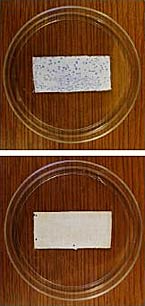
(Bottom slide covered with alkylated PEI)
In the above illustration, a regular commercial glass slide (top) and another one coated with alkylated PEI "paint" (bottom) were sprayed with aqueous suspensions of Staphylococcus aureus cells, and then incubated. Some 200 bacterial colonies are seen on the unprotected slide—and only 4 on the protected one.
Staphylococcus aureus is described by the CDC as a "superbug" that is resistant to many types of antibiotics. Studies have shown that it can survive for weeks even on hard surfaces.
Klibanov writes:
Our recent studies have resulted in a new, “non-release” strategy for rendering common materials (plastics, glass, textiles) permanently microbicidal. This strategy, involving covalent attachment of certain long, moderately hydrophobic polycations to material surfaces, has been proven to be very effective against a variety of pathogenic bacteria and fungi, both airborne and waterborne. This work continues along with a quest for creating material coatings with anti-viral and anti-sporal activities.
Klibanov and his colleagues found that the prickly polymer worked on bacteria; they tested it with the smaller flu virus and found the same effects. They applied droplets of a flu solution to glass slips painted with the polymer. After a few minutes' exposure, they were unable to recover any active virus from the samples, meaning the coating reduced the pathogen's abundance by at least a factor of 10,000.
How does it work? In the case of bacteria, the polymer seems to gouge holes in a microbe's cell wall and spilling out its contents. The polymer molecules stay rigid because they are all positively charged and repel each other; they are like strands of hair standing on end from a static charge. The spikes have sufficiently few charges, however, that they can breach bacterial walls, which repel strongly charged molecules. The polymer probably neutralizes flu because the virus has an envelope around it suitable for spearing, Klibanov says.
Here are some other inventions that work on small organisms:
- First Motor Powered By Living Bacteria
Amazing new motor powered by hard-working bacteria. - Fungus Devours CDs
You thought you had enough to worry about - now there's a fungus that consumes CDs, metal and all. - Implanted Biothermal RFID Chips May Warn Of Avian Flu
Digital Angel, which makes VeriChips for humans, suggests using its thermal biosensing chips to check chickens for avian flu.
From Scientific American via MedGadget; read more about Alexander Klibanov.
Scroll down for more stories in the same category. (Story submitted 11/16/2006)
Follow this kind of news @Technovelgy.| Email | RSS | Blog It | Stumble | del.icio.us | Digg | Reddit |
Would
you like to contribute a story tip?
It's easy:
Get the URL of the story, and the related sf author, and add
it here.
Comment/Join discussion ( 0 )
Related News Stories - (" Medical ")
3D Printed Organs From Space
'For a while your colonists will have to come up to the [orbital] Hospital...'
Health Kiosk Has No Human Doctor
'The electronic body analyzer had been developed...' - Michael Crichton, 1969.
NEO Brain Computer Interface (BCI)
'The remains of the lace took on the rough shape of a brain...' - Iain Banks, 2010.
MIT Computerized Bionic Leg Is Part Of The User
'The leg was to function, in a way, as a servo-mechanism operated by Larry’s brain, through the mediation of the electronic brain in the leg.' - Charles Recour, 1949.
Technovelgy (that's tech-novel-gee!) is devoted to the creative science inventions and ideas of sf authors. Look for the Invention Category that interests you, the Glossary, the Invention Timeline, or see what's New.

Science Fiction
Timeline
1600-1899
1900-1939
1940's 1950's
1960's 1970's
1980's 1990's
2000's 2010's
Current News
'If Anyone Is Watching Earth...'
'Our study of your race has convinced us that you are not fitted to leave your planet in the present state of your civilization.'
Epirus High-Power Microwave Defeats Drones
'...the spreading beam of the deranging ray struck them, and Then one toppled and fell. Then another.'
Cloud Of Space Rubbish From China's Long March Rocket
'Within seconds the material was spread out over fifty yards, in a matter of hours it might occupy several cubic miles of space...'
Biomimetic Tendons From Rochu Robotics
'... the curious parallelism to animal motions.'
Living Human Neuron Biological Compute Rack
'The men are dead, but their acquired wisdom lives on and I am the beneficiary.'
Martha Stewart Approves Ojai 'Living Room On Wheels'
'Young people found the driverless car admirable for petting.'
ESA's Draco To Study Heat Of Reentry
'...a synthetic which air-friction would erode.'
Buy A Galaxy? Maybe Start Smaller
'The sky is the limit' just got higher.
The United States Space Academy Is Official
'Is our orbit to Space Academy clear?'
Is There A Global Problem With Who Is Having Children?
'After twenty generations of shillyshallying...'
You Will Eat The Cookies Made From Plastic...
'Our planes are going to start bringing in bales of discarded plastics...'
It's A Giant Robot! You Reporters Have Been Warned!
'... completely forgetting the ship at sight of the awesome figure and great head of the giant Gaut...'
Birds Learn To Sing Pictures ala Frank Herbert's Distrans
'We will fight in the time of fighting.'
ElectionSim: China's 'Ender's Game' Battle Sim, Or Lem's 'Kingdom In A Box'?
'So, Ender, we will now begin your education.'
Tactile Skin Supplier Map
'What strange sensitivity! What an amazing development of science was manifested in every move and act and word of this Robot!'
Flock Stymied By 'Adversarial Fashion'
'Forget the head atop it, the legs below, feet, arms, hands. It compels erasure.'

