
Science Fiction
Dictionary
A B C D E F G H I J K L M N O P Q R S T U V W X Y Z

 |
Space Sunshade Idea Now Worrisomely Popular

In the past year, I've covered two different proposals on using space technology to create some sort of "shade" for the entire planet that would save us from global warming. In covering those stories, words like "radical" and even "outlandish" seemed appropriate.
Now, NASA has actually funded a more thorough study of a third "sunshade" proposal. Should I be worried that the government is actually thinking they need some sort of space-based fallback plan for the global warming problem?
If you'd like to see the past proposals, take a look at the single giant concave fresnel lens at L1 solution and the space ring girdles the Earth solution.
The new (third!) sunshade solution is proposed by University of Arizona Steward Observatory optics expert Roger Angel. He suggests that we launch trillions of tiny (0.6 meters across) screens. The screens would be thin transparent disks with little 0.1 meter protruding fins with solar energy-gathering capabilities for position adjustment. The disks would essentially be lenses that would take a small amount of the sun's light (energy) and focus it away from Earth.
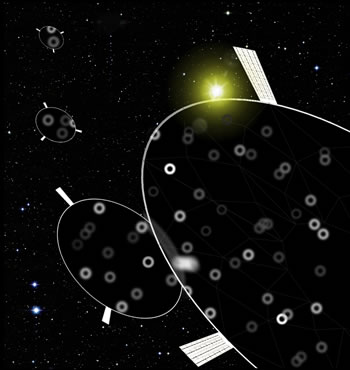
(Roger Angel suggests L1 sunshade)
They would be sent to the inner Lagrange point L1, the point (or relatively small area) between the sun and the Earth where the orbital period of any object becomes exactly equal to the Earth's orbital period (read a bit more about L1 here). In other words, all of the trillions of tiny "lenses" could stay there forever without expending extra energy, shielding the Earth from about 1.8% of the sun's radiation, according to Dr. Angel.
According to Dr. Angel's paper, just published in Proceedings of the National Academy of Sciences, there would have to be a cloud of lenses about 100,000 kilometers long. To accomplish this, we would need to launch an 800,000 unit stack of these every five minutes for ten years. Angel suggests that this could be done with electromagnetic rail launchers powered (preferably) by some sort of renewable power source like hydroelectric or wind.
As Dr. Angel puts it "...if there's nothing you can do except shade the planet, you may want to think about it."
Now that we are getting more comfortable with large-scale space construction projects, take a look at the giant fresnel lens and the space ring. Also, read more about Dr. Angel's solution in A Sunshade for Planet Earth and Space Sunshade Might Be Feasible in Global Warming Emergency.
Scroll down for more stories in the same category. (Story submitted 11/4/2006)
Follow this kind of news @Technovelgy.| Email | RSS | Blog It | Stumble | del.icio.us | Digg | Reddit |
Would
you like to contribute a story tip?
It's easy:
Get the URL of the story, and the related sf author, and add
it here.
Comment/Join discussion ( 11 )
Related News Stories - (" Space Tech ")
'If Anyone Is Watching Earth...'
'Our study of your race has convinced us that you are not fitted to leave your planet in the present state of your civilization.' - Arthur C. Clarke, 1946.
Cloud Of Space Rubbish From China's Long March Rocket
'Within seconds the material was spread out over fifty yards, in a matter of hours it might occupy several cubic miles of space...'
ESA's Draco To Study Heat Of Reentry
'...a synthetic which air-friction would erode.' - EE Doc Smith, 1934.
The United States Space Academy Is Official
'Is our orbit to Space Academy clear?' - Carey Rockwell
Technovelgy (that's tech-novel-gee!) is devoted to the creative science inventions and ideas of sf authors. Look for the Invention Category that interests you, the Glossary, the Invention Timeline, or see what's New.

Science Fiction
Timeline
1600-1899
1900-1939
1940's 1950's
1960's 1970's
1980's 1990's
2000's 2010's
Current News
'If Anyone Is Watching Earth...'
'Our study of your race has convinced us that you are not fitted to leave your planet in the present state of your civilization.'
Epirus High-Power Microwave Defeats Drones
'...the spreading beam of the deranging ray struck them, and Then one toppled and fell. Then another.'
Cloud Of Space Rubbish From China's Long March Rocket
'Within seconds the material was spread out over fifty yards, in a matter of hours it might occupy several cubic miles of space...'
Biomimetic Tendons From Rochu Robotics
'... the curious parallelism to animal motions.'
Living Human Neuron Biological Compute Rack
'The men are dead, but their acquired wisdom lives on and I am the beneficiary.'
Martha Stewart Approves Ojai 'Living Room On Wheels'
'Young people found the driverless car admirable for petting.'
ESA's Draco To Study Heat Of Reentry
'...a synthetic which air-friction would erode.'
Buy A Galaxy? Maybe Start Smaller
'The sky is the limit' just got higher.
The United States Space Academy Is Official
'Is our orbit to Space Academy clear?'
Is There A Global Problem With Who Is Having Children?
'After twenty generations of shillyshallying...'
You Will Eat The Cookies Made From Plastic...
'Our planes are going to start bringing in bales of discarded plastics...'
It's A Giant Robot! You Reporters Have Been Warned!
'... completely forgetting the ship at sight of the awesome figure and great head of the giant Gaut...'
Birds Learn To Sing Pictures ala Frank Herbert's Distrans
'We will fight in the time of fighting.'
ElectionSim: China's 'Ender's Game' Battle Sim, Or Lem's 'Kingdom In A Box'?
'So, Ender, we will now begin your education.'
Tactile Skin Supplier Map
'What strange sensitivity! What an amazing development of science was manifested in every move and act and word of this Robot!'
Flock Stymied By 'Adversarial Fashion'
'Forget the head atop it, the legs below, feet, arms, hands. It compels erasure.'

