
Science Fiction
Dictionary
A B C D E F G H I J K L M N O P Q R S T U V W X Y Z

 |
Flying Aircraft Carrier Crash Site Surveyed

The Navy zeppelin USS Macon was lost off the coast of California in heavy winds on February 12, 1935. This enormous airship was four times the length of a modern Goodyear blimp, and carried 100 crewmembers. More remarkably, the Macon was a "flying aircraft carrier" able to launch and retrieve reconnaissance airplanes in flight.
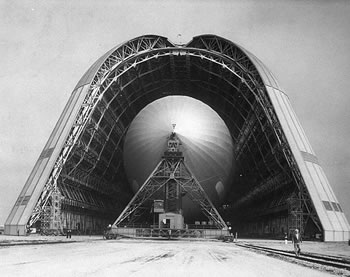
(USS Macon airship in hangar, 1935)
On September 17th of this year, Stanford engineers joined an expedition from the Monterey Bay Aquarium Research Institute (MBARI) to explore the wreck. Deep-diving remotely operated vehicles (ROVs) with cameras were used to take more than 14,000 pictures detailing the crash site, which is now spread over 75,000 square feet of ocean floor. Over the next few months, these images will be combined and color corrected to form a complete image of the wreckage of this unique aviation experiment.
Built by the Goodyear-Zeppelin company in the early thirties, the Macon and its sister ship the Akron were constructed with rigid hulls of aluminum alloy. The ships were kept aloft by 12 helium-filled cells inside the hull; 6.5 million cubic feet of helium were used. Each airship was 785 feet long with a special internal hangars located about two-thirds of the way behind the nose of the airship, housing five light Sparrowhawk aircraft.
The Macon and the Akron were able to launch and recover the planes using a T-shaped opening in the floor of the hangar. A welded metal "sky hook" was attached to the top of each plane; the hook attached the plane to a trapeze. The trapeze with its attached plane was lowered through the hangar floor. Pilots revved their engines, yanked a release lever, and dropped into the air.
The retrieval process was a bit trickier. Piolots had to match speed with the rigid airship, and guide the hook back onto the trapeze. The whole assembly was then lifted back into the body of the airship.
The airships used eight Maybach 560-horsepower gasoline reversible engines to drive outboard propellers; speeds of up to eighty miles per hour were possible.
The concept of a "flying aircraft carrier" still fascinates us. In the Sky Captain and the World of Tomorrow, a 2004 movie directed by Kerry Conran and starring Jude Law and Gwyneth Paltrow, the intrepid Sky Captain runs out of fuel in the middle of nowhere. Fortunately, a huge flying platform commanded by his friend Franky (played by Angelina Jolie) was in the area.
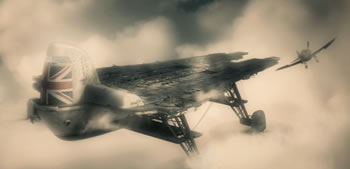
(Movie-style flying aircraft carrier with plane in foreground)
This improbably large craft had hundreds of crewmembers with dozens of aircraft; it was kept aloft by large downward-pointing rotors. This excellent film was shot almost entirely against a blue background; computer-generated graphics make enormous flying platforms possible in the movies, if not in real life.

(Movie-style flying aircraft carrier seen from below)
The photographic expedition by Stanford and MBARI will provide a fitting tribute and ending to the real-life airship Macon, whose great size and rumbling engines were a familiar part of life to students at Stanford in the early 'thirties.
Update 03-Jul-2022: Ed Earl Repp writing in Air Wonder Stories in 1929 describes an enormous air-freighter cargo plane in his short story The Invisible Raiders. End update.
Read more about the Stanford/MBARI expedition and the USS Macon
Scroll down for more stories in the same category. (Story submitted 10/19/2006)
Follow this kind of news @Technovelgy.| Email | RSS | Blog It | Stumble | del.icio.us | Digg | Reddit |
Would
you like to contribute a story tip?
It's easy:
Get the URL of the story, and the related sf author, and add
it here.
Comment/Join discussion ( 1 )
Related News Stories - (" Warfare ")
'Warrior Suit' Combat Exoskeleton Project Still Alive
'Suited up, you look like a big steel gorilla.'
Sea Drones Attack Russian Fleet
'...autofreighters, and other self-piloting craft.' - Ray Naylor, 2022.
Slaughterbot AI KIller Quadcopter Drones
'The real border was defended by... a swarm of quasi-independent aerostats.' - Neal Stephenson, 1995.
Russia Working On Military Exoskeletons
'...you look like a big steel gorilla...' - Robert Heinlein, 1959.
Technovelgy (that's tech-novel-gee!) is devoted to the creative science inventions and ideas of sf authors. Look for the Invention Category that interests you, the Glossary, the Invention Timeline, or see what's New.

Science Fiction
Timeline
1600-1899
1900-1939
1940's 1950's
1960's 1970's
1980's 1990's
2000's 2010's
Current News
'If Anyone Is Watching Earth...'
'Our study of your race has convinced us that you are not fitted to leave your planet in the present state of your civilization.'
Epirus High-Power Microwave Defeats Drones
'...the spreading beam of the deranging ray struck them, and Then one toppled and fell. Then another.'
Cloud Of Space Rubbish From China's Long March Rocket
'Within seconds the material was spread out over fifty yards, in a matter of hours it might occupy several cubic miles of space...'
Biomimetic Tendons From Rochu Robotics
'... the curious parallelism to animal motions.'
Living Human Neuron Biological Compute Rack
'The men are dead, but their acquired wisdom lives on and I am the beneficiary.'
Martha Stewart Approves Ojai 'Living Room On Wheels'
'Young people found the driverless car admirable for petting.'
ESA's Draco To Study Heat Of Reentry
'...a synthetic which air-friction would erode.'
Buy A Galaxy? Maybe Start Smaller
'The sky is the limit' just got higher.
The United States Space Academy Is Official
'Is our orbit to Space Academy clear?'
Is There A Global Problem With Who Is Having Children?
'After twenty generations of shillyshallying...'
You Will Eat The Cookies Made From Plastic...
'Our planes are going to start bringing in bales of discarded plastics...'
It's A Giant Robot! You Reporters Have Been Warned!
'... completely forgetting the ship at sight of the awesome figure and great head of the giant Gaut...'
Birds Learn To Sing Pictures ala Frank Herbert's Distrans
'We will fight in the time of fighting.'
ElectionSim: China's 'Ender's Game' Battle Sim, Or Lem's 'Kingdom In A Box'?
'So, Ender, we will now begin your education.'
Tactile Skin Supplier Map
'What strange sensitivity! What an amazing development of science was manifested in every move and act and word of this Robot!'
Flock Stymied By 'Adversarial Fashion'
'Forget the head atop it, the legs below, feet, arms, hands. It compels erasure.'

