
Science Fiction
Dictionary
A B C D E F G H I J K L M N O P Q R S T U V W X Y Z

 |
A-Lab The Autonomous Lab At Berkeley

The A-Lab is an autonomous, robotically controlled laboratory environment at the Department of Energy’s Lawrence Berkeley National Laboratory (Berkeley Lab).
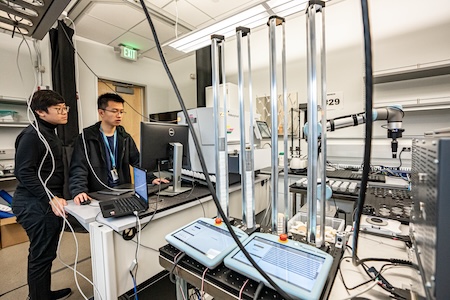
(Bernardus Rendy (left) and Yuxing Fei fine-tune the A-Lab components)
“We see this as a new way of doing research,” said Gerd Ceder, the principal investigator for A-Lab. In many ways, Ceder noted, lab research has been the same for the last 70 years: the equipment may have gotten better, but ultimately a person is needed to take measurements, analyze results, and decide what to do next.“The important thing is not working in parallel, but instead to iterate rapidly, the way scientists operate. We want the system to try something, analyze the data, and then decide what to do next to get closer to the goal.”
A-Lab is thought to be the first fully automated lab that uses inorganic powders as the starting ingredients. This “solid-state synthesis” is a more difficult task than automating processes that use liquids, which can be easily dispensed with pumps and valves. But the extra effort comes with a big payoff.
“Our solid-state synthesis is more realistic, can incorporate a wider variety of materials, and can make larger quantities of materials,” Ceder said. “You can produce quantities that are ready for application, not just science exploration. It’s ready to scale.”
The process works like this:
The first robot weighs and mixes different combinations of starting ingredients known as powder precursors. The robot can choose from nearly 200 precursors, including different metal oxides containing elements such as lithium, iron, copper, manganese, and nickel. After mixing the powders with solvent to evenly distribute them, the robot moves the slurry into crucibles.The next robotic arm loads the crucibles into furnaces that can reach 2200 degrees Fahrenheit and inject various mixtures of gases... The AI system determines what temperature the samples should bake at, and for how long.
After the robot removes the baked crucibles, it must extract the new material. An automated machine modeled on a gumball dispenser adds a ball bearing to the cup. Intense shaking grinds the new substance into a fine powder that the robot loads onto a slide.
The final robotic arm moves the samples into two automated machines for analysis. The X-ray diffractometer determines whether one or more new chemicals have been formed, and how much of the initial ingredients are left over. The automated electron microscope does further shape and chemical analysis. Both tools send their results back to the AI system.
Guided by artificial intelligence, the cycle adjusts and begins again.
(Cool videos here)
One of the early versions of a science-fictional automatic laboratory is presented by sf author Michael Moorcock in his 1964 story The Shores of Death:
OLONO SHAEVIS’s VAST network of laboratories impressed Clovis Marca. He had visited similar places on Earth but none so spectacular, none designed not simply for function but also for beauty. The complex underground building — built, he remembered, by the efforts of one man — was, in fact, a palace of incredible beauty. There were chambers in it which far outweighed the old cathedrals of Earth in their ability to transport the mind into realms other than the physical. They moved Clovis Marca deeply and he felt that no-one capable of creating such superb architecture could be evil.
(Read more about the automatic laboratory)
Scroll down for more stories in the same category. (Story submitted 12/25/2023)
Follow this kind of news @Technovelgy.| Email | RSS | Blog It | Stumble | del.icio.us | Digg | Reddit |
Would
you like to contribute a story tip?
It's easy:
Get the URL of the story, and the related sf author, and add
it here.
Comment/Join discussion ( 0 )
Related News Stories - (" Robotics ")
Epirus High-Power Microwave Defeats Drones
'...the spreading beam of the deranging ray struck them, and Then one toppled and fell. Then another.' - Ray Cummings, 1931.
It's A Giant Robot! You Reporters Have Been Warned!
'... completely forgetting the ship at sight of the awesome figure and great head of the giant Gaut...'
Tactile Skin Supplier Map
'What strange sensitivity! What an amazing development of science was manifested in every move and act and word of this Robot!' - Ray Cummings, 1931.
Robot Bees 3D Printed By Festo
'At first I was struck by the large size of these bees..' - Ernst Junger, 1957.
Technovelgy (that's tech-novel-gee!) is devoted to the creative science inventions and ideas of sf authors. Look for the Invention Category that interests you, the Glossary, the Invention Timeline, or see what's New.

Science Fiction
Timeline
1600-1899
1900-1939
1940's 1950's
1960's 1970's
1980's 1990's
2000's 2010's
Current News
'If Anyone Is Watching Earth...'
'Our study of your race has convinced us that you are not fitted to leave your planet in the present state of your civilization.'
Epirus High-Power Microwave Defeats Drones
'...the spreading beam of the deranging ray struck them, and Then one toppled and fell. Then another.'
Cloud Of Space Rubbish From China's Long March Rocket
'Within seconds the material was spread out over fifty yards, in a matter of hours it might occupy several cubic miles of space...'
Biomimetic Tendons From Rochu Robotics
'... the curious parallelism to animal motions.'
Living Human Neuron Biological Compute Rack
'The men are dead, but their acquired wisdom lives on and I am the beneficiary.'
Martha Stewart Approves Ojai 'Living Room On Wheels'
'Young people found the driverless car admirable for petting.'
ESA's Draco To Study Heat Of Reentry
'...a synthetic which air-friction would erode.'
Buy A Galaxy? Maybe Start Smaller
'The sky is the limit' just got higher.
The United States Space Academy Is Official
'Is our orbit to Space Academy clear?'
Is There A Global Problem With Who Is Having Children?
'After twenty generations of shillyshallying...'
You Will Eat The Cookies Made From Plastic...
'Our planes are going to start bringing in bales of discarded plastics...'
It's A Giant Robot! You Reporters Have Been Warned!
'... completely forgetting the ship at sight of the awesome figure and great head of the giant Gaut...'
Birds Learn To Sing Pictures ala Frank Herbert's Distrans
'We will fight in the time of fighting.'
ElectionSim: China's 'Ender's Game' Battle Sim, Or Lem's 'Kingdom In A Box'?
'So, Ender, we will now begin your education.'
Tactile Skin Supplier Map
'What strange sensitivity! What an amazing development of science was manifested in every move and act and word of this Robot!'
Flock Stymied By 'Adversarial Fashion'
'Forget the head atop it, the legs below, feet, arms, hands. It compels erasure.'

