
Science Fiction
Dictionary
A B C D E F G H I J K L M N O P Q R S T U V W X Y Z

 |
NASA Strategy For Urban Heat island NYC

Temperatures in New York City and other urban areas are typically warmer than in the surrounding countryside. A phenomenon called the urban heat island effect is the cause; air quality, public health and energy demand are all affected.
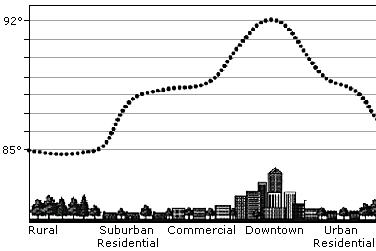
(Urban Heat Island Profile)
NASA researchers, using NASA satellite observations, weather pattern data and computer models, have recently assessed how well city officials, activists and community organizations are doing in reducing the effect in NYC. Their results were discussed during the 2006 American Meteorological Society’s annual meeting in Atlanta, Ga., which took place last week.
"We need to help public officials find the most successful ways to reduce the heat island effect in New York. With ever-increasing urban populations around the world, the heat island effect will become even more significant in the future," said Stuart Gaffin, an associate research scientist at Columbia University, New York, and a co-author of the new NASA study. "The summertime impacts are especially intense with the deterioration of air quality, because higher air temperatures increase ozone. That has health effects for everyone. We also run an increased risk of major heat waves and blackouts as the heat island effect raises demand for electricity."
(From ScienceBlog)
The heat island effect in cities is caused by the non-natural heat-absorbing materials used in enormous buildings, streets, sidewalks and other public works. According to the NASA study, the heat island effect in urban areas can be most effectively reduced with more green space (vegation offers moisture to cool the air). Also, light-colored surfaces can reflect sunlight, and should be used on rooftops.
As you know, science fiction writers often take a larger view of problems. For example, in his 1970 novel Ringworld, Larry Niven had to help an entire species, the Puppeteers, sentient herd animals whose vast cities and works covered their entire planet. What can you do for a species whose entire planet is a heat island?
"I had explained," said Nessus, "that our civilisation was dying in its own waste heat. Total conversion of energy had rid us of all waste products of civilisation, save that one. We had no choice but to move our world outward from its primary.""Was that not dangerous?"
"Very. There was much madness that year. For that reason it is famous in our history. But we had purchased a reactionless, inertialess drive from the Outsiders. You may have guessed their price. We are still paying in installments. We had moved two agricultural worlds; we had experimented with other, useless worlds of our system using the Outsider drive. In any case, we did it. We moved our world."
"In short, we found that a sun was a liability rather than an asset. We moved our world to a tenth of a light year's distance, keeping the primary only as an anchor...
(Read more about the Puppeteer Kemplerer Rosette)
Take a look at a couple of stories about solving Earth's warming conditions; Reduce Global Warming By Blocking Sunlight and Space Ring Latest Implausible Warming Solution. Read more about heat islands at ScienceBlog and NASA.
Scroll down for more stories in the same category. (Story submitted 2/9/2006)
Follow this kind of news @Technovelgy.| Email | RSS | Blog It | Stumble | del.icio.us | Digg | Reddit |
Would
you like to contribute a story tip?
It's easy:
Get the URL of the story, and the related sf author, and add
it here.
Comment/Join discussion ( 1 )
Related News Stories - (" Engineering ")
Biomimetic Tendons From Rochu Robotics
'... the curious parallelism to animal motions.' - HG Wells, 1898.
You Will Eat The Cookies Made From Plastic...
'Our planes are going to start bringing in bales of discarded plastics...' - Rick Shelley, 1989.
ICE Buys Shock Gloves Like Batman's
What else is the Caped Crusader using?
When Colds Threaten You Can't Do This - Or Can You?
'...a hemispherical force field enclosing his head.' - FL Wallace, 1955.
Technovelgy (that's tech-novel-gee!) is devoted to the creative science inventions and ideas of sf authors. Look for the Invention Category that interests you, the Glossary, the Invention Timeline, or see what's New.

Science Fiction
Timeline
1600-1899
1900-1939
1940's 1950's
1960's 1970's
1980's 1990's
2000's 2010's
Current News
'If Anyone Is Watching Earth...'
'Our study of your race has convinced us that you are not fitted to leave your planet in the present state of your civilization.'
Epirus High-Power Microwave Defeats Drones
'...the spreading beam of the deranging ray struck them, and Then one toppled and fell. Then another.'
Cloud Of Space Rubbish From China's Long March Rocket
'Within seconds the material was spread out over fifty yards, in a matter of hours it might occupy several cubic miles of space...'
Biomimetic Tendons From Rochu Robotics
'... the curious parallelism to animal motions.'
Living Human Neuron Biological Compute Rack
'The men are dead, but their acquired wisdom lives on and I am the beneficiary.'
Martha Stewart Approves Ojai 'Living Room On Wheels'
'Young people found the driverless car admirable for petting.'
ESA's Draco To Study Heat Of Reentry
'...a synthetic which air-friction would erode.'
Buy A Galaxy? Maybe Start Smaller
'The sky is the limit' just got higher.
The United States Space Academy Is Official
'Is our orbit to Space Academy clear?'
Is There A Global Problem With Who Is Having Children?
'After twenty generations of shillyshallying...'
You Will Eat The Cookies Made From Plastic...
'Our planes are going to start bringing in bales of discarded plastics...'
It's A Giant Robot! You Reporters Have Been Warned!
'... completely forgetting the ship at sight of the awesome figure and great head of the giant Gaut...'
Birds Learn To Sing Pictures ala Frank Herbert's Distrans
'We will fight in the time of fighting.'
ElectionSim: China's 'Ender's Game' Battle Sim, Or Lem's 'Kingdom In A Box'?
'So, Ender, we will now begin your education.'
Tactile Skin Supplier Map
'What strange sensitivity! What an amazing development of science was manifested in every move and act and word of this Robot!'
Flock Stymied By 'Adversarial Fashion'
'Forget the head atop it, the legs below, feet, arms, hands. It compels erasure.'

