
Science Fiction
Dictionary
A B C D E F G H I J K L M N O P Q R S T U V W X Y Z

 |
NanoTerminator Prevents Annoying Space Debris Build-Up

The nanoTerminator, recently released by TUI (Tethers Unlimited International), could help to prevent a rapidly growing problem in space - human-made debris from rockets and satellites. Although space is large (the volume of the known universe is about 1.9 x 10(33) cubic light years), space junk is a problem because it is concentrated right where we want to go - within a few hundred miles of the Earth's surface. Collisions with working spacecraft have already happened.
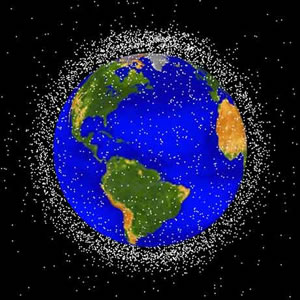
(NASA' actual space debris tracking)
These pieces of space debris range in size from flecks of paint and insulation to whole rocket stages and dead satellites. The greatest concentration of objects is found in the area between 550 miles and 625 miles above the Earth, above the orbits of the International Space Station and most shuttle flights. The US Space Surveillance Network tracks over 13,000 objects larger than ten centimeters.
The nanoTerminator™ is just 55 mm high and masses about 56 grams. It contains a 100-meter long space-survivable conducting tether and a simple spring-based deployment system. It can be integrated into a nanosat either externally or internally with an appropriate aperture for ejection. The module is designed to fit perfectly within the cylindrical ejection post of Ecliptic’s RocketPod CubeSat Plus.
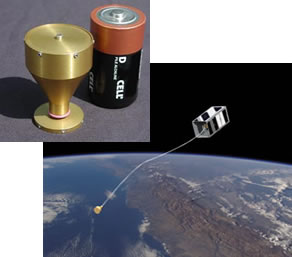
(nanoTerminator on Earth and deployed in space)
When the satellite reaches the end of its operational phase, a release mechanism deploys the tether. Gravity gradient forces will orient the tether along the local vertical; the conducting tether will drag against the geomagnetic field, rapidly lowering the orbit of the nanosatellite until it burns up in the upper atmosphere.
Science fiction authors have thought about this for a long time. Arthur C. Clarke wrote about Operation Cleanup, required before the space elevator in his 1978 novel The Fountains of Paradise could be built. Read more about the Clarke connection (and more about how tethers work) in an earlier story about the Terminator Tether - EDT Solution To Space Debris.
Makoto Yukimura began publishing Planetes in Japan in 1999; the first graphic novel form was published in 2000. Planetes follows the story of a team of debris cleaners charged with clearing space junk from space flight paths.
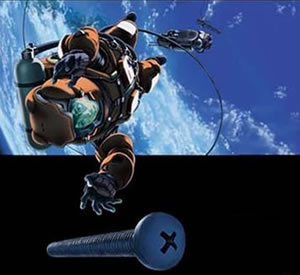
Planetes cover art
The journal Science just published a new study about space debris; it starts with the simplifying assumption that no rocket bodies or spacecraft will be launched for the next two hundred years. Based on the data, it looks like new fragments from collisions will replace the population of objects that fall out of orbit and back to Earth. Beyond 2055, fragments from new collisions will actually cause the debris population to grow. We may need both nanoTerminators and space debris teams to clean up this problem.
Read Space Junk Cleanup and Space debris a growing problem; thanks to Fred Kiesche for writing in with the story and manga references.
Scroll down for more stories in the same category. (Story submitted 1/25/2006)
Follow this kind of news @Technovelgy.| Email | RSS | Blog It | Stumble | del.icio.us | Digg | Reddit |
Would
you like to contribute a story tip?
It's easy:
Get the URL of the story, and the related sf author, and add
it here.
Comment/Join discussion ( 2 )
Related News Stories - (" Space Tech ")
'If Anyone Is Watching Earth...'
'Our study of your race has convinced us that you are not fitted to leave your planet in the present state of your civilization.' - Arthur C. Clarke, 1946.
Cloud Of Space Rubbish From China's Long March Rocket
'Within seconds the material was spread out over fifty yards, in a matter of hours it might occupy several cubic miles of space...'
ESA's Draco To Study Heat Of Reentry
'...a synthetic which air-friction would erode.' - EE Doc Smith, 1934.
The United States Space Academy Is Official
'Is our orbit to Space Academy clear?' - Carey Rockwell
Technovelgy (that's tech-novel-gee!) is devoted to the creative science inventions and ideas of sf authors. Look for the Invention Category that interests you, the Glossary, the Invention Timeline, or see what's New.

Science Fiction
Timeline
1600-1899
1900-1939
1940's 1950's
1960's 1970's
1980's 1990's
2000's 2010's
Current News
'If Anyone Is Watching Earth...'
'Our study of your race has convinced us that you are not fitted to leave your planet in the present state of your civilization.'
Epirus High-Power Microwave Defeats Drones
'...the spreading beam of the deranging ray struck them, and Then one toppled and fell. Then another.'
Cloud Of Space Rubbish From China's Long March Rocket
'Within seconds the material was spread out over fifty yards, in a matter of hours it might occupy several cubic miles of space...'
Biomimetic Tendons From Rochu Robotics
'... the curious parallelism to animal motions.'
Living Human Neuron Biological Compute Rack
'The men are dead, but their acquired wisdom lives on and I am the beneficiary.'
Martha Stewart Approves Ojai 'Living Room On Wheels'
'Young people found the driverless car admirable for petting.'
ESA's Draco To Study Heat Of Reentry
'...a synthetic which air-friction would erode.'
Buy A Galaxy? Maybe Start Smaller
'The sky is the limit' just got higher.
The United States Space Academy Is Official
'Is our orbit to Space Academy clear?'
Is There A Global Problem With Who Is Having Children?
'After twenty generations of shillyshallying...'
You Will Eat The Cookies Made From Plastic...
'Our planes are going to start bringing in bales of discarded plastics...'
It's A Giant Robot! You Reporters Have Been Warned!
'... completely forgetting the ship at sight of the awesome figure and great head of the giant Gaut...'
Birds Learn To Sing Pictures ala Frank Herbert's Distrans
'We will fight in the time of fighting.'
ElectionSim: China's 'Ender's Game' Battle Sim, Or Lem's 'Kingdom In A Box'?
'So, Ender, we will now begin your education.'
Tactile Skin Supplier Map
'What strange sensitivity! What an amazing development of science was manifested in every move and act and word of this Robot!'
Flock Stymied By 'Adversarial Fashion'
'Forget the head atop it, the legs below, feet, arms, hands. It compels erasure.'

