
Science Fiction
Dictionary
A B C D E F G H I J K L M N O P Q R S T U V W X Y Z

 |
Is 'The Pulsar Positioning System' Evidence For SETI?

Clément Vidal, author of a new paper about astrophysics and the search for extraterrestrial intelligence, poses an interesting question about pulsars:
In the view of the author, pulsars could not only be used as a navigation system but are also sufficiently good clocks that they could be used to synchronize the work of a civilization.
To emphasize the significance of this research program, imagine that we would find around Mars’ orbit well-distributed timekeeping devices with a precision comparable to atomic clocks, beaming timing information that can be used as a “Mars Positioning System”, just like GPS. Wouldn’t we be compelled to explore the hypothesis that extraterrestrial intelligence is at play? This is exactly the current situation with millisecond pulsars, but on a galactic scale.
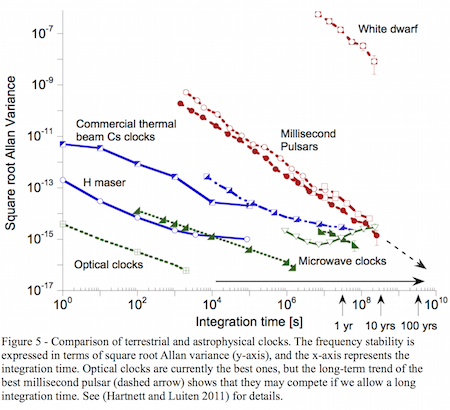
(Astrophysical vs. Terrestrial clocks)
First, all pulsars could be perfectly natural, but we can reasonably expect that civilizations in the galaxy will use them as standards (section 6). By studying and using XNAV, we are also getting potentially ready to receive and send messages to extraterrestrial intelligence in a galactically meaningful way. From now on, we might be able to decipher a first level of timing and positioning metadata in any galactic communication. We made a first risk-benefit analysis of asking permission to use PPS, but this largely remains to be debated.Second, what remains uncertain is whether the pulsar positioning system is natural or artificial. We put forward the SETI-XNAV quest to answer this issue. It draws on pulsar astronomy, and navigation and positioning science to make SETI predictions. This concrete project is grounded in a universal problem and need: navigation. Decades of pulsar empirical data is available, and I have proposed 9 lines of inquiry to start the endeavor (section 5). These include predictions regarding the spatial and power distribution of pulsars in the galaxy, their population, their evolutionary tracks, possible synchronization between pulsars, testing the navigability near the speed of light, decoding galactic coordinates, testing various directed panspermia hypotheses, as well as decoding metadata or more information in pulsar’s pulses.
As far as I know, the earliest reference to this idea is in George O. Smith's 1952 story Troubled Star; he described a space beacon.
In his paper, Vidal states that by observing three or more pulsars, a position can be determined.
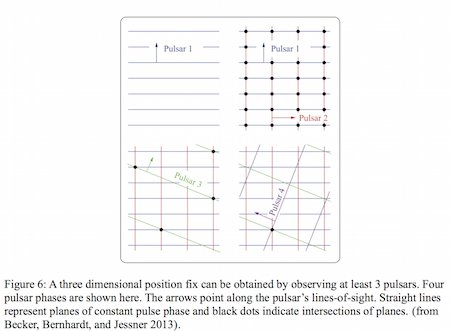
(A fix requires at least 3 pulsars)
In his 1959 short story The Repairman, Harry Harrison wrote about automated hyperspace beacons placed at ideal locations on lonely planets, as well as the number of beacons needed to determine one's position in the galaxy:
The first ships to enter hyperspace had no place to go - and no way to tell if they had even moved. The beacons solved that problem and opened up the entire universe. They are built on planets and generate tremendous amounts of power...For a hyperspace jump, you need at least four beacons for an accurate fix. For long jumps, navigators use up to seven or eight. So every beacon is important and every one has to keep operating...
(Read more about Harry Harrison's hyperspace beacons)
Via Pulsar Positioning System: A quest for evidence of extraterrestrial engineering. Thanks to Winchell Chung (@nyrath) and Adam Crowl (@qraal)
Scroll down for more stories in the same category. (Story submitted 3/30/2017)
Follow this kind of news @Technovelgy.| Email | RSS | Blog It | Stumble | del.icio.us | Digg | Reddit |
Would
you like to contribute a story tip?
It's easy:
Get the URL of the story, and the related sf author, and add
it here.
Comment/Join discussion ( 0 )
Related News Stories - (" Space Tech ")
'If Anyone Is Watching Earth...'
'Our study of your race has convinced us that you are not fitted to leave your planet in the present state of your civilization.' - Arthur C. Clarke, 1946.
Cloud Of Space Rubbish From China's Long March Rocket
'Within seconds the material was spread out over fifty yards, in a matter of hours it might occupy several cubic miles of space...'
ESA's Draco To Study Heat Of Reentry
'...a synthetic which air-friction would erode.' - EE Doc Smith, 1934.
The United States Space Academy Is Official
'Is our orbit to Space Academy clear?' - Carey Rockwell
Technovelgy (that's tech-novel-gee!) is devoted to the creative science inventions and ideas of sf authors. Look for the Invention Category that interests you, the Glossary, the Invention Timeline, or see what's New.

Science Fiction
Timeline
1600-1899
1900-1939
1940's 1950's
1960's 1970's
1980's 1990's
2000's 2010's
Current News
'If Anyone Is Watching Earth...'
'Our study of your race has convinced us that you are not fitted to leave your planet in the present state of your civilization.'
Epirus High-Power Microwave Defeats Drones
'...the spreading beam of the deranging ray struck them, and Then one toppled and fell. Then another.'
Cloud Of Space Rubbish From China's Long March Rocket
'Within seconds the material was spread out over fifty yards, in a matter of hours it might occupy several cubic miles of space...'
Biomimetic Tendons From Rochu Robotics
'... the curious parallelism to animal motions.'
Living Human Neuron Biological Compute Rack
'The men are dead, but their acquired wisdom lives on and I am the beneficiary.'
Martha Stewart Approves Ojai 'Living Room On Wheels'
'Young people found the driverless car admirable for petting.'
ESA's Draco To Study Heat Of Reentry
'...a synthetic which air-friction would erode.'
Buy A Galaxy? Maybe Start Smaller
'The sky is the limit' just got higher.
The United States Space Academy Is Official
'Is our orbit to Space Academy clear?'
Is There A Global Problem With Who Is Having Children?
'After twenty generations of shillyshallying...'
You Will Eat The Cookies Made From Plastic...
'Our planes are going to start bringing in bales of discarded plastics...'
It's A Giant Robot! You Reporters Have Been Warned!
'... completely forgetting the ship at sight of the awesome figure and great head of the giant Gaut...'
Birds Learn To Sing Pictures ala Frank Herbert's Distrans
'We will fight in the time of fighting.'
ElectionSim: China's 'Ender's Game' Battle Sim, Or Lem's 'Kingdom In A Box'?
'So, Ender, we will now begin your education.'
Tactile Skin Supplier Map
'What strange sensitivity! What an amazing development of science was manifested in every move and act and word of this Robot!'
Flock Stymied By 'Adversarial Fashion'
'Forget the head atop it, the legs below, feet, arms, hands. It compels erasure.'

