
Science Fiction
Dictionary
A B C D E F G H I J K L M N O P Q R S T U V W X Y Z

 |
AESA Radars Used As 'Death Ray' Weapons?

According to Aviation Week, the Pentagon is now developing active electronically scanned array (AESA) radars that could be used as weapons. A bizarre historical twist to this story is that in 1934, a rumor was started to the effect that Nazi Germany had developed a death ray based on radar. Physicist Robert Watson-Watt was asked to check on the feasibility of such a weapon. He quickly determined that it was unlikely, but that using radio waves to locate incoming bombers might be a real possibility. By 1937, three stations were ready, with more to come; this was a key element in winning the Battle of Britain during WWII.
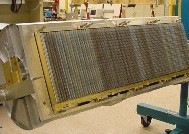
(AESA radar)
Now it appears that AESA radars may have a weapons component. AESA radars are comprised of many small transmit/receive modules that each scan a fixed area; the antenna does not need to move to scan an area. They have an extremely fast scanning rate, higher range, multiple target engagement and can act as a jamming device.
Some of the airborne AESA radars... use thousands of small transmitters/receivers, each a couple of inches square, that allow the array to conduct many tasks simultaneously. Those include detection of small, even stealthy targets, tracking and communications... and "jamming"... Possible AESA techniques for attacking another radar could include burning through the target radar's antenna side-lobes, filter side-lobes, or other known features of the target system. Radar specialists suggest it is reasonable to suppose this capability is already available to some fielded systems...[Airborne radar weapon development] appear[s] to be focused on cruise missiles and self-defense against anti-radiation, home-on-jam and air-to-air missiles. The radars seem particularly effective against the latter categories because energy available to focus on the approaching missile increases as an inverse square as distance decreases.
High Power Microwaves (HPM) are also in the process of development as weapons. HPMs generate very short bursts of energy across a wider range of frequencies, while AESA produces longer, more directed bursts of energy:
While HPM produces higher peak power, AESA often generates greater average power. That produces different operational and targeting strategies. For example, Raytheon's [HPM-based] airport protection system uses infrared sensors to find the target and determine where to focus its beam. It also produces effects at longer range, possibly as much as 100 mi., because it produces powerful pulses of energy. AESA radar has the built-in ability to find and track a target, so it can be held on the target for the necessary additional microseconds needed to create its weapons effect.
It was a British writer, H.G. Wells, who first suggested the general idea of "death rays" - namely, the heat ray in his 1898 novel War of the Worlds. The idea for radar was suggested at a very early date by science fiction writer Hugo Gernsback - he called it an actinoscope in his remarkable 1911 story Ralph 124c 41 +:
A pulsating polarized ether wave, if directed on a metal object can be reflected in the same manner as a light ray is reflected from a bright surface… By manipulating the entire apparatus like a searchlight, waves would be sent over a large area.
(Read more about Hugo Gernsback's actinoscope)
Update 22-Mar-2020: As far as I know, the earliest use of the term "death ray" can be found in the 1903 novel The World Masters by George Griffith; see the entry for death-ray. End update.
If you are interested in energy beam weapons, take a look at the MTHEL - Mobile Tactical High Energy Laser under development by the US Army. Read more about the 'death ray' story at Military.com; thanks to an alert reader for suggesting this story. The original story in Aviation Week requires paid registration, unfortunately.
Scroll down for more stories in the same category. (Story submitted 10/14/2005)
Follow this kind of news @Technovelgy.| Email | RSS | Blog It | Stumble | del.icio.us | Digg | Reddit |
Would
you like to contribute a story tip?
It's easy:
Get the URL of the story, and the related sf author, and add
it here.
Comment/Join discussion ( 2 )
Related News Stories - (" Weapon ")
Sleeper Drones Lie in Wait
'Wandering mines, you took them out on the edge of the desert, set them down and activated them.' - Maureen F. McHugh, 1994.
Worm Disrupts Physics Simulations Undetected For A Decade
'It diverts integers of the data, the fundamental message-units, so that they no longer agree.' - Philip K. Dick, 1965.
Moscow Attacked By Hundreds Of Drones
'It hurtled on down with inconceivable speed until it was visible as thousands of tiny robot planes...' - Hal K. Wells, 1942.
China's Handheld Electromagnetic Gun
'Completely silent, accurate up to about twenty meters. No recoil...' - Richard Morgan, 2003.
Technovelgy (that's tech-novel-gee!) is devoted to the creative science inventions and ideas of sf authors. Look for the Invention Category that interests you, the Glossary, the Invention Timeline, or see what's New.

Science Fiction
Timeline
1600-1899
1900-1939
1940's 1950's
1960's 1970's
1980's 1990's
2000's 2010's
Current News
'If Anyone Is Watching Earth...'
'Our study of your race has convinced us that you are not fitted to leave your planet in the present state of your civilization.'
Epirus High-Power Microwave Defeats Drones
'...the spreading beam of the deranging ray struck them, and Then one toppled and fell. Then another.'
Cloud Of Space Rubbish From China's Long March Rocket
'Within seconds the material was spread out over fifty yards, in a matter of hours it might occupy several cubic miles of space...'
Biomimetic Tendons From Rochu Robotics
'... the curious parallelism to animal motions.'
Living Human Neuron Biological Compute Rack
'The men are dead, but their acquired wisdom lives on and I am the beneficiary.'
Martha Stewart Approves Ojai 'Living Room On Wheels'
'Young people found the driverless car admirable for petting.'
ESA's Draco To Study Heat Of Reentry
'...a synthetic which air-friction would erode.'
Buy A Galaxy? Maybe Start Smaller
'The sky is the limit' just got higher.
The United States Space Academy Is Official
'Is our orbit to Space Academy clear?'
Is There A Global Problem With Who Is Having Children?
'After twenty generations of shillyshallying...'
You Will Eat The Cookies Made From Plastic...
'Our planes are going to start bringing in bales of discarded plastics...'
It's A Giant Robot! You Reporters Have Been Warned!
'... completely forgetting the ship at sight of the awesome figure and great head of the giant Gaut...'
Birds Learn To Sing Pictures ala Frank Herbert's Distrans
'We will fight in the time of fighting.'
ElectionSim: China's 'Ender's Game' Battle Sim, Or Lem's 'Kingdom In A Box'?
'So, Ender, we will now begin your education.'
Tactile Skin Supplier Map
'What strange sensitivity! What an amazing development of science was manifested in every move and act and word of this Robot!'
Flock Stymied By 'Adversarial Fashion'
'Forget the head atop it, the legs below, feet, arms, hands. It compels erasure.'

