
Science Fiction
Dictionary
A B C D E F G H I J K L M N O P Q R S T U V W X Y Z

 |
Martian Concrete, Rich In Sulphur, Made After Arrival

Once on the Red Planet, human explorers will need a base of operations. Rather than bring building materials all the way from Earth, it makes much more sense to make them on site.
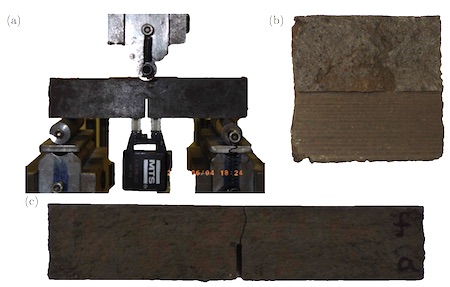
(Martian Concrete)
a, Three point bending setup;
b, fracture surface;
c, typical cracks after bending test.
A significant step in space exploration during the 21st century will be human settlement on Mars. Instead of transporting all the construction materials from Earth to the red planet with incredibly high cost, using Martian soil to construct a site on Mars is a superior choice.Knowing that Mars has long been considered a "sulfur-rich planet", a new construction material composed of simulated Martian soil and molten sulfur is developed. In addition to the raw material availability for producing sulfur concrete, while its strength reaches similar levels to conventional cementitious concrete, fast curing, low temperature sustainability, acid and salt environment resistance, 100% recyclability are appealing superior characteristics of the developed Martian Concrete.
In this study, different percentages of sulfur are investigated to obtain the optimal mixing proportions. Three point bending, unconfined compression and splitting tests were conducted to determine strength development, strength variability, and failure mechanisms. The test results are compared with sulfur concrete utilizing regular sand. It is observed that the particle size distribution plays a significant role in the mixture's final strength.
Furthermore, since Martian soil is metal rich, sulfates and, potentially, polysulfates are also formed during high temperature mixing, which contribute to the high strength. The optimal mix developed as Martian Concrete has an unconfined compressive strength of above 50 MPa, which corresponds to a roughly 150 MPa concrete on Mars due to the difference in gravity between Mars and Earth.
The formulated Martian Concrete is then simulated by the Lattice Discrete Particle Model (LDPM), which exhibits excellent ability in modeling the material response under various loading conditions.
Science fiction readers are already familiar with the idea of making what you need once you arrive on a new planet. In his 1951 novel The Moon is Hell, John W. Campbell wrote about marooned members of the second lunar expedition surviving by manufacturing solar cells using lunar materials.
"We have been mining steadily, and making some photocells... Another bank of photocells built, and set up. Our clockwork that keeps the cells facing the sun is overloaded. Rice to the rescue - with an electric torque amplifier...
More recently, William Gibson wrote about lunar concrete for use, not on the Moon itself, but in Earth orbit, in his 1988 novel Mona Lisa Overdrive:
Tessier-Ashpool ascended to high orbit's archipelago... And here they began to build... Ashpool borrowed heavily and the wall of lunar concrete that would be Freeside grew and curved, enclosing its creators.
From A Novel Material for In Situ Construction on Mars: Experiments and Numerical Simulations via the always excellent BLDGBLOG (haven't seen you in a while!).
Scroll down for more stories in the same category. (Story submitted 1/8/2016)
Follow this kind of news @Technovelgy.| Email | RSS | Blog It | Stumble | del.icio.us | Digg | Reddit |
Would
you like to contribute a story tip?
It's easy:
Get the URL of the story, and the related sf author, and add
it here.
Comment/Join discussion ( 0 )
Related News Stories - (" Space Tech ")
'If Anyone Is Watching Earth...'
'Our study of your race has convinced us that you are not fitted to leave your planet in the present state of your civilization.' - Arthur C. Clarke, 1946.
Cloud Of Space Rubbish From China's Long March Rocket
'Within seconds the material was spread out over fifty yards, in a matter of hours it might occupy several cubic miles of space...'
ESA's Draco To Study Heat Of Reentry
'...a synthetic which air-friction would erode.' - EE Doc Smith, 1934.
The United States Space Academy Is Official
'Is our orbit to Space Academy clear?' - Carey Rockwell
Technovelgy (that's tech-novel-gee!) is devoted to the creative science inventions and ideas of sf authors. Look for the Invention Category that interests you, the Glossary, the Invention Timeline, or see what's New.

Science Fiction
Timeline
1600-1899
1900-1939
1940's 1950's
1960's 1970's
1980's 1990's
2000's 2010's
Current News
'If Anyone Is Watching Earth...'
'Our study of your race has convinced us that you are not fitted to leave your planet in the present state of your civilization.'
Epirus High-Power Microwave Defeats Drones
'...the spreading beam of the deranging ray struck them, and Then one toppled and fell. Then another.'
Cloud Of Space Rubbish From China's Long March Rocket
'Within seconds the material was spread out over fifty yards, in a matter of hours it might occupy several cubic miles of space...'
Biomimetic Tendons From Rochu Robotics
'... the curious parallelism to animal motions.'
Living Human Neuron Biological Compute Rack
'The men are dead, but their acquired wisdom lives on and I am the beneficiary.'
Martha Stewart Approves Ojai 'Living Room On Wheels'
'Young people found the driverless car admirable for petting.'
ESA's Draco To Study Heat Of Reentry
'...a synthetic which air-friction would erode.'
Buy A Galaxy? Maybe Start Smaller
'The sky is the limit' just got higher.
The United States Space Academy Is Official
'Is our orbit to Space Academy clear?'
Is There A Global Problem With Who Is Having Children?
'After twenty generations of shillyshallying...'
You Will Eat The Cookies Made From Plastic...
'Our planes are going to start bringing in bales of discarded plastics...'
It's A Giant Robot! You Reporters Have Been Warned!
'... completely forgetting the ship at sight of the awesome figure and great head of the giant Gaut...'
Birds Learn To Sing Pictures ala Frank Herbert's Distrans
'We will fight in the time of fighting.'
ElectionSim: China's 'Ender's Game' Battle Sim, Or Lem's 'Kingdom In A Box'?
'So, Ender, we will now begin your education.'
Tactile Skin Supplier Map
'What strange sensitivity! What an amazing development of science was manifested in every move and act and word of this Robot!'
Flock Stymied By 'Adversarial Fashion'
'Forget the head atop it, the legs below, feet, arms, hands. It compels erasure.'

