
Science Fiction
Dictionary
A B C D E F G H I J K L M N O P Q R S T U V W X Y Z

 |
Carbon Nanotube Ribbon For Space Elevator

Carbon nanotube ribbons created in a University of Texas laboratory may stretch all the way into space. According to research to be published in Science today, Dr. Mei Zhang and his team have succeeded in creating yard-long ribbons of carbon nanotubes - just the sort of ultra-light, ultra-strong filaments needed to create the space elevator (among many other things).
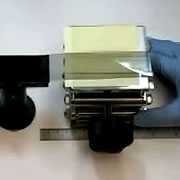
(From Carbon Nanotube Ribbon)
The researchers started with a "forest" of nanotubes about 300 micrometres long, held together by van der Waals forces. They used the glue from a post-it note to tug at right angles at the nanotubes on the outside of the forest (see graphic below).
Still held together by van der Waals forces, the nanotubes were spun out into a metre-long strip no more than 10 micrometers thick. "When you pull on one, it actually pulls the others but it has to rotate," says researcher Ken Atkinson. Using this method the researchers produced the nanotube ribbon at a rate of 7 metres per minute, about three times slower than the rate for commercial wool spinning at 20 metres per minute.
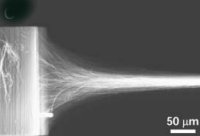
(From Carbon Nanotube Ribbon Spun from Vertical Forest of Nanotubes)
The researchers then laid the nanotube ribbon on a piece of glass and soaked it in ethanol. This caused the nanotubes to line up more closely with each other making a transparent ribbon just 50 nanometres thick. Sheets more than a meter long, about two inches wide, and less than one-thousandth the width of a human hair thick can be pulled in less than a minute, by hand in the lab.
In his 1978 novel The Fountains of Paradise, Arthur C. Clarke writes about the enabling technology for a space elevator - the one-dimensional diamond (carbon) crystal:
"So you do have an invisible wire. Clever - but what use is it, except for parlour tricks?""I can't blame you for jumping to that conclusion. But it's quite wrong. The reason you can't see this sample is that it's only a few microns thick. Much thinner than a spider's web."
"...What is it?"
"The result of two hundred years of solid-state physics. For whatever good that does, it is a continuous pseudo-one dimensional diamond crystal - though it's not actually pure carbon. There are several trace elements in carefully controlled amounts. It can be mass-produced only in the orbiting factories, where there's no gravity to interfere with the growth process."
"Fascinating ... I can appreciate that this may have all sorts of technical applications. It would make a splendid cheese cutter."
(Read more about the One-dimensional Diamond Crystal)
A space elevator is essentially a long cable that is anchored on Earth at one end - and "anchored" at the other end 35,000 kilometers away by a satellite in geosynchronous orbit. Gravity and centripetal acceleration keeps the cable taut; a small elevator, or car, can crawl up the elevator at a fraction of the energy expenditure needed to actually hurl an object into orbit. Putting a satellite in orbit could cost hundreds of dollars per pound, rather than $7,000 per pound as it does on the space shuttle.
Read more at Little creation, big step and Space elevator comes closer to reality.
Scroll down for more stories in the same category. (Story submitted 8/19/2005)
Follow this kind of news @Technovelgy.| Email | RSS | Blog It | Stumble | del.icio.us | Digg | Reddit |
Would
you like to contribute a story tip?
It's easy:
Get the URL of the story, and the related sf author, and add
it here.
Comment/Join discussion ( 31 )
Related News Stories - (" Space Tech ")
'If Anyone Is Watching Earth...'
'Our study of your race has convinced us that you are not fitted to leave your planet in the present state of your civilization.' - Arthur C. Clarke, 1946.
Cloud Of Space Rubbish From China's Long March Rocket
'Within seconds the material was spread out over fifty yards, in a matter of hours it might occupy several cubic miles of space...'
ESA's Draco To Study Heat Of Reentry
'...a synthetic which air-friction would erode.' - EE Doc Smith, 1934.
The United States Space Academy Is Official
'Is our orbit to Space Academy clear?' - Carey Rockwell
Technovelgy (that's tech-novel-gee!) is devoted to the creative science inventions and ideas of sf authors. Look for the Invention Category that interests you, the Glossary, the Invention Timeline, or see what's New.

Science Fiction
Timeline
1600-1899
1900-1939
1940's 1950's
1960's 1970's
1980's 1990's
2000's 2010's
Current News
'If Anyone Is Watching Earth...'
'Our study of your race has convinced us that you are not fitted to leave your planet in the present state of your civilization.'
Epirus High-Power Microwave Defeats Drones
'...the spreading beam of the deranging ray struck them, and Then one toppled and fell. Then another.'
Cloud Of Space Rubbish From China's Long March Rocket
'Within seconds the material was spread out over fifty yards, in a matter of hours it might occupy several cubic miles of space...'
Biomimetic Tendons From Rochu Robotics
'... the curious parallelism to animal motions.'
Living Human Neuron Biological Compute Rack
'The men are dead, but their acquired wisdom lives on and I am the beneficiary.'
Martha Stewart Approves Ojai 'Living Room On Wheels'
'Young people found the driverless car admirable for petting.'
ESA's Draco To Study Heat Of Reentry
'...a synthetic which air-friction would erode.'
Buy A Galaxy? Maybe Start Smaller
'The sky is the limit' just got higher.
The United States Space Academy Is Official
'Is our orbit to Space Academy clear?'
Is There A Global Problem With Who Is Having Children?
'After twenty generations of shillyshallying...'
You Will Eat The Cookies Made From Plastic...
'Our planes are going to start bringing in bales of discarded plastics...'
It's A Giant Robot! You Reporters Have Been Warned!
'... completely forgetting the ship at sight of the awesome figure and great head of the giant Gaut...'
Birds Learn To Sing Pictures ala Frank Herbert's Distrans
'We will fight in the time of fighting.'
ElectionSim: China's 'Ender's Game' Battle Sim, Or Lem's 'Kingdom In A Box'?
'So, Ender, we will now begin your education.'
Tactile Skin Supplier Map
'What strange sensitivity! What an amazing development of science was manifested in every move and act and word of this Robot!'
Flock Stymied By 'Adversarial Fashion'
'Forget the head atop it, the legs below, feet, arms, hands. It compels erasure.'

