
Science Fiction
Dictionary
A B C D E F G H I J K L M N O P Q R S T U V W X Y Z

 |
Robot Fabricates Endless Tools For Itself (Updated)

I'm sure this has happened to you. You planned, you reviewed, you thought outside the box, but as soon as your robot gets to Mars and starts poking into things, you realize that the perfect tool ... is sitting back in the shop on Earth. What do you do?
Well, if you're Luzius Brodbeck of the Bio-Inspired Robotics Lab at the Swiss Federal Institute of Technology, you made a robot that can fabricate its own tools on the spot! So no problem. Now, the video.
(Robot fabricates its own tools video)
Unlike a similar robot that can adapt its body shape using sprayable foam [see Spray-Foam Robot Built By... Another Robot], Brodbeck's robot constructs intricate tools. In the video above, for example, the robot makes itself a small scoop and then uses it to move water from one bowl to another.The robots construct these new parts using hot-melt adhesive - a substance that can be switched repeatedly between liquid and solid states by controlling its temperature. Highly adhesive and pliable when heated, the material solidifies and forms strong bonds when cooled.
This raw material can be used to form new tools by itself or used to glue larger parts together - including new sensors or motors. The team have also demonstrated the fabrication of movable grippers. The work is presented at the International Conference on Intelligent Robots and Systems in Vilamoura, Portugal, next week.
I can't think of an exact match for this idea, but readers might have thought of this spider robot from Charles Sheffield's 1979 novel The Web Between the Worlds which extrudes building materials from its own body:
As Rob watched, the great, faceted eyes turned towards him. The Spiders were aware of his presence. Somewhere deep in their organic components lurked a hint of consciousness.Corrie had been fascinated by them from the first moment she saw one. "Why eight legs?" she had asked.
Rob had shrugged. "It extrudes material like a spider. How many legs would you have given it?
Update: Reader Nic Creznic points out that the ExoComps from Star Trek: The Next Generation had onboard "mini-replicators" to generate tools to meet unique circumstances:
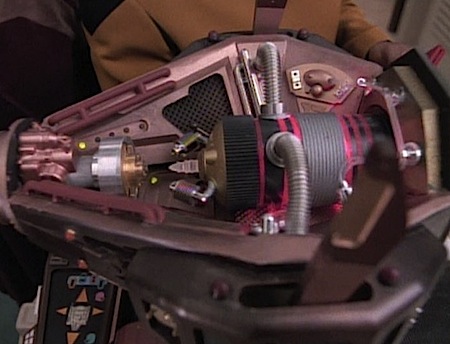
(Exocomp)
The exocomp consisted of a micro-replicator, a boridium power converter and axionic chip network. This axionic network gave the exocomp formidable computational power. The micro-replicator not only created tools which the exocomp could use to solve problems but also created new circuit pathways in the exocomps memory when it performed new tasks. This mechanism gave the exocomp the ability to learn. The more tasks it had to perform, the more pathways were formed in its memory.
End update.
Fans of the Terrahawks! might be thinking of the Cubes, which could work together to create unique shapes to solve problems. in one episode they club together to form a forcefield trapping Hudson, Kate and Dr Ninestein, and in another episode they join together to create a powerful cannon attack.
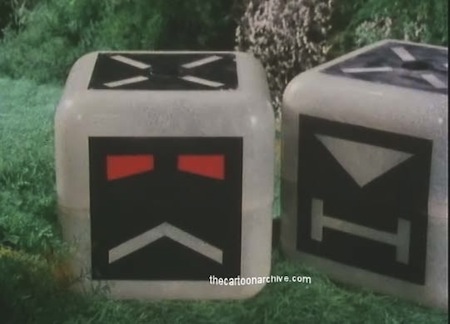
(The Cubes from Terrahawks!)
Via New Scientist.
Scroll down for more stories in the same category. (Story submitted 10/4/2012)
Follow this kind of news @Technovelgy.| Email | RSS | Blog It | Stumble | del.icio.us | Digg | Reddit |
Would
you like to contribute a story tip?
It's easy:
Get the URL of the story, and the related sf author, and add
it here.
Comment/Join discussion ( 0 )
Related News Stories - (" Robotics ")
Epirus High-Power Microwave Defeats Drones
'...the spreading beam of the deranging ray struck them, and Then one toppled and fell. Then another.' - Ray Cummings, 1931.
It's A Giant Robot! You Reporters Have Been Warned!
'... completely forgetting the ship at sight of the awesome figure and great head of the giant Gaut...'
Tactile Skin Supplier Map
'What strange sensitivity! What an amazing development of science was manifested in every move and act and word of this Robot!' - Ray Cummings, 1931.
Robot Bees 3D Printed By Festo
'At first I was struck by the large size of these bees..' - Ernst Junger, 1957.
Technovelgy (that's tech-novel-gee!) is devoted to the creative science inventions and ideas of sf authors. Look for the Invention Category that interests you, the Glossary, the Invention Timeline, or see what's New.

Science Fiction
Timeline
1600-1899
1900-1939
1940's 1950's
1960's 1970's
1980's 1990's
2000's 2010's
Current News
'If Anyone Is Watching Earth...'
'Our study of your race has convinced us that you are not fitted to leave your planet in the present state of your civilization.'
Epirus High-Power Microwave Defeats Drones
'...the spreading beam of the deranging ray struck them, and Then one toppled and fell. Then another.'
Cloud Of Space Rubbish From China's Long March Rocket
'Within seconds the material was spread out over fifty yards, in a matter of hours it might occupy several cubic miles of space...'
Biomimetic Tendons From Rochu Robotics
'... the curious parallelism to animal motions.'
Living Human Neuron Biological Compute Rack
'The men are dead, but their acquired wisdom lives on and I am the beneficiary.'
Martha Stewart Approves Ojai 'Living Room On Wheels'
'Young people found the driverless car admirable for petting.'
ESA's Draco To Study Heat Of Reentry
'...a synthetic which air-friction would erode.'
Buy A Galaxy? Maybe Start Smaller
'The sky is the limit' just got higher.
The United States Space Academy Is Official
'Is our orbit to Space Academy clear?'
Is There A Global Problem With Who Is Having Children?
'After twenty generations of shillyshallying...'
You Will Eat The Cookies Made From Plastic...
'Our planes are going to start bringing in bales of discarded plastics...'
It's A Giant Robot! You Reporters Have Been Warned!
'... completely forgetting the ship at sight of the awesome figure and great head of the giant Gaut...'
Birds Learn To Sing Pictures ala Frank Herbert's Distrans
'We will fight in the time of fighting.'
ElectionSim: China's 'Ender's Game' Battle Sim, Or Lem's 'Kingdom In A Box'?
'So, Ender, we will now begin your education.'
Tactile Skin Supplier Map
'What strange sensitivity! What an amazing development of science was manifested in every move and act and word of this Robot!'
Flock Stymied By 'Adversarial Fashion'
'Forget the head atop it, the legs below, feet, arms, hands. It compels erasure.'

