
Science Fiction
Dictionary
A B C D E F G H I J K L M N O P Q R S T U V W X Y Z

 |
First Asteroid Belt Found Around Star Like Our Sun

An asteroid belt may have been found surrounding a star much like our own Sun, according to Dr. Charles Beichman of CIT. His team used NASA's Spitzer Space Telescope to make the discovery. If confirmed, this would be the first asteroid belt detected around a star that is about the same age and size as our Sun. If true, it could offer a rare look at a star system that closely resembles our own.
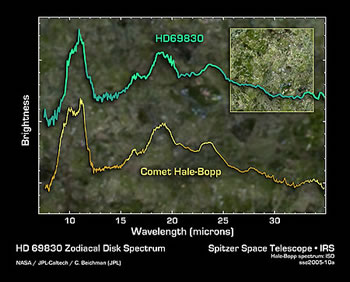
(From Star HD 69830 Zodiacal Disk Spectrum)
The graph of data shown above shows the the dust around the nearby (about 41 light years) star HD 69830 has a composition that is very similar to that of the recent comet Hale-Bopp. The hills and valleys seen in the data demonstrate the presence of various minerals. These spectra show that a silicate mineral called olivine (in this case, forsterite - see inset box) is present. This mineral is found on Earth - and in comets and asteroids.
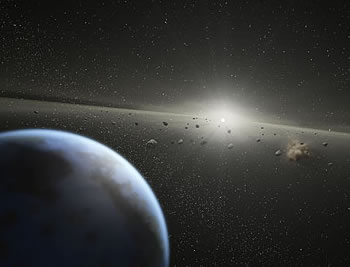
(From Star HD 69830 Asteroid Belt (artist concept))
The above artist's conception of the system shows the view from a planet that might exist in the system. Note the asteroid collision in the foreground - this replenishes the dust detected by the Spitzer telescope.
Science fiction writers like Larry Niven and Jerry Pournelle assumed that other stars would also have asteroid belts. In their excellent novel The Mote In God's Eye, they wrote about an alien civilization that had expanded into space to colonize (and move) the asteroids into the stable Trojan points of a large gas giant planet. ("Trojan points" are points sixty degrees ahead of and sixty degrees behind a large planet; a zone of stable equilibrium is created in which space rubble accumulates.)
"Either this whole system is cluttered with asteroids from edge to edge or there is a new principle at work. There's more junk in Mote Beta's Trojans than has ever been reported in another system."
As it turned out, the asteroids in the Trojan points were inhabited; the Moties had moved asteroids from throughout their system. There is no word from Dr. Beichman and his colleagues about (possibly inhabited) Trojan points.
However, a second theory (somewhat less likely) will need to be checked out. According to the astronomers, it is possible that a giant comet, as big as the planet Pluto, got knocked into the inner solar system and is slowly boiling away, shedding dust in the process. "The 'super comet' theory is more of a long shot," Beichman said, "but we'll know soon enough." Future observations of the star using Spitzer and ground-based telescopes are expected to conclude whether asteroids or comets are the source of the dust.
Science fiction writers also have the "super comet" possibility covered. In his dated (but still cool) 1936 novel The Cometeers, Jack Williamson writes about a "comet" that is twelve million miles long! As it turns out, it wasn't a comet, but that's another story entirely.
Read more about the Alien Asteroid Belt press release; see more Alien Asteroid Belt images and videos.
Scroll down for more stories in the same category. (Story submitted 4/21/2005)
Follow this kind of news @Technovelgy.| Email | RSS | Blog It | Stumble | del.icio.us | Digg | Reddit |
Would
you like to contribute a story tip?
It's easy:
Get the URL of the story, and the related sf author, and add
it here.
Comment/Join discussion ( 1 )
Related News Stories - (" Space Tech ")
'If Anyone Is Watching Earth...'
'Our study of your race has convinced us that you are not fitted to leave your planet in the present state of your civilization.' - Arthur C. Clarke, 1946.
Cloud Of Space Rubbish From China's Long March Rocket
'Within seconds the material was spread out over fifty yards, in a matter of hours it might occupy several cubic miles of space...'
ESA's Draco To Study Heat Of Reentry
'...a synthetic which air-friction would erode.' - EE Doc Smith, 1934.
The United States Space Academy Is Official
'Is our orbit to Space Academy clear?' - Carey Rockwell
Technovelgy (that's tech-novel-gee!) is devoted to the creative science inventions and ideas of sf authors. Look for the Invention Category that interests you, the Glossary, the Invention Timeline, or see what's New.

Science Fiction
Timeline
1600-1899
1900-1939
1940's 1950's
1960's 1970's
1980's 1990's
2000's 2010's
Current News
'If Anyone Is Watching Earth...'
'Our study of your race has convinced us that you are not fitted to leave your planet in the present state of your civilization.'
Epirus High-Power Microwave Defeats Drones
'...the spreading beam of the deranging ray struck them, and Then one toppled and fell. Then another.'
Cloud Of Space Rubbish From China's Long March Rocket
'Within seconds the material was spread out over fifty yards, in a matter of hours it might occupy several cubic miles of space...'
Biomimetic Tendons From Rochu Robotics
'... the curious parallelism to animal motions.'
Living Human Neuron Biological Compute Rack
'The men are dead, but their acquired wisdom lives on and I am the beneficiary.'
Martha Stewart Approves Ojai 'Living Room On Wheels'
'Young people found the driverless car admirable for petting.'
ESA's Draco To Study Heat Of Reentry
'...a synthetic which air-friction would erode.'
Buy A Galaxy? Maybe Start Smaller
'The sky is the limit' just got higher.
The United States Space Academy Is Official
'Is our orbit to Space Academy clear?'
Is There A Global Problem With Who Is Having Children?
'After twenty generations of shillyshallying...'
You Will Eat The Cookies Made From Plastic...
'Our planes are going to start bringing in bales of discarded plastics...'
It's A Giant Robot! You Reporters Have Been Warned!
'... completely forgetting the ship at sight of the awesome figure and great head of the giant Gaut...'
Birds Learn To Sing Pictures ala Frank Herbert's Distrans
'We will fight in the time of fighting.'
ElectionSim: China's 'Ender's Game' Battle Sim, Or Lem's 'Kingdom In A Box'?
'So, Ender, we will now begin your education.'
Tactile Skin Supplier Map
'What strange sensitivity! What an amazing development of science was manifested in every move and act and word of this Robot!'
Flock Stymied By 'Adversarial Fashion'
'Forget the head atop it, the legs below, feet, arms, hands. It compels erasure.'

