
Science Fiction
Dictionary
A B C D E F G H I J K L M N O P Q R S T U V W X Y Z

 |
DNA-Based Robots To Fight Cancer

A robotic device made from DNA may one day be released into the body to find specific cell targets and then deliver molecular-based instructions to self-destruct.
The device was developed by researchers at the Wyss Institute for Biologically Inspired Engineering at Harvard University.
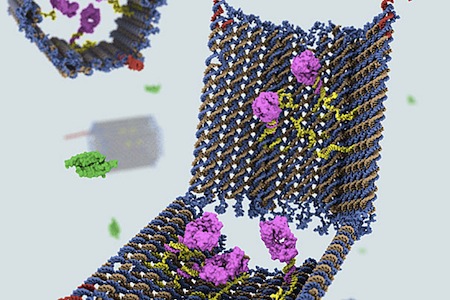
(Robotic device made from DNA)
Using the DNA origami method, in which complex 3-D shapes and objects are constructed by folding strands of DNA, Shawn Douglas, a Wyss Technology Development Fellow, and Ido Bachelet, a former Wyss postdoctoral fellow who is now an assistant professor in the Faculty of Life Sciences and the Nano-Center at Bar-Ilan University in Israel, created a nanosized robot in the form of an open barrel whose two halves are connected by a hinge. The DNA barrel, which acts as a container, is held shut by special DNA latches that can recognize and seek out combinations of cell-surface proteins, including disease markers. When the latches find their targets, they reconfigure, causing the two halves of the barrel to swing open and expose its contents, or payload. The container can hold various types of payloads, including specific molecules with encoded instructions that can interact with specific cell surface signaling receptors.By combining several novel elements for the first time, the new system represents a significant advance in overcoming these implementation obstacles. For instance, because the barrel-shaped structure has no top or bottom lids, the payloads can be loaded from the side in a single step — without having to open the structure first and then reclose it. Also, while other systems use release mechanisms that respond to DNA or RNA, the novel mechanism used here responds to proteins, which are more commonly found on cell surfaces and are largely responsible for transmembrane signaling in cells. Finally, this is the first DNA-origami-based system that uses antibody fragments to convey molecular messages — a feature that offers a controlled and programmable way to replicate an immune response or develop new types of targeted therapies.
Science fiction fans have already been exposed to this idea. In his 1967 novel These Savage Futurians, Philip E. High described a "constructed micro-organism" to fight it out with viruses and bacteria.
"This object, strictly speaking, is a constructed micro-organism about the size of Hartman's virus. It is molded from special plastics, the molecules of which have been atomically arranged for durability in these conditions." He paused and almost managed a smile. "It is also a warrior robot." Again he paused and drew a deep audible breath. "Impressed on the recognition tapes of this robot is a picture of the _Metricitus spirochaeta!_" He walked over to the picture and pointed. "This pointed tube at the front of the robot is a contact device. It is designed to release on contact with the spirochaeta a lethal charge of electricity electronically restricted to a nervous system, or it you prefer it, the substance of the hostile microorganism." He turned to Judith and said, gently, "Have you followed me?""Yes, I've followed you." She looked puzzled.
"Judith, this auto-factory has produced sub-microscopic robots in hundred of millions. I propose injecting a few million into your blood stream in a special solution and letting them seek out and destroy the spirochaeta which are causing your illness.
(Read more about High's Sub-microscopic Medical Robots)
From Harvard; thanks to Winchell Chung for contributing the tip and reference for this story.
Scroll down for more stories in the same category. (Story submitted 2/20/2012)
Follow this kind of news @Technovelgy.| Email | RSS | Blog It | Stumble | del.icio.us | Digg | Reddit |
Would
you like to contribute a story tip?
It's easy:
Get the URL of the story, and the related sf author, and add
it here.
Comment/Join discussion ( 0 )
Related News Stories - (" Medical ")
3D Printed Organs From Space
'For a while your colonists will have to come up to the [orbital] Hospital...'
Health Kiosk Has No Human Doctor
'The electronic body analyzer had been developed...' - Michael Crichton, 1969.
NEO Brain Computer Interface (BCI)
'The remains of the lace took on the rough shape of a brain...' - Iain Banks, 2010.
MIT Computerized Bionic Leg Is Part Of The User
'The leg was to function, in a way, as a servo-mechanism operated by Larry’s brain, through the mediation of the electronic brain in the leg.' - Charles Recour, 1949.
Technovelgy (that's tech-novel-gee!) is devoted to the creative science inventions and ideas of sf authors. Look for the Invention Category that interests you, the Glossary, the Invention Timeline, or see what's New.

Science Fiction
Timeline
1600-1899
1900-1939
1940's 1950's
1960's 1970's
1980's 1990's
2000's 2010's
Current News
'If Anyone Is Watching Earth...'
'Our study of your race has convinced us that you are not fitted to leave your planet in the present state of your civilization.'
Epirus High-Power Microwave Defeats Drones
'...the spreading beam of the deranging ray struck them, and Then one toppled and fell. Then another.'
Cloud Of Space Rubbish From China's Long March Rocket
'Within seconds the material was spread out over fifty yards, in a matter of hours it might occupy several cubic miles of space...'
Biomimetic Tendons From Rochu Robotics
'... the curious parallelism to animal motions.'
Living Human Neuron Biological Compute Rack
'The men are dead, but their acquired wisdom lives on and I am the beneficiary.'
Martha Stewart Approves Ojai 'Living Room On Wheels'
'Young people found the driverless car admirable for petting.'
ESA's Draco To Study Heat Of Reentry
'...a synthetic which air-friction would erode.'
Buy A Galaxy? Maybe Start Smaller
'The sky is the limit' just got higher.
The United States Space Academy Is Official
'Is our orbit to Space Academy clear?'
Is There A Global Problem With Who Is Having Children?
'After twenty generations of shillyshallying...'
You Will Eat The Cookies Made From Plastic...
'Our planes are going to start bringing in bales of discarded plastics...'
It's A Giant Robot! You Reporters Have Been Warned!
'... completely forgetting the ship at sight of the awesome figure and great head of the giant Gaut...'
Birds Learn To Sing Pictures ala Frank Herbert's Distrans
'We will fight in the time of fighting.'
ElectionSim: China's 'Ender's Game' Battle Sim, Or Lem's 'Kingdom In A Box'?
'So, Ender, we will now begin your education.'
Tactile Skin Supplier Map
'What strange sensitivity! What an amazing development of science was manifested in every move and act and word of this Robot!'
Flock Stymied By 'Adversarial Fashion'
'Forget the head atop it, the legs below, feet, arms, hands. It compels erasure.'

