
Science Fiction
Dictionary
A B C D E F G H I J K L M N O P Q R S T U V W X Y Z

 |
See People Through Walls

An innovative system created at MIT will let you see people through concrete walls. The device is an ultrawideband (UWB) multiple-input, multiple-output phased-array sensor with real-time acquisition and processing capability; it provides video-like synthetic aperture radar (SAR) images of people moving behind a concrete wall.
The image quality is sufficiently high to resolve multiple humans behind a wall. Humans were located through the three types of wall tested when they were moving or standing still. Humans were located through the 4-inch concrete and cinder block wall even if they were sitting still or holding their breath while standing. Because humans move slightly even while trying to remain still, the radar system detected those small movements by using coherent radar processing techniques
At the core of the system is a range-gated continuous-wave radar architecture that provides dynamic range and sensitivity to acquire weak signals scattered from targets behind the wall. The radar set is connected to an array of UWB antenna elements consisting of two subarrays made up of 8 receive elements and 13 transmit elements. Microwave switches guide the transmitter port from the radar to one transmit element at a time. Similarly, microwave switches guide the receive port to one receive antenna at a time.
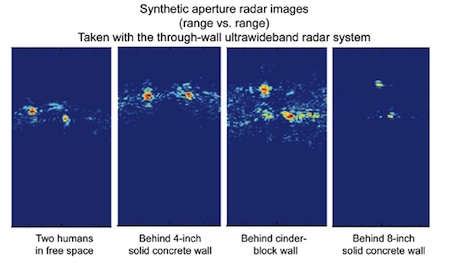
(Two humans about 30 feet down range)
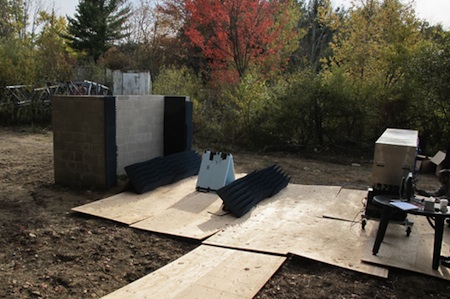
(One of the through-wall experimental setups)
The radar system is located to the right and the cinder block wall is to the left. An absorber is mounted on the vertical reinforcement sections of the wall and clutter fences using a pyramidal absorber are mounted on the front of the wall to approximate the conditions of two-dimensional air-wall-air models. Plywood sheets on the ground allow the radar system to be easily moved around the target area. A Styrofoam "A-frame" holds the calibration target in front of the wall. When measurements are acquired, one or two humans walk around about 10 feet behind the wall.
I use some other sf devices as predecessors in the other stories; here's an amusing reference from a 1936 John W. Campbell story:
"They had the tube then. They called it the PTW tube - Probability Time Wave. They'd been trying to make a television set that would see through walls..."
(Read more)
This passage just goes to show that even seventy years ago, people were thinking about a device just like this one. Gordon Giles used a similar idea in his 1937 story Diamond Planetoid to see which planetoids where worth mining; take a look at the X-beam projector.
From MIT Lincoln Lab.
Scroll down for more stories in the same category. (Story submitted 10/18/2011)
Follow this kind of news @Technovelgy.| Email | RSS | Blog It | Stumble | del.icio.us | Digg | Reddit |
Would
you like to contribute a story tip?
It's easy:
Get the URL of the story, and the related sf author, and add
it here.
Comment/Join discussion ( 0 )
Related News Stories - (" Engineering ")
Biomimetic Tendons From Rochu Robotics
'... the curious parallelism to animal motions.' - HG Wells, 1898.
You Will Eat The Cookies Made From Plastic...
'Our planes are going to start bringing in bales of discarded plastics...' - Rick Shelley, 1989.
ICE Buys Shock Gloves Like Batman's
What else is the Caped Crusader using?
When Colds Threaten You Can't Do This - Or Can You?
'...a hemispherical force field enclosing his head.' - FL Wallace, 1955.
Technovelgy (that's tech-novel-gee!) is devoted to the creative science inventions and ideas of sf authors. Look for the Invention Category that interests you, the Glossary, the Invention Timeline, or see what's New.

Science Fiction
Timeline
1600-1899
1900-1939
1940's 1950's
1960's 1970's
1980's 1990's
2000's 2010's
Current News
'If Anyone Is Watching Earth...'
'Our study of your race has convinced us that you are not fitted to leave your planet in the present state of your civilization.'
Epirus High-Power Microwave Defeats Drones
'...the spreading beam of the deranging ray struck them, and Then one toppled and fell. Then another.'
Cloud Of Space Rubbish From China's Long March Rocket
'Within seconds the material was spread out over fifty yards, in a matter of hours it might occupy several cubic miles of space...'
Biomimetic Tendons From Rochu Robotics
'... the curious parallelism to animal motions.'
Living Human Neuron Biological Compute Rack
'The men are dead, but their acquired wisdom lives on and I am the beneficiary.'
Martha Stewart Approves Ojai 'Living Room On Wheels'
'Young people found the driverless car admirable for petting.'
ESA's Draco To Study Heat Of Reentry
'...a synthetic which air-friction would erode.'
Buy A Galaxy? Maybe Start Smaller
'The sky is the limit' just got higher.
The United States Space Academy Is Official
'Is our orbit to Space Academy clear?'
Is There A Global Problem With Who Is Having Children?
'After twenty generations of shillyshallying...'
You Will Eat The Cookies Made From Plastic...
'Our planes are going to start bringing in bales of discarded plastics...'
It's A Giant Robot! You Reporters Have Been Warned!
'... completely forgetting the ship at sight of the awesome figure and great head of the giant Gaut...'
Birds Learn To Sing Pictures ala Frank Herbert's Distrans
'We will fight in the time of fighting.'
ElectionSim: China's 'Ender's Game' Battle Sim, Or Lem's 'Kingdom In A Box'?
'So, Ender, we will now begin your education.'
Tactile Skin Supplier Map
'What strange sensitivity! What an amazing development of science was manifested in every move and act and word of this Robot!'
Flock Stymied By 'Adversarial Fashion'
'Forget the head atop it, the legs below, feet, arms, hands. It compels erasure.'

