
Science Fiction
Dictionary
A B C D E F G H I J K L M N O P Q R S T U V W X Y Z

 |
Nanowire Transistors For Smallest Computers

Nanowire transistors could form the basis for the tiniest computers possible, says a team led by Charles Lieber, a professor of chemistry at Harvard, and Shamik Das, lead engineer in MITRE's nanosystems group.
They built a reprogrammable circuit out of nanowire transistors; taken together, you wind up with the first scalable nanowire computer.
The nanowire transistors maintain their state-on or off—regardless of whether the power is on. This gives it an instant-on capability, important for low-power sensors that might need to collect data only sporadically and also need to conserve power.
To make the new nanowire circuit, researchers deposited lines of nanowires, made of a germanium core and silicon shell, on a substrate and crossed them with lines of metal electrodes to create a grid. The points where the nanowires and electrodes intersect act as a transistor that can be turned on and off independently. The researchers made a single tile, with an area of 960 square microns containing 496 functional transistors. It is designed to wire to other tiles so that the transistors, in aggregate, could act as complex logic gates for processing or memory.
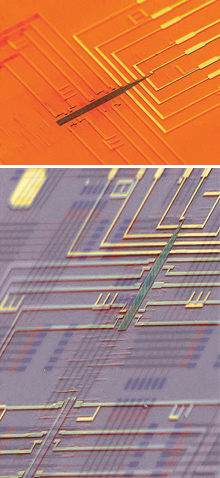
(Smallest computers yet?)
Top: Scanning electron microscopy (SEM) image of a programmable
nanowire logic circuit tile assembled bottom-up for computational
functionalities such as full-adder. The tile can be scaled up into a
fully-functional integrated nanoprocessor
Bottom: This false-colored scanning electron microscope image
shows a nanowire processor tile superimposed on top of the
architecture used to design the circuit.
These circuits could be as much as ten times more power-efficient than circuits made of traditional materials. Nanowire doesn't allow electric current to leak, and the design uses capacitive connections instead of resistive ones.
This is the kind of computing size and power you'd need to implement the nanomachine swarm from Stanislaw Lem's amazing 1954 novel The Invincible:
"Two types of systems were successful in this evolutionary pattern: first, those that made the greatest progress in miniaturization and then those that became settled in a definite place. The first type were the beginning of these 'black clouds.' I believe them to be very tiny pseudo insects that, if necessary, and for their common good, can unite to form a superordinate system. This is the course taken by the evolution of the mobile mechanisms."
(Read more about Lem's nanomachine swarms)
Fans of Philip K. Dick are also anticipating the arrival of the autofac from his 1955 short story of the same name:
The pellet was a smashed container of machinery, tiny metallic elements too minute to be analyzed without a microscope...The bits were in motion. Microscopic machinery, smaller than ants, smaller than pins, working energetically, purposefully - constructing something that looked like a tiny rectangle of steel.
From Lieber research group via Technology Review.
Scroll down for more stories in the same category. (Story submitted 2/10/2011)
Follow this kind of news @Technovelgy.| Email | RSS | Blog It | Stumble | del.icio.us | Digg | Reddit |
Would
you like to contribute a story tip?
It's easy:
Get the URL of the story, and the related sf author, and add
it here.
Comment/Join discussion ( 0 )
Related News Stories - (" Computer ")
ElectionSim: China's 'Ender's Game' Battle Sim, Or Lem's 'Kingdom In A Box'?
'So, Ender, we will now begin your education.' - Orson Scott Card, 1985.
Muxcard Redditor's DIY Credit Card-Sized Computer
It's a computer, but just barely.
Cortex 1 - Today A Warehouse, Tomorrow A Calculator Planet
'There were cubic miles of it, and it glistened like a silvery Christmas tree...' - Clifford Simak, 1949.
Is Agentic AI The Wrong Kind Of Smartness?
'It’s smart enough to go wrong in very complicated ways, but not smart enough to help us find out what’s wrong.' - Isaac Asimov, 1975.
Technovelgy (that's tech-novel-gee!) is devoted to the creative science inventions and ideas of sf authors. Look for the Invention Category that interests you, the Glossary, the Invention Timeline, or see what's New.

Science Fiction
Timeline
1600-1899
1900-1939
1940's 1950's
1960's 1970's
1980's 1990's
2000's 2010's
Current News
'If Anyone Is Watching Earth...'
'Our study of your race has convinced us that you are not fitted to leave your planet in the present state of your civilization.'
Epirus High-Power Microwave Defeats Drones
'...the spreading beam of the deranging ray struck them, and Then one toppled and fell. Then another.'
Cloud Of Space Rubbish From China's Long March Rocket
'Within seconds the material was spread out over fifty yards, in a matter of hours it might occupy several cubic miles of space...'
Biomimetic Tendons From Rochu Robotics
'... the curious parallelism to animal motions.'
Living Human Neuron Biological Compute Rack
'The men are dead, but their acquired wisdom lives on and I am the beneficiary.'
Martha Stewart Approves Ojai 'Living Room On Wheels'
'Young people found the driverless car admirable for petting.'
ESA's Draco To Study Heat Of Reentry
'...a synthetic which air-friction would erode.'
Buy A Galaxy? Maybe Start Smaller
'The sky is the limit' just got higher.
The United States Space Academy Is Official
'Is our orbit to Space Academy clear?'
Is There A Global Problem With Who Is Having Children?
'After twenty generations of shillyshallying...'
You Will Eat The Cookies Made From Plastic...
'Our planes are going to start bringing in bales of discarded plastics...'
It's A Giant Robot! You Reporters Have Been Warned!
'... completely forgetting the ship at sight of the awesome figure and great head of the giant Gaut...'
Birds Learn To Sing Pictures ala Frank Herbert's Distrans
'We will fight in the time of fighting.'
ElectionSim: China's 'Ender's Game' Battle Sim, Or Lem's 'Kingdom In A Box'?
'So, Ender, we will now begin your education.'
Tactile Skin Supplier Map
'What strange sensitivity! What an amazing development of science was manifested in every move and act and word of this Robot!'
Flock Stymied By 'Adversarial Fashion'
'Forget the head atop it, the legs below, feet, arms, hands. It compels erasure.'

