
Science Fiction
Dictionary
A B C D E F G H I J K L M N O P Q R S T U V W X Y Z

 |
'Significant Amount' Of Lunar Water Found

A 'significant amount' of lunar water was found by NASA's LCROSS probe when it impacted a permanently-shadowed crater on the moon last month.
The water LCROSS detected "would be water you could drink, water like any other water," Colaprete said. "If you could clean it, it would be drinkable water."
The LCROSS probe impacted the lunar south pole at a crater called Cabeus on Oct. 9. The $79 million spacecraft, preceded by its Centaur rocket stage, hit the lunar surface in an effort to create a debris plume that could be analyzed by scientists for signs of water ice.
Those signs were visible in the data from spectrographic measurements (which measure light absorbed at different wavelengths, revealing different compounds) of the Centaur stage crater and the two-part debris plume the impact created. The signature of water was seen in both infrared and ultraviolet spectroscopic measurements.
"Indeed, yes, we found water. And we didn't find just a little bit, we found a significant amount," Anthony Colaprete, LCROSS project scientist and principal investigator from NASA's Ames Research Center at Moffett Field, Calif.
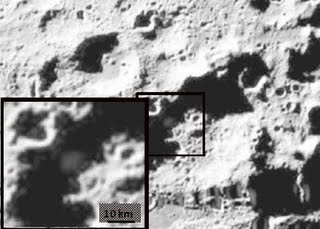
( LCROSS impacts in Cabeus crater on October 9th, 2009 )
The possibility of ice in the floors of polar lunar craters was first suggested by scientists in 1961 by Caltech researchers Kenneth Watson, Bruce C. Murray, and Harrison Brown.
Science fiction fans heard about the idea of lunar ice mining from Robert Heinlein in his 1966 novel The Moon is a Harsh Mistress:
One shy little fellow with bloodshot eyes of old-time drillman stood up. "I'm an ice miner," he said. "Learned by trade doing time for Warden like most of you. I've been on my own thirty years and done okay... I should say did do okay... because today you have to listen farther out or deeper down to find ice. "That's okay, still ice in The Rock and a miner expects to sound for it..."
(Read more about fictional lunar ice mining)
I should also add that sf readers were clued into the idea of using some sort of impactor to send up a cloud of particles for examination some years earlier. In his 1958 classic The Mechanical Monarch, E.C. Tubb used explosive missiles to determine the composition of asteroids:
Fire streaked in a thin line from the muzzle of a cannon-like tube mounted beneath the viewing instruments and a tiny, rocket-powered projectile, drove towards the mysterious bulk. It hit, exploding into a cloud of incandescent vapour, and Wendis stared thoughtfully at the brilliant lines on the spectroscope screen.
From Space.com.
Scroll down for more stories in the same category. (Story submitted 11/14/2009)
Follow this kind of news @Technovelgy.| Email | RSS | Blog It | Stumble | del.icio.us | Digg | Reddit |
Would
you like to contribute a story tip?
It's easy:
Get the URL of the story, and the related sf author, and add
it here.
Comment/Join discussion ( 0 )
Related News Stories - (" Space Tech ")
'If Anyone Is Watching Earth...'
'Our study of your race has convinced us that you are not fitted to leave your planet in the present state of your civilization.' - Arthur C. Clarke, 1946.
Cloud Of Space Rubbish From China's Long March Rocket
'Within seconds the material was spread out over fifty yards, in a matter of hours it might occupy several cubic miles of space...'
ESA's Draco To Study Heat Of Reentry
'...a synthetic which air-friction would erode.' - EE Doc Smith, 1934.
The United States Space Academy Is Official
'Is our orbit to Space Academy clear?' - Carey Rockwell
Technovelgy (that's tech-novel-gee!) is devoted to the creative science inventions and ideas of sf authors. Look for the Invention Category that interests you, the Glossary, the Invention Timeline, or see what's New.

Science Fiction
Timeline
1600-1899
1900-1939
1940's 1950's
1960's 1970's
1980's 1990's
2000's 2010's
Current News
'If Anyone Is Watching Earth...'
'Our study of your race has convinced us that you are not fitted to leave your planet in the present state of your civilization.'
Epirus High-Power Microwave Defeats Drones
'...the spreading beam of the deranging ray struck them, and Then one toppled and fell. Then another.'
Cloud Of Space Rubbish From China's Long March Rocket
'Within seconds the material was spread out over fifty yards, in a matter of hours it might occupy several cubic miles of space...'
Biomimetic Tendons From Rochu Robotics
'... the curious parallelism to animal motions.'
Living Human Neuron Biological Compute Rack
'The men are dead, but their acquired wisdom lives on and I am the beneficiary.'
Martha Stewart Approves Ojai 'Living Room On Wheels'
'Young people found the driverless car admirable for petting.'
ESA's Draco To Study Heat Of Reentry
'...a synthetic which air-friction would erode.'
Buy A Galaxy? Maybe Start Smaller
'The sky is the limit' just got higher.
The United States Space Academy Is Official
'Is our orbit to Space Academy clear?'
Is There A Global Problem With Who Is Having Children?
'After twenty generations of shillyshallying...'
You Will Eat The Cookies Made From Plastic...
'Our planes are going to start bringing in bales of discarded plastics...'
It's A Giant Robot! You Reporters Have Been Warned!
'... completely forgetting the ship at sight of the awesome figure and great head of the giant Gaut...'
Birds Learn To Sing Pictures ala Frank Herbert's Distrans
'We will fight in the time of fighting.'
ElectionSim: China's 'Ender's Game' Battle Sim, Or Lem's 'Kingdom In A Box'?
'So, Ender, we will now begin your education.'
Tactile Skin Supplier Map
'What strange sensitivity! What an amazing development of science was manifested in every move and act and word of this Robot!'
Flock Stymied By 'Adversarial Fashion'
'Forget the head atop it, the legs below, feet, arms, hands. It compels erasure.'

