
Science Fiction
Dictionary
A B C D E F G H I J K L M N O P Q R S T U V W X Y Z

 |
Cosmos 1 Sets Solar Sail - Update

Update 24-Jun-2005: Emily Lakdawalla, project assistant, writes as of June 25th:
Update 21-Jun-2005: Cosmos 1 is now scheduled to be launched today at 3:46 pm EST in the Barents Sea. A three-stage Volna rocket will launch the satellite into a near circular polar orbit.
Here's the latest news as of 12 noon on June 22nd:
While it is likely that this conclusion is correct, there are some inconsistent indications from information received from other sources. The Cosmos 1 team observed what appear to be signals, that looks like they are from the spacecraft when it was over the first three ground stations and some Doppler data over one of these stations. This might indicate that Cosmos 1 made it into orbit, but probably a lower one than intended. The project team now considers this to be a very small probability. But because there is a slim chance that it might be so, efforts to contact and track the spacecraft continue. We are working with US Strategic Command to provide additional information in a day or so.
Cosmos 1, the world's first solar sail spacecraft, is scheduled to be launched on March 1, 2005. The mission of the flight is to perform the first controlled solar sail flight.
The launch will be performed by the Russian navy; Cosmos 1 will reach space propelled by a Volna rocket taken from the operational intercontinental ballistic missile inventory, and fired from a submerged submarine. Cosmos 1 is a private venture financed by The Planetary Society.
The frustrating wait for information continues. We haven't heard from the spacecraft yet. Nor have we heard of a crash site. Nor have we convinced ourselves of the detections at those ground stations. Hope continues to diminish, but it remains. Who knows, maybe someone will look upward on June 26 after 04:40 UTC, and see a bright spot moving across the sky.
(From the Cosmos 1 Weblog)
In the past twenty-four hours, the Russian space agency (RKA) has made a tentative conclusion that the Volna rocket carrying Cosmos 1 failed during the firing of the first stage. This would mean that Cosmos 1 is lost.
----------------------
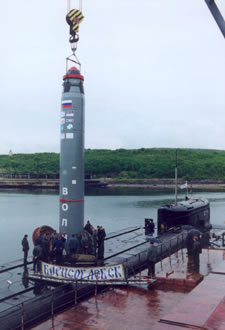
(From Planetary Society)
The spacecraft is the result of the efforts of a mostly Russian team of scientists and engineers. The Space Research Institute in Moscow oversaw development of flight electronics and mission control software. The craft itself was built by NPO Lavochkin, a Russian aerospace company. American consultants provided additional components.
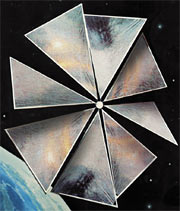
(From Planetary Society)
Cosmos 1 uses reflected light pressure on its large sail for propulsion. The 600-square meter sail will have eight blades (see illustration above), configured like a windmill. The sail will be deployed by inflatable tubes, which will also make the structure rigid.
If successful, it should be a naked eye object visible from most of the world.
Science fiction authors have lead the way on solar sail design, development and inspiration. It seems incredible, but the basic idea that light pressure would provide a mechanical means of propulsion may be found in Jules Verne's 1867 novel From the Earth to the Moon:
"...there will some day appear velocities far greater than these, of which light or electricity will probably be the mechanical agent..."
(Read more)
This is particularly noteworthy since the existence of light pressure was not even proven in theory until 1873 (by James Clerk Maxwell).
The Russian theoretician Konstantin Tsiolkovsky worked on the idea of solar sailing in the 1920's, but the first work to spark the interest of scientists and sf writers came in 1951, with the publication of "Clipper Ships of Space." This Astounding Science Fiction article was not a story, but an exposition of the principles of solar sails.
Cordwainer Smith wrote what was probably the first actual story about solar sails in 1960. "The Lady Who Sailed The Soul" took place in the far future, when people ventured on decades-long voyages in ships equipped with solar sails "tissue-metal wings with which the bodies of people finally fluttered out among the stars."
The next story about light sails was a 1962 short story by Jack Vance - a classic named "Sail 25." This is the story of a "sink-or-swim" training cruise in which six space cadets find themselves under the unforgiving tutelage of Henry Belt, who stated that it was his fate to one day die in space:
The ship, great sail spread to the fading sunlight, fled like a ghost - out, always out. Each of the cadets had quietly performed the same calculations, and arrived at the same result. If the swing around Jupiter were not performed with exactitude, if the ship werre not slung back like a stone on a string, there was nothing beyond..."
(Read more from Sail 25).
Cordwainer Smith wrote another story in 1963 with more descriptions of this technology: "immense sails - huge films assorted in space on long, rigid, coldproof rigging." Arthur C. Clarke's 1964 story "Sunjammer" details the story of a race of seven sun yachts and was published in Boy's Life.
The last example I will include here comes from Mote in God's Eye, a 1974 novel by Larry Niven and Jerry Pournelle. The book contains an excellent description of a light sail spacecraft accelerated to a significant fraction of light speed by a set of laser cannon. This method was first proposed in 1961 by Robert L. Forward (in Ground-Based Lasers for Propulsion in Space):
"The intruder came from here. Whoever launched it fired a laser cannon, or a set of laser cannon - probably a whole mess of them on asteroids, with mirrors to focus them - for about forty-five years, so the intruder would have a beam to travel on."Get updates on Cosmos 1 at the Cosmos 1 Mission Tracking Site. Thanks to space.com for the story.
(Read more from laser cannon.)
(This article was originally published on 11-Nov-2004.)
Scroll down for more stories in the same category. (Story submitted 6/23/2005)
Follow this kind of news @Technovelgy.| Email | RSS | Blog It | Stumble | del.icio.us | Digg | Reddit |
Would
you like to contribute a story tip?
It's easy:
Get the URL of the story, and the related sf author, and add
it here.
Comment/Join discussion ( 4 )
Related News Stories - (" Spacecraft ")
Europa Clipper Plate Carries A Special Message
'...a universal cryptogram — yet it is one which can be interpreted by any intelligent creature on any planet in the Solar System!' -
China Wants To Build Mega Space Ships
'Don't do anything to endanger our shipping privileges...' - Frank Herbert, 1965.
Dream Of Building Your Own Rocket?
Fiorello Bodoni, you inspire all of us.
Used Dragon Cargo Spacecraft Will Fly Again
'the overstrained meters made the smaller craft skittish as a young horse...' - Robert Heinlein
Technovelgy (that's tech-novel-gee!) is devoted to the creative science inventions and ideas of sf authors. Look for the Invention Category that interests you, the Glossary, the Invention Timeline, or see what's New.

Science Fiction
Timeline
1600-1899
1900-1939
1940's 1950's
1960's 1970's
1980's 1990's
2000's 2010's
Current News
'If Anyone Is Watching Earth...'
'Our study of your race has convinced us that you are not fitted to leave your planet in the present state of your civilization.'
Epirus High-Power Microwave Defeats Drones
'...the spreading beam of the deranging ray struck them, and Then one toppled and fell. Then another.'
Cloud Of Space Rubbish From China's Long March Rocket
'Within seconds the material was spread out over fifty yards, in a matter of hours it might occupy several cubic miles of space...'
Biomimetic Tendons From Rochu Robotics
'... the curious parallelism to animal motions.'
Living Human Neuron Biological Compute Rack
'The men are dead, but their acquired wisdom lives on and I am the beneficiary.'
Martha Stewart Approves Ojai 'Living Room On Wheels'
'Young people found the driverless car admirable for petting.'
ESA's Draco To Study Heat Of Reentry
'...a synthetic which air-friction would erode.'
Buy A Galaxy? Maybe Start Smaller
'The sky is the limit' just got higher.
The United States Space Academy Is Official
'Is our orbit to Space Academy clear?'
Is There A Global Problem With Who Is Having Children?
'After twenty generations of shillyshallying...'
You Will Eat The Cookies Made From Plastic...
'Our planes are going to start bringing in bales of discarded plastics...'
It's A Giant Robot! You Reporters Have Been Warned!
'... completely forgetting the ship at sight of the awesome figure and great head of the giant Gaut...'
Birds Learn To Sing Pictures ala Frank Herbert's Distrans
'We will fight in the time of fighting.'
ElectionSim: China's 'Ender's Game' Battle Sim, Or Lem's 'Kingdom In A Box'?
'So, Ender, we will now begin your education.'
Tactile Skin Supplier Map
'What strange sensitivity! What an amazing development of science was manifested in every move and act and word of this Robot!'
Flock Stymied By 'Adversarial Fashion'
'Forget the head atop it, the legs below, feet, arms, hands. It compels erasure.'

