
Science Fiction
Dictionary
A B C D E F G H I J K L M N O P Q R S T U V W X Y Z

 |
Graphene Memory Arrays Are Stackable, Awesome

Graphene memory arrays in three dimensions may be possible, according to research performed at Rice University. It turns out that a tiny jolt of electricity can 'break' a strip of graphene just ten atoms thick; another jolt restores it to normal. This kind of graphene 'switch' could revolutionize data storage, making it possible to store more data in less space with less energy.
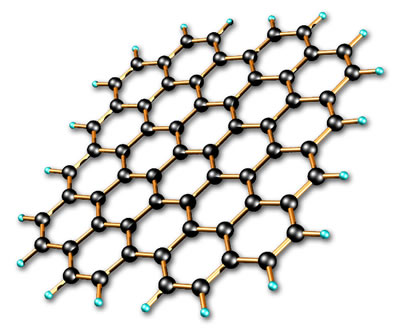
(Are graphene memory sheets possible?)
Graphene memory arrays could increase the quantity of storage in a two-dimensional array by a factor of five. Individual bits would be smaller than 10 nanometers, much smaller than the ponderous 45-nanometer circuitry in use in flash memory today. Also, the new switches could be controlled by two terminals instead of three.
Two switches is a key advance; this makes three-dimensional memory practical. Also, a graphene memory bit is essentially a mechanical device; it would consume virtually no power while keeping data intact.
What distinguishes graphene from other next-generation memories is the on-off power ratio -- the amount of juice a circuit holds when it’s on, as opposed to off. “It’s huge -- a million-to-one,” said James Tour, Rice’s Chao Professor of Chemistry as well as a professor of mechanical engineering and materials science and of computer science. “Phase-change memory, the other thing the industry is considering, runs at 10-to-1. That means the ‘off’ state holds, say, one-tenth the amount of current than the ‘on’ state.”Electrical current tends to leak from an “off” that’s holding a charge. “That means in a 10-by-10 grid, 10 ‘offs’ would leak enough to look like they were ‘on.’ With our method, it would take a million ‘offs’ in a line to look like ‘on,’’ he said. “So this is big. It allows us to make a much larger array.”
And, in the It Just Keeps Getting Better And Better department, Tour says that graphene 'switches' are significantly faster in operation, have a longer operating lifetime, and work well from minus 75 degrees to more than 200 degrees Celcius.
SF fans may recall the Schrön Loop memory storage device, from Dan Simmons 1991 novel Hyperion; it had somewhat greater capacity (and could be implanted in a person):
"A man or woman could carry AIs or complete planetary dataspheres in a Schrön loop." (More)
From James Tour’s graphene device may make massive storage practical.
Scroll down for more stories in the same category. (Story submitted 11/22/2008)
Follow this kind of news @Technovelgy.| Email | RSS | Blog It | Stumble | del.icio.us | Digg | Reddit |
Would
you like to contribute a story tip?
It's easy:
Get the URL of the story, and the related sf author, and add
it here.
Comment/Join discussion ( 0 )
Related News Stories - (" Data Storage ")
Project Silica Offers 'Long-Term' Digital Storage
'... folios and tapes and playable discs of platinum alloy.' - EE 'Doc' Smith, 1934.
Lonestar Offers Lunar Storage For Ultimate In Security
'Scarif, the off-site backup of all the secret knowledge of the Empire'
100X Improvement In DNA Information Storage
'A record that wouldn't get lost and couldn't be destroyed.' Barbara Hambly, 1982.
Twist Bioscience High Density Digital Data On DNA
'They tied the memory to the bloodline and that was their record!' - Barbara Humbly, 1982.
Technovelgy (that's tech-novel-gee!) is devoted to the creative science inventions and ideas of sf authors. Look for the Invention Category that interests you, the Glossary, the Invention Timeline, or see what's New.

Science Fiction
Timeline
1600-1899
1900-1939
1940's 1950's
1960's 1970's
1980's 1990's
2000's 2010's
Current News
'If Anyone Is Watching Earth...'
'Our study of your race has convinced us that you are not fitted to leave your planet in the present state of your civilization.'
Epirus High-Power Microwave Defeats Drones
'...the spreading beam of the deranging ray struck them, and Then one toppled and fell. Then another.'
Cloud Of Space Rubbish From China's Long March Rocket
'Within seconds the material was spread out over fifty yards, in a matter of hours it might occupy several cubic miles of space...'
Biomimetic Tendons From Rochu Robotics
'... the curious parallelism to animal motions.'
Living Human Neuron Biological Compute Rack
'The men are dead, but their acquired wisdom lives on and I am the beneficiary.'
Martha Stewart Approves Ojai 'Living Room On Wheels'
'Young people found the driverless car admirable for petting.'
ESA's Draco To Study Heat Of Reentry
'...a synthetic which air-friction would erode.'
Buy A Galaxy? Maybe Start Smaller
'The sky is the limit' just got higher.
The United States Space Academy Is Official
'Is our orbit to Space Academy clear?'
Is There A Global Problem With Who Is Having Children?
'After twenty generations of shillyshallying...'
You Will Eat The Cookies Made From Plastic...
'Our planes are going to start bringing in bales of discarded plastics...'
It's A Giant Robot! You Reporters Have Been Warned!
'... completely forgetting the ship at sight of the awesome figure and great head of the giant Gaut...'
Birds Learn To Sing Pictures ala Frank Herbert's Distrans
'We will fight in the time of fighting.'
ElectionSim: China's 'Ender's Game' Battle Sim, Or Lem's 'Kingdom In A Box'?
'So, Ender, we will now begin your education.'
Tactile Skin Supplier Map
'What strange sensitivity! What an amazing development of science was manifested in every move and act and word of this Robot!'
Flock Stymied By 'Adversarial Fashion'
'Forget the head atop it, the legs below, feet, arms, hands. It compels erasure.'

