
Science Fiction
Dictionary
A B C D E F G H I J K L M N O P Q R S T U V W X Y Z

 |
ExoFly Flapping Planetary Survey Aerobot

ExoFly is a light-weight flapping wing robotic fly under development for use as a planetary survey and exploration tool. The device is based on the well-known DelFly, very small micro camera plane (just three grams!).
A demonstrator has been implemented for use in
Earth atmosphere, capable of autonomous, stable and
robust straight-line flight and hovering, as well as
take-off and landing capabilities. This demonstrator
has a total weight of 17 grams and is able to fly for 12
minutes with onboard energy storage and a pinhole
camera payload.
Flapping winged flight is well suited to the
low density and highly viscous Martian atmosphere,
but may also be used in a denser atmosphere such as
Titan. In any planetary mission, ExoFly would be a
highly innovative mission element, technically part of
the mission infrastructure, but enabling scientific
breakthrough observations with the imaging system
and micro-payload.
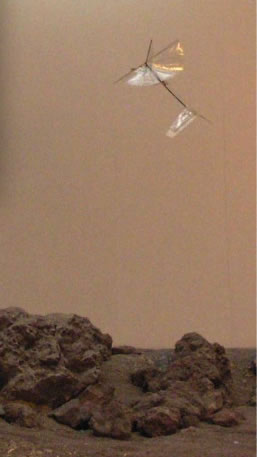
(ExoFly Flapping Planetary Survey Aerobot [pdf])
Scientists are excited to be able to break away from the limitations of traditional, ground-based exploration of planetary surfaces, so ably carried out by robotic explorers like the Mars rovers.
One of the most important aspects of ExoFly is that it will provide outcrop scale visual information from a mobile platform. The importance of such observations on the planetary surface can not be overemphasized: most of the clues about the current environmental conditions (e.g. wind, chemical erosion) or the past environment, though geological studies of the rock record (e.g. sedimentary structures, volcanic flow features indicative of water depth, particle size in fans and deltas) are between 1mm and 1 m in size. To avoid misinterpretations, such features need to be analysed in 3D, such as commonly done during field expeditions on Earth. Current planetary data sources, from orbit or from a rover, can not provide such observations, due to a combination of lack of visual resolution, atmospheric haze, and limitations in mobility and viewing angles.
I can't think of the of a better science-fictional precursor than the iconic Scarab flying insect robot from Raymond Z. Gallun's The Scarab, published in Astounding Stories magazine in 1936.
The Scarab rubbed its hind legs together, as flies will do when at rest. Then, apparently satisfied that it was in condition, it unfolded the coleoptera-like plates over its wings. With a buzz that any uninformed person would have mistaken for that of a beetle, it started out on its journey.
(Read more about the scarab flying insect robot)
The Scarab was also flown by remote control; the pilot was able to see what the Scarab saw with its "minute vision tubes."
Read the short paper abstract provided in PDF format - ExoFly: a flapping wing aerobot for planetary survey and exploration - for more information.
Scroll down for more stories in the same category. (Story submitted 9/30/2008)
Follow this kind of news @Technovelgy.| Email | RSS | Blog It | Stumble | del.icio.us | Digg | Reddit |
Would
you like to contribute a story tip?
It's easy:
Get the URL of the story, and the related sf author, and add
it here.
Comment/Join discussion ( 0 )
Related News Stories - (" Space Tech ")
'If Anyone Is Watching Earth...'
'Our study of your race has convinced us that you are not fitted to leave your planet in the present state of your civilization.' - Arthur C. Clarke, 1946.
Cloud Of Space Rubbish From China's Long March Rocket
'Within seconds the material was spread out over fifty yards, in a matter of hours it might occupy several cubic miles of space...'
ESA's Draco To Study Heat Of Reentry
'...a synthetic which air-friction would erode.' - EE Doc Smith, 1934.
The United States Space Academy Is Official
'Is our orbit to Space Academy clear?' - Carey Rockwell
Technovelgy (that's tech-novel-gee!) is devoted to the creative science inventions and ideas of sf authors. Look for the Invention Category that interests you, the Glossary, the Invention Timeline, or see what's New.

Science Fiction
Timeline
1600-1899
1900-1939
1940's 1950's
1960's 1970's
1980's 1990's
2000's 2010's
Current News
'If Anyone Is Watching Earth...'
'Our study of your race has convinced us that you are not fitted to leave your planet in the present state of your civilization.'
Epirus High-Power Microwave Defeats Drones
'...the spreading beam of the deranging ray struck them, and Then one toppled and fell. Then another.'
Cloud Of Space Rubbish From China's Long March Rocket
'Within seconds the material was spread out over fifty yards, in a matter of hours it might occupy several cubic miles of space...'
Biomimetic Tendons From Rochu Robotics
'... the curious parallelism to animal motions.'
Living Human Neuron Biological Compute Rack
'The men are dead, but their acquired wisdom lives on and I am the beneficiary.'
Martha Stewart Approves Ojai 'Living Room On Wheels'
'Young people found the driverless car admirable for petting.'
ESA's Draco To Study Heat Of Reentry
'...a synthetic which air-friction would erode.'
Buy A Galaxy? Maybe Start Smaller
'The sky is the limit' just got higher.
The United States Space Academy Is Official
'Is our orbit to Space Academy clear?'
Is There A Global Problem With Who Is Having Children?
'After twenty generations of shillyshallying...'
You Will Eat The Cookies Made From Plastic...
'Our planes are going to start bringing in bales of discarded plastics...'
It's A Giant Robot! You Reporters Have Been Warned!
'... completely forgetting the ship at sight of the awesome figure and great head of the giant Gaut...'
Birds Learn To Sing Pictures ala Frank Herbert's Distrans
'We will fight in the time of fighting.'
ElectionSim: China's 'Ender's Game' Battle Sim, Or Lem's 'Kingdom In A Box'?
'So, Ender, we will now begin your education.'
Tactile Skin Supplier Map
'What strange sensitivity! What an amazing development of science was manifested in every move and act and word of this Robot!'
Flock Stymied By 'Adversarial Fashion'
'Forget the head atop it, the legs below, feet, arms, hands. It compels erasure.'

