
Science Fiction
Dictionary
A B C D E F G H I J K L M N O P Q R S T U V W X Y Z

 |
Self-Propelled Underwater Fish Cages

A self-propelled underwater fish cage developed and recently tested by an MIT researcher may provide a way for fish farming to move out onto the open ocean.
(Giant self-propelled fish farm video)
Cliff Goudey, director of MIT Sea Grant's Offshore Aquaculture Engineering Center, is exploring a different approach to moving the cages. By placing large, slow-turning propellers directly on a cage, Goudey frees it from the normal constraints of a boat. His system uses a pair of eight-foot diameter, electrically powered propellers, with 6.2-horsepower underwater motors. The motors are powered through tethers to the surface attached to a diesel generator and a pair of motor controllers mounted on a small boat.Recently he tested the approach at Snapperfarm Inc., an offshore fish farm in Culebra, Puerto Rico, that grows cobia in submerged cages. By fixing a pair of the propellers to the mid-depth of a 62-foot diameter Aquapod® fish cage in a horizontal line 9 feet apart, Goudey maneuvered the cage as well as any boat-based system.
Mobile fish cages could solve a variety of problems related to fish farming in the open ocean. The limiting factor in the number of fish that can be raised in a cage is often the oxygen content of the water during slack water. A moving cage could ensure a steady supply of fresh water.
Fish farming, in the sense of raising fish in a land enclosure for food, has been around for centuries. Mariculture, the raising of fish for food in the open ocean, is only a few decades old.
Update 27-Jan-2024: This is a patent drawing submitted by Hugo Gernsback, not part of a science fiction story, however:
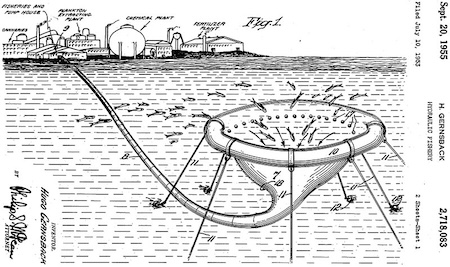
(Hydraulic Fishery patent drawing by Hugo Gernsback in 1953)
End update.
From MIT tests self-propelled cage for fish farming.
Scroll down for more stories in the same category. (Story submitted 9/11/2008)
Follow this kind of news @Technovelgy.| Email | RSS | Blog It | Stumble | del.icio.us | Digg | Reddit |
Would
you like to contribute a story tip?
It's easy:
Get the URL of the story, and the related sf author, and add
it here.
Comment/Join discussion ( 2 )
Related News Stories - (" Biology ")
Living Human Neuron Biological Compute Rack
'The men are dead, but their acquired wisdom lives on and I am the beneficiary.' - Dr. David H. Keller, 1931
Biological War: A Scenario
'And now they wre busily transforming all their companions, and so on, and so on...' - Greg Bear, 1984.
What'll You Have? Extinct Animals Returned, Or Synthetic Eggshells?
'...a new plastic with the characteristics of an avian eggshell.' - Michael Crichton, 1990.
Black Fungus Blocks Radiation
'You were surrounded by Astrophage most of the time' - Andy Weir, 2021.
Technovelgy (that's tech-novel-gee!) is devoted to the creative science inventions and ideas of sf authors. Look for the Invention Category that interests you, the Glossary, the Invention Timeline, or see what's New.

Science Fiction
Timeline
1600-1899
1900-1939
1940's 1950's
1960's 1970's
1980's 1990's
2000's 2010's
Current News
'If Anyone Is Watching Earth...'
'Our study of your race has convinced us that you are not fitted to leave your planet in the present state of your civilization.'
Epirus High-Power Microwave Defeats Drones
'...the spreading beam of the deranging ray struck them, and Then one toppled and fell. Then another.'
Cloud Of Space Rubbish From China's Long March Rocket
'Within seconds the material was spread out over fifty yards, in a matter of hours it might occupy several cubic miles of space...'
Biomimetic Tendons From Rochu Robotics
'... the curious parallelism to animal motions.'
Living Human Neuron Biological Compute Rack
'The men are dead, but their acquired wisdom lives on and I am the beneficiary.'
Martha Stewart Approves Ojai 'Living Room On Wheels'
'Young people found the driverless car admirable for petting.'
ESA's Draco To Study Heat Of Reentry
'...a synthetic which air-friction would erode.'
Buy A Galaxy? Maybe Start Smaller
'The sky is the limit' just got higher.
The United States Space Academy Is Official
'Is our orbit to Space Academy clear?'
Is There A Global Problem With Who Is Having Children?
'After twenty generations of shillyshallying...'
You Will Eat The Cookies Made From Plastic...
'Our planes are going to start bringing in bales of discarded plastics...'
It's A Giant Robot! You Reporters Have Been Warned!
'... completely forgetting the ship at sight of the awesome figure and great head of the giant Gaut...'
Birds Learn To Sing Pictures ala Frank Herbert's Distrans
'We will fight in the time of fighting.'
ElectionSim: China's 'Ender's Game' Battle Sim, Or Lem's 'Kingdom In A Box'?
'So, Ender, we will now begin your education.'
Tactile Skin Supplier Map
'What strange sensitivity! What an amazing development of science was manifested in every move and act and word of this Robot!'
Flock Stymied By 'Adversarial Fashion'
'Forget the head atop it, the legs below, feet, arms, hands. It compels erasure.'

