
Science Fiction
Dictionary
A B C D E F G H I J K L M N O P Q R S T U V W X Y Z

 |
NASA's Chariot Is Not Your Father's Moon Rover

The NASA Chariot is a lunar truck prototype created to service the future US lunar outpost. Developed by the Exploration Technology Development Program's Human-Robotics Systems Project in just eleven months, the vehicle is designed to meet the payload transport, range, terrain and speed specifications defined by NASA’s Lunar Architecture Team.
(NASA Chariot rover video)
The Chariot's chassis can be reconfigured for a variety of purposes and payloads. It can carry a mix of suited crew and payload; it can also be outfitted with a small pressurized cabin.
The pilot's control pedestal can rotate 360 degrees; the Chariot has no "front" or "rear." According to Johnson Space Center roboticist Rob Ambrose "The Apollo astronauts couldn't back up at all because they couldn't see where they were going in reverse." The vehicle itself has a zero turn radius - it can turn around entirely within its own length.
NASA's Chariot is also the first lunar drop deck lowboy - take a look at the Chariot with the chassis dropped right down to the ground for easy loading and unloading.
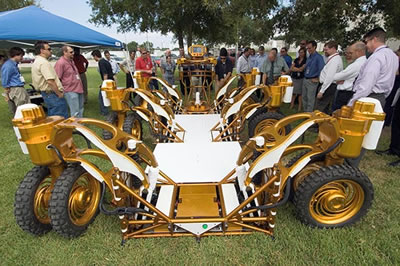
(NASA Chariot shown here dropped to the ground)
The specifications for Chariot were set forth as follows:
| Chariot Spec | Earth Prototype | Lunar System |
| Payload | 1000 kg | 3000-6000 kg |
| Vehicle Mass | 2000 kg | 1000 kg |
| Top Speed | 20 kph | 20 kph |
| Range | 25 km | 100 km |
| Slope Climbing | 15 Degrees | 25 Degrees |
Science fiction writers have spent a fair amount of time thinking about how to get around on the Moon's surface. Arthur C. Clarke thought we might need mass transit:
The monocab entered a long tunnel at the base of one of the domes. Sadler had a glimpse of great doors closing behind them - then another set, then another. Then there was the unmistakable sound of air surging around them, a final door opened ahead...
(Read more about Clarke's monocab from Earthlight [1955])
Clarke also created a practical vehicle for towing material around on the Moon's surface that took advantage of the powdery lunar soil - the dust-ski, which moved like a jet-ski through deep lunar powder:
At that very moment... one of the searching dusk-skis was passing directly overhead. Built for speed, efficiency and cheapness ... It was, in fact, no more than an open sledge with seats for the pilot and one passenger - each wearing a space suit - and with a canopy overhead to give protection from the sun. A simple control panel, motor and twin fans at the rear, storage racks for tools and equipment - that completed the inventory. A ski going about its normal work usually towed at least one carrier sledge behind it
(Read more about Clarke's dusk-ski from A Fall of Moondust [1961])
Robert Heinlein thought that lunar prospectors might want to have something more personal for travel and hauling:
The solitary prospector, deprived of his traditional burro, found the bicycle an acceptable and reliable, if somewhat less congenial, substitute. A miner's bike would have looked odd in the streets of Stockholm; over-sized wheels, doughnut sand tires, towing yoke and trailer, battery trickle charger, two-way radio, saddle bags and Geiger-counter mount made it not the vehicle for a spin in the park - but on Mars or on the Moon it fitted its purpose the way a canoe fits a Canadian stream.
(Read more about Heinlein's lunocycle from The Rolling Stones [1952])
From NASA Chariot via Wired.
Scroll down for more stories in the same category. (Story submitted 3/5/2008)
Follow this kind of news @Technovelgy.| Email | RSS | Blog It | Stumble | del.icio.us | Digg | Reddit |
Would
you like to contribute a story tip?
It's easy:
Get the URL of the story, and the related sf author, and add
it here.
Comment/Join discussion ( 0 )
Related News Stories - (" Space Tech ")
'If Anyone Is Watching Earth...'
'Our study of your race has convinced us that you are not fitted to leave your planet in the present state of your civilization.' - Arthur C. Clarke, 1946.
Cloud Of Space Rubbish From China's Long March Rocket
'Within seconds the material was spread out over fifty yards, in a matter of hours it might occupy several cubic miles of space...'
ESA's Draco To Study Heat Of Reentry
'...a synthetic which air-friction would erode.' - EE Doc Smith, 1934.
The United States Space Academy Is Official
'Is our orbit to Space Academy clear?' - Carey Rockwell
Technovelgy (that's tech-novel-gee!) is devoted to the creative science inventions and ideas of sf authors. Look for the Invention Category that interests you, the Glossary, the Invention Timeline, or see what's New.

Science Fiction
Timeline
1600-1899
1900-1939
1940's 1950's
1960's 1970's
1980's 1990's
2000's 2010's
Current News
'If Anyone Is Watching Earth...'
'Our study of your race has convinced us that you are not fitted to leave your planet in the present state of your civilization.'
Epirus High-Power Microwave Defeats Drones
'...the spreading beam of the deranging ray struck them, and Then one toppled and fell. Then another.'
Cloud Of Space Rubbish From China's Long March Rocket
'Within seconds the material was spread out over fifty yards, in a matter of hours it might occupy several cubic miles of space...'
Biomimetic Tendons From Rochu Robotics
'... the curious parallelism to animal motions.'
Living Human Neuron Biological Compute Rack
'The men are dead, but their acquired wisdom lives on and I am the beneficiary.'
Martha Stewart Approves Ojai 'Living Room On Wheels'
'Young people found the driverless car admirable for petting.'
ESA's Draco To Study Heat Of Reentry
'...a synthetic which air-friction would erode.'
Buy A Galaxy? Maybe Start Smaller
'The sky is the limit' just got higher.
The United States Space Academy Is Official
'Is our orbit to Space Academy clear?'
Is There A Global Problem With Who Is Having Children?
'After twenty generations of shillyshallying...'
You Will Eat The Cookies Made From Plastic...
'Our planes are going to start bringing in bales of discarded plastics...'
It's A Giant Robot! You Reporters Have Been Warned!
'... completely forgetting the ship at sight of the awesome figure and great head of the giant Gaut...'
Birds Learn To Sing Pictures ala Frank Herbert's Distrans
'We will fight in the time of fighting.'
ElectionSim: China's 'Ender's Game' Battle Sim, Or Lem's 'Kingdom In A Box'?
'So, Ender, we will now begin your education.'
Tactile Skin Supplier Map
'What strange sensitivity! What an amazing development of science was manifested in every move and act and word of this Robot!'
Flock Stymied By 'Adversarial Fashion'
'Forget the head atop it, the legs below, feet, arms, hands. It compels erasure.'

