
Science Fiction
Dictionary
A B C D E F G H I J K L M N O P Q R S T U V W X Y Z

 |
MoonLITE 'Mole' Penetrators For Lunar Exploration

The MoonLITE (Moon Lightweight Interior and Telecoms Experiment) project is a proposed collaboration by the British government and NASA. A satellite would be placed in orbit around the Moon carrying penetrator probes. These probes would be dropped from orbit, penetrating the lunar crust. Readings from shock-resistant instruments would be sent back to the orbiter, and then back to Earth.
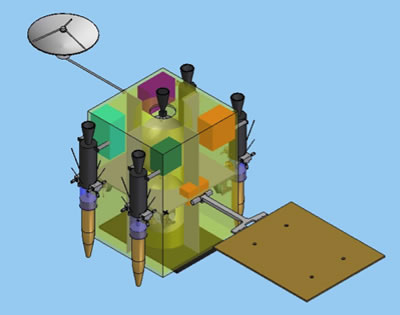
(MoonLITE Lunar Orbiter working design [pdf])
The orbiting platform would consist of a large, high thrust propulsion system and associated support structure, including communications and navigation capabilities. Power would be provided by a single solar array. The platform would communicate with the penetrators at data rates ranging from 200 bps to 3kbs.
According to the UK Space Board's Professor Keith Mason:
"This joint report represents a milestone... The [plans] provide an opportunity to harness the UK’s world-class expertise in small satellite, communication and robotic technologies focused on exploration of the Moon... the UK is fully exploiting and strategically maximising its technological and scientific strengths in space exploration."
The primary science goals of the program are summarized as follows:
- Constraining the origin, differentiation, internal structure, and early geological evolution of the Moon.
- Gaining a better understanding of the origin and history of the volatile flux in the Earth-Moon system.
- Collecting of “ground truth” geochemical data for the calibration of orbiting remote-sensing instruments.
- Collecting in situ surface data that would help in the planning of future lunar exploration activities.
Initially, the platform would enter a 100 kilometer altitude circular orbit; it would come within 40 kilometers of the surface for deployment of penetrators. Following deployment, the orbiter would move into a higher orbit to increase long-term orbit stability.
The penetrator deployment sequence is shown below. After a free-fall of about 3.5 minutes, the penetrator realigns itself to assure a near-vertical impact. The final impact velocity is estimated at about 350 meters per second.
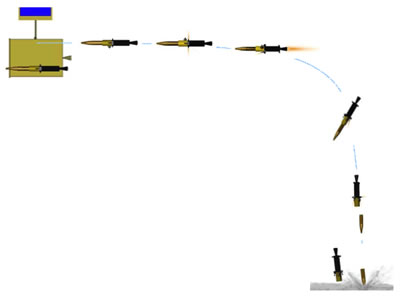
(MoonLITE penetrator impact launch sequence [pdf])
The Penetrator Delivery System is shown below in a conceptual sketch.
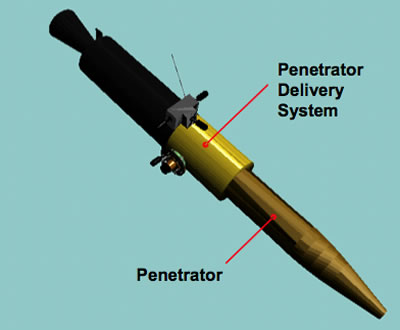
(MoonLITE Lunar penetrator delivery system design concept [pdf])
The penetrator instrument package would include the following capabilities:
- Accelerometer/tilt assembly
- Micro Electro Mechanical Systems (MEMS)- based microseismometer
- Pressure sensors, impedance spectrometer, compact mass spectrometer
- Sample collection and thermal control system is based on the drill and the pyrotechnic sample volume sealing device based on NASA Deep Space 2.
- Thermal sensors
- Geochemical analysis
- Microscope
- Radiation sensor
- Magnetometer
- Descent camera
The group believes that by deploying instruments to a variety of carefully chosen locations never before explored (including the poles and the lunar farside), MoonLITE penetrators have the potential to make major contributions to lunar science. The mission would also provide knowledge essenial to future human missions to the Moon, and demonstrate technology that could be used elsewhere in the solar system.
In his 1958 novel The Mechanical Monarch, EC Tubb writes about asteroid miners who want to know the composition of asteroids prior to actually landing on them. They use a projectile to blow some material into vapor, and then use spectral analysis to determine composition.
From Joint Working Group Report on Lunar Cooperation via The Register.
Scroll down for more stories in the same category. (Story submitted 2/20/2008)
Follow this kind of news @Technovelgy.| Email | RSS | Blog It | Stumble | del.icio.us | Digg | Reddit |
Would
you like to contribute a story tip?
It's easy:
Get the URL of the story, and the related sf author, and add
it here.
Comment/Join discussion ( 5 )
Related News Stories - (" Space Tech ")
'If Anyone Is Watching Earth...'
'Our study of your race has convinced us that you are not fitted to leave your planet in the present state of your civilization.' - Arthur C. Clarke, 1946.
Cloud Of Space Rubbish From China's Long March Rocket
'Within seconds the material was spread out over fifty yards, in a matter of hours it might occupy several cubic miles of space...'
ESA's Draco To Study Heat Of Reentry
'...a synthetic which air-friction would erode.' - EE Doc Smith, 1934.
The United States Space Academy Is Official
'Is our orbit to Space Academy clear?' - Carey Rockwell
Technovelgy (that's tech-novel-gee!) is devoted to the creative science inventions and ideas of sf authors. Look for the Invention Category that interests you, the Glossary, the Invention Timeline, or see what's New.

Science Fiction
Timeline
1600-1899
1900-1939
1940's 1950's
1960's 1970's
1980's 1990's
2000's 2010's
Current News
'If Anyone Is Watching Earth...'
'Our study of your race has convinced us that you are not fitted to leave your planet in the present state of your civilization.'
Epirus High-Power Microwave Defeats Drones
'...the spreading beam of the deranging ray struck them, and Then one toppled and fell. Then another.'
Cloud Of Space Rubbish From China's Long March Rocket
'Within seconds the material was spread out over fifty yards, in a matter of hours it might occupy several cubic miles of space...'
Biomimetic Tendons From Rochu Robotics
'... the curious parallelism to animal motions.'
Living Human Neuron Biological Compute Rack
'The men are dead, but their acquired wisdom lives on and I am the beneficiary.'
Martha Stewart Approves Ojai 'Living Room On Wheels'
'Young people found the driverless car admirable for petting.'
ESA's Draco To Study Heat Of Reentry
'...a synthetic which air-friction would erode.'
Buy A Galaxy? Maybe Start Smaller
'The sky is the limit' just got higher.
The United States Space Academy Is Official
'Is our orbit to Space Academy clear?'
Is There A Global Problem With Who Is Having Children?
'After twenty generations of shillyshallying...'
You Will Eat The Cookies Made From Plastic...
'Our planes are going to start bringing in bales of discarded plastics...'
It's A Giant Robot! You Reporters Have Been Warned!
'... completely forgetting the ship at sight of the awesome figure and great head of the giant Gaut...'
Birds Learn To Sing Pictures ala Frank Herbert's Distrans
'We will fight in the time of fighting.'
ElectionSim: China's 'Ender's Game' Battle Sim, Or Lem's 'Kingdom In A Box'?
'So, Ender, we will now begin your education.'
Tactile Skin Supplier Map
'What strange sensitivity! What an amazing development of science was manifested in every move and act and word of this Robot!'
Flock Stymied By 'Adversarial Fashion'
'Forget the head atop it, the legs below, feet, arms, hands. It compels erasure.'

