
Science Fiction
Dictionary
A B C D E F G H I J K L M N O P Q R S T U V W X Y Z

 |
Circuit Smart Contact Lens, Presaged By Niven, Barnes and Vinge

Contact lenses with imprinted electronic circuits and lights for augmented reality display vision are under development by University of Washington scientists.

(Contact lens with circuits worn by rabbit)
The UW engineers used microscopic scale manufacturing techniques to create a flexible, biologically safe contact lens with imprinted electronic circuits and lights. If used by human beings, a pair of contact lenses with circuits and lights would be the perfect display for augmented reality systems.
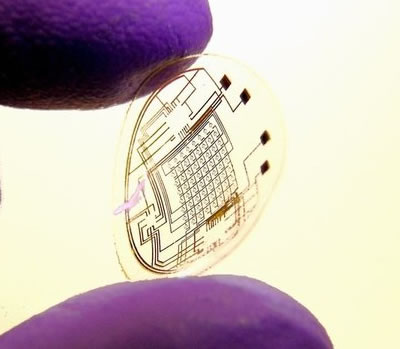
(Contact lens with circuits close-up)
The prototype device contains an electric circuit as well as red light-emitting diodes for a display, though it does not yet light up. The lenses were tested on rabbits for up to 20 minutes and the animals showed no adverse effects.
"Looking through a completed lens, you would see what the display is generating superimposed on the world outside," said Babak Parviz, a UW assistant professor of electrical engineering. "This is a very small step toward that goal, but I think it's extremely promising."
Researchers built the circuits from layers of metal only a few nanometers thick, about one thousandth the width of a human hair, and constructed light-emitting diodes one third of a millimeter across. The researchers hope to power the whole system using a combination of radio-frequency power and solar cells placed on the lens.
Science fiction readers are fortunate to have had this idea presented to them several years ago. In his 2001 novella Fast Times at Fairmont High, sf writer, computer scientist and mathematician Vernor Vinge described a near-future world in which everyone used smart contact lens displays. In his 2006 novel Rainbows End, set in the same milieu, he describes them this way:
Miri... leaned her head forward, and stuck a finger close to her right eye. "You already know about contacts, right? Wanna see one?" Her hand came away from her eye. A tiny disk sat on the tip of her middle finger. It was the size and shape of the contact lenses he had known. He hadn't expected more, but... he bent closed and looked. After a moment, he realized that it was not quite a clear lens. Speckles of colored brightness swirled and gathered in it. "I'm driving it at safety max, or you wouldn't see the lights." The tiny lens became hazy, then frosty white. "Uk. It powered down. But you get the idea.."
(Read more about Vinge's smart contact lenses)
The results were presented today at the Institute of Electrical and Electronics Engineers' international conference on Micro Electro Mechanical Systems by Harvey Ho, a former graduate student of Parviz's now working at Sandia National Laboratories in Livermore, Calif. Other co-authors are Ehsan Saeedi and Samuel Kim in the UW's electrical engineering department and Tueng Shen in the UW Medical Center's ophthalmology department.
A full-fledged display won't be available for a while, but a version that has a basic display with just a few pixels could be operational "fairly quickly," according to Parviz.
Update 21-Jan-08: According to Babak Parviz, he and his colleagues got started on this idea in 2004; he hadn't heard about the Vinge story. End update.
Update 22-Jan-08: I wrote Vernor Vinge and asked him whether or not he was familiar with Parviz' research. He replied that he was not. I asked him how he thought of the idea:
"I think I had these in "Fast Times at Fairmont High" (2001). Basically I wanted an augmented reality display that wouldn't involve implants but which would not appear intrusive. The full-bore invention will be a real challenge: the form factor, the power supply, the transparency management, the wireless networking, the very accurate overlay positioning.However, lightweight head-up displays will probably take off incrementally (and soon!) and that process should be very fun to track."
I corrected the article and the reference to reflect the earlier time. Note that Vinge also mentioned "I bet there is prior sf'nal art on this!" End update.
Update 22-Jan-08: Thanks to diligent and alert readers, I can add to (keep correcting!) the story. In their 1992 collaboration The California Voodoo Game, Larry Niven and Steven Barnes wrote about scleral contact lenses:
To Nigel Bishop, the walls had become blue glass. He saw and evaluated holographic projection equipment, fiber optics, electrical and plumbing, communications...His eyes no longer resembled human eyes...
"Scleral lenses?" she asked. "You've got DreamTime technology in contact lenses? That's not available to the public!"
(Read more about Niven and Barnes' DreamTime scleral contact lenses)
It seems clear that the scleral contacts describe a display upon which images or data can be viewed, and the images do not appear to be projected from elsewhere upon the surface of the lens. End update.
Read about other efforts at establishing augmented reality displays:
- Augmented Reality Humanoid Robot U-Tsu-Shi-O-Mi
This disturbing robot prototype s a "mixed reality" (or augmented reality) set-up that uses an otherwise featureless humanoid robot as a substrate. - Smart Dressing Mirror RFID-Based mi-tu Fashion
This innovative smart dressing system offers real-time mix-and-match style advices to customers when they view their selected fashion items.
Via Contact lenses with circuits, lights a possible platform for superhuman vision; thanks to Misja van Laatum for writing in with the tip on the story.
Scroll down for more stories in the same category. (Story submitted 1/17/2008)
Follow this kind of news @Technovelgy.| Email | RSS | Blog It | Stumble | del.icio.us | Digg | Reddit |
Would
you like to contribute a story tip?
It's easy:
Get the URL of the story, and the related sf author, and add
it here.
Comment/Join discussion ( 29 )
Related News Stories - (" Display ")
Did Frank Herbert Predict Bistable Displays Like E-Ink?
'A broken circle with arrows pointing to a right-hand flow appeared in the chalf.' - Frank Herbert, 1964.
I Need An Outdoor Spherical Display
'Usually a spherical display hovered in the centre...' - Iain M. Banks, 2010.
Outdoor Video Screens Can Be Arbitrarily Large
The Shape of Things To Come, HG Wells, 1936.
iPhone Air Fulfils Jobs' Promise From 2007 - A Giant Screen!
'... oblongs were all over the floor and surfaces.' - Kazuo Ishiguro, 2021.
Technovelgy (that's tech-novel-gee!) is devoted to the creative science inventions and ideas of sf authors. Look for the Invention Category that interests you, the Glossary, the Invention Timeline, or see what's New.

Science Fiction
Timeline
1600-1899
1900-1939
1940's 1950's
1960's 1970's
1980's 1990's
2000's 2010's
Current News
'If Anyone Is Watching Earth...'
'Our study of your race has convinced us that you are not fitted to leave your planet in the present state of your civilization.'
Epirus High-Power Microwave Defeats Drones
'...the spreading beam of the deranging ray struck them, and Then one toppled and fell. Then another.'
Cloud Of Space Rubbish From China's Long March Rocket
'Within seconds the material was spread out over fifty yards, in a matter of hours it might occupy several cubic miles of space...'
Biomimetic Tendons From Rochu Robotics
'... the curious parallelism to animal motions.'
Living Human Neuron Biological Compute Rack
'The men are dead, but their acquired wisdom lives on and I am the beneficiary.'
Martha Stewart Approves Ojai 'Living Room On Wheels'
'Young people found the driverless car admirable for petting.'
ESA's Draco To Study Heat Of Reentry
'...a synthetic which air-friction would erode.'
Buy A Galaxy? Maybe Start Smaller
'The sky is the limit' just got higher.
The United States Space Academy Is Official
'Is our orbit to Space Academy clear?'
Is There A Global Problem With Who Is Having Children?
'After twenty generations of shillyshallying...'
You Will Eat The Cookies Made From Plastic...
'Our planes are going to start bringing in bales of discarded plastics...'
It's A Giant Robot! You Reporters Have Been Warned!
'... completely forgetting the ship at sight of the awesome figure and great head of the giant Gaut...'
Birds Learn To Sing Pictures ala Frank Herbert's Distrans
'We will fight in the time of fighting.'
ElectionSim: China's 'Ender's Game' Battle Sim, Or Lem's 'Kingdom In A Box'?
'So, Ender, we will now begin your education.'
Tactile Skin Supplier Map
'What strange sensitivity! What an amazing development of science was manifested in every move and act and word of this Robot!'
Flock Stymied By 'Adversarial Fashion'
'Forget the head atop it, the legs below, feet, arms, hands. It compels erasure.'

