
Science Fiction
Dictionary
A B C D E F G H I J K L M N O P Q R S T U V W X Y Z

 |
Web Photos Now Have Zero Credibility

Well-meaning researchers from Carnegie Mellon University destroyed the credibility of all photos on the web today. Alexiei Efros, assistant professor of computer science and robotics lead the team that created two related systems that, together, will do what governments and corporations could only dream of (until now).
The first program, called Photo Clip Art, uses thousands of labeled images from a site called LabelMe. These images can be added to photos. The system analyzes the geometric context of a photo, and place objects within the scene, adjusting its size as necessary to put it in proportion to other objects of equal distance from the camera.
The second program is called Scene Completion. It draws upon millions of photos from the Flickr website to fill in holes in photos. These "holes" are created when editors decide that some part of a picture is unsightly, and wants to remove it.
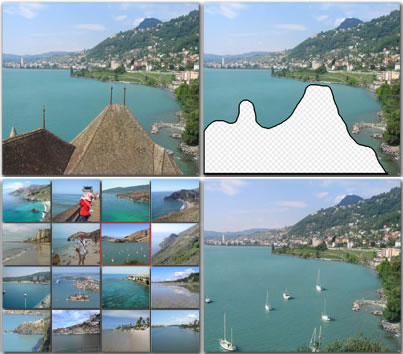
(Scene completion work flow)
Clockwise from top left 1) the original photo, 2) undesirable material removed, 3) thousands of possible matches scanned and 4) the new, doctored photo
This kind of work was done before, of course, but it was a painstaking and difficult chore. A person did all of the steps by hand, searching through photos for possible matches, and sizing and placing the substitute image fragments.
Now, any photo can be doctored easily, in seconds. Something unpleasant in that picture? Take it out. Don't like that person in the picture? Find someone else. Maybe even you, if you have a picture on Flickr.
I'm guessing that this technique will probably not stand up to rigorous examination of large file pictures; that's why I'm limiting it to web pictures, which are of relatively low quality. The entire graphic shown on this page is only 403x354 pixels.
Just think of all the tedious work done by Winston Smith, rewriting history in 1984 - and all that effort done with text, let alone pictures.
What happened in the unseen labyrinth to which the pneumatic tubes led, he did not know in detail, but he did know in general terms. As soon as all the corrections which happened to be necessary in any particular number of 'The Times' had been assembled and collated, that number would be reprinted, the original copy destroyed, and the corrected copy placed on the files in its stead. This process of continuous alteration was applied not only to newspapers, but to books, periodicals, pamphlets, posters, leaflets, films, sound-tracks, cartoons, photographs--to every kind of literature or documentation which might conceivably hold any political or ideological significance. Day by day and almost minute by minute the past was brought up to date.
Via Eurekalert.
Scroll down for more stories in the same category. (Story submitted 7/11/2007)
Follow this kind of news @Technovelgy.| Email | RSS | Blog It | Stumble | del.icio.us | Digg | Reddit |
Would
you like to contribute a story tip?
It's easy:
Get the URL of the story, and the related sf author, and add
it here.
Comment/Join discussion ( 2 )
Related News Stories - (" Communication ")
Birds Learn To Sing Pictures ala Frank Herbert's Distrans
'We will fight in the time of fighting.' - Frank Herbert, 1965.
Polish Turns Your Nail Into A Stylus
'He wrote on it, using the pointed fingernail of his right forefinger...' - Cordwainer Smith, 1950.
Huawei Pura X Folding Phattie Phone
Why can't we get more innovative phone configurations?
Positioned Cybertrucks With Free Starlinks WiFi In LA
'Several thousand of them formed the positioning grid on the rubble pile.' Vernor Vinge, 1999.
Technovelgy (that's tech-novel-gee!) is devoted to the creative science inventions and ideas of sf authors. Look for the Invention Category that interests you, the Glossary, the Invention Timeline, or see what's New.

Science Fiction
Timeline
1600-1899
1900-1939
1940's 1950's
1960's 1970's
1980's 1990's
2000's 2010's
Current News
'If Anyone Is Watching Earth...'
'Our study of your race has convinced us that you are not fitted to leave your planet in the present state of your civilization.'
Epirus High-Power Microwave Defeats Drones
'...the spreading beam of the deranging ray struck them, and Then one toppled and fell. Then another.'
Cloud Of Space Rubbish From China's Long March Rocket
'Within seconds the material was spread out over fifty yards, in a matter of hours it might occupy several cubic miles of space...'
Biomimetic Tendons From Rochu Robotics
'... the curious parallelism to animal motions.'
Living Human Neuron Biological Compute Rack
'The men are dead, but their acquired wisdom lives on and I am the beneficiary.'
Martha Stewart Approves Ojai 'Living Room On Wheels'
'Young people found the driverless car admirable for petting.'
ESA's Draco To Study Heat Of Reentry
'...a synthetic which air-friction would erode.'
Buy A Galaxy? Maybe Start Smaller
'The sky is the limit' just got higher.
The United States Space Academy Is Official
'Is our orbit to Space Academy clear?'
Is There A Global Problem With Who Is Having Children?
'After twenty generations of shillyshallying...'
You Will Eat The Cookies Made From Plastic...
'Our planes are going to start bringing in bales of discarded plastics...'
It's A Giant Robot! You Reporters Have Been Warned!
'... completely forgetting the ship at sight of the awesome figure and great head of the giant Gaut...'
Birds Learn To Sing Pictures ala Frank Herbert's Distrans
'We will fight in the time of fighting.'
ElectionSim: China's 'Ender's Game' Battle Sim, Or Lem's 'Kingdom In A Box'?
'So, Ender, we will now begin your education.'
Tactile Skin Supplier Map
'What strange sensitivity! What an amazing development of science was manifested in every move and act and word of this Robot!'
Flock Stymied By 'Adversarial Fashion'
'Forget the head atop it, the legs below, feet, arms, hands. It compels erasure.'

