
Science Fiction
Dictionary
A B C D E F G H I J K L M N O P Q R S T U V W X Y Z

 |
Space Station Gets Shielding, Not Blasters

Russian cosmonauts climbed out of the International Space Station on Wednesday afternoon to install protective panels. Commander Fyodor Yurchikhin and flight engineer Oleg Kotov completed the planned work five hours later. The spacewalk was delayed due to problems encountered during communication checks. The 17 protective panels, each about 2 feet by 3 feet and weighing about 20 pounds, were delivered to the station last December.
The plan is for Kotov to retrieve three bundles of Service Module Debris Protection Panels and then attach them to the Zvezda Service Module. Zvezda provides some of the station's life support systems, as well as living quarters for two crewmen with a treadmill and a bicycle for exercise. A second spacewalk planned for June 6th will complete the installation.
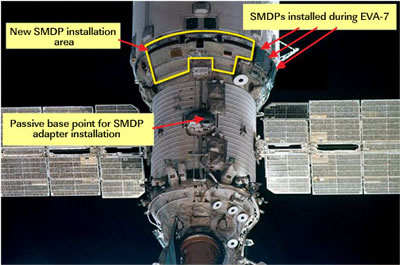
(SMDP installation locations on Zvezda)
NASA engineers are concerned that space debris, in the form of everything from rocket parts to Chinese ASAT test debris to dropped wrenches, will damage the ISS. It will be possible to turn the ISS slightly to present a shield to oncoming debris, assuming that the object is big enough to be tracked.
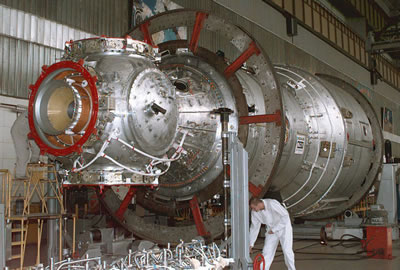
(Zvezda under construction)
Science fiction writers have been working on protection for spacecraft for generations now, and frankly, nobody's interested in those passive bolt-on panels. To paraphrase Han Solo, panels are fine but they're "no match for a good blaster at your side."
In his 1945 classic First Contact, writer Murray Leinster puts his money on blasters as the best way to deal with any object large enough to damage your ship.
The blasters are those beams of ravening destruction which take care of recalcitrant meteorites in a ship's course when the deflectors can't handle them. They are not designed as weapons, but they can serve as pretty good ones. They can go into action at five thousand miles, and draw on the entire power output of a whole ship. With automatic aim and a traverse of five degrees, a ship like the Llanvabon can come very close to blasting a whole through a small-sized asteroid which gets in the way.
(Read more about meteor blasters)
I know it's a lot of extra work, but it gives you a better ride than those deflector shields that George Lucas suggests. If you didn't mind using a bit of propellant, you could try the solution that George O. Smith suggests in his 1943 story Recoil - meteor-spotting radar:
Spacecraft were protected from meteors by means of radar that was coupled to the steering panels of the ships; when a meteor threatened, the ship merely turned aside by that fraction of a degree that gave it safety.
(Read more about meteor-spotting radar)
But then, of course, you don't get to use your blasters.
Read about the origin of the sf term "blaster." Read more about the space walk at ISS Mission Update and NASA.
Scroll down for more stories in the same category. (Story submitted 5/30/2007)
Follow this kind of news @Technovelgy.| Email | RSS | Blog It | Stumble | del.icio.us | Digg | Reddit |
Would
you like to contribute a story tip?
It's easy:
Get the URL of the story, and the related sf author, and add
it here.
Comment/Join discussion ( 2 )
Related News Stories - (" Space Tech ")
'If Anyone Is Watching Earth...'
'Our study of your race has convinced us that you are not fitted to leave your planet in the present state of your civilization.' - Arthur C. Clarke, 1946.
Cloud Of Space Rubbish From China's Long March Rocket
'Within seconds the material was spread out over fifty yards, in a matter of hours it might occupy several cubic miles of space...'
ESA's Draco To Study Heat Of Reentry
'...a synthetic which air-friction would erode.' - EE Doc Smith, 1934.
The United States Space Academy Is Official
'Is our orbit to Space Academy clear?' - Carey Rockwell
Technovelgy (that's tech-novel-gee!) is devoted to the creative science inventions and ideas of sf authors. Look for the Invention Category that interests you, the Glossary, the Invention Timeline, or see what's New.

Science Fiction
Timeline
1600-1899
1900-1939
1940's 1950's
1960's 1970's
1980's 1990's
2000's 2010's
Current News
'If Anyone Is Watching Earth...'
'Our study of your race has convinced us that you are not fitted to leave your planet in the present state of your civilization.'
Epirus High-Power Microwave Defeats Drones
'...the spreading beam of the deranging ray struck them, and Then one toppled and fell. Then another.'
Cloud Of Space Rubbish From China's Long March Rocket
'Within seconds the material was spread out over fifty yards, in a matter of hours it might occupy several cubic miles of space...'
Biomimetic Tendons From Rochu Robotics
'... the curious parallelism to animal motions.'
Living Human Neuron Biological Compute Rack
'The men are dead, but their acquired wisdom lives on and I am the beneficiary.'
Martha Stewart Approves Ojai 'Living Room On Wheels'
'Young people found the driverless car admirable for petting.'
ESA's Draco To Study Heat Of Reentry
'...a synthetic which air-friction would erode.'
Buy A Galaxy? Maybe Start Smaller
'The sky is the limit' just got higher.
The United States Space Academy Is Official
'Is our orbit to Space Academy clear?'
Is There A Global Problem With Who Is Having Children?
'After twenty generations of shillyshallying...'
You Will Eat The Cookies Made From Plastic...
'Our planes are going to start bringing in bales of discarded plastics...'
It's A Giant Robot! You Reporters Have Been Warned!
'... completely forgetting the ship at sight of the awesome figure and great head of the giant Gaut...'
Birds Learn To Sing Pictures ala Frank Herbert's Distrans
'We will fight in the time of fighting.'
ElectionSim: China's 'Ender's Game' Battle Sim, Or Lem's 'Kingdom In A Box'?
'So, Ender, we will now begin your education.'
Tactile Skin Supplier Map
'What strange sensitivity! What an amazing development of science was manifested in every move and act and word of this Robot!'
Flock Stymied By 'Adversarial Fashion'
'Forget the head atop it, the legs below, feet, arms, hands. It compels erasure.'

