
Science Fiction
Dictionary
A B C D E F G H I J K L M N O P Q R S T U V W X Y Z
Latest By
Category:
Armor
Artificial
Intelligence
Biology
Clothing
Communication
Computers
Culture
Data Storage
Displays
Engineering
Entertainment
Food
Input Devices
Lifestyle
Living Space
Manufacturing
Material
Media
Medical
Miscellaneous
Robotics
Security
Space Tech
Spacecraft
Surveillance
Transportation
Travel
Vehicle
Virtual
Person
Warfare
Weapon
Work
"Money to me is freedom, and freedom is essential. Money allows me to say that I will now devote my life to being me, rather than putting on my shoes and tie, and going to an office every day."
- Robert Silverberg

 |
| Networked Telephone Answering Machine | ||
| A device that would accept verbal messages and store them for replay from any remote station. |

H.G. Wells was not the first person to think of a telephone answering machine; however, he was the first one to really get it right.
| On his second walk with Mr. Barnstaple he said he was going to hear
from his mother, and Mr. Barnstaple was shown the equivalent of
correspondence in Utopia. Crystal carried a little bundle of wires
and light rods; and presently coming to a place where a pillar
stood in the midst of a lawn he spread this affair out like a long
cat's cradle and tapped a little stud in the pillar with a key that
he carried on a light gold chain about his neck. Then he took up a
receiver attached to his apparatus, and spoke aloud and listened
and presently heard a voice.
It was a very pleasant woman's voice; it talked to Crystal for a time without interruption, and then Crystal talked back, and afterwards there were other voices, some of which Crystal answered and some which he heard without replying. Then he gathered up his apparatus again. This Mr. Barnstaple learnt was the Utopian equivalent of letter and telephone. For in Utopia, except by previous arrangement, people do not talk together on the telephone. A message is sent to the station of the district in which the recipient is known to be, and there it waits until he chooses to tap his accumulated messages. And any that one wishes to repeat can be repeated. Then he talks back to the senders and dispatches any other messages he wishes. The transmission is wireless. The little pillars supply electric power for transmission or for any other purpose the Utopians require. For example, the gardeners resort to them to run their mowers and diggers and rakes and rollers. |
| Technovelgy from Men Like Gods,
by H.G. Wells. Published by Macmillan in 1923 Additional resources -
|
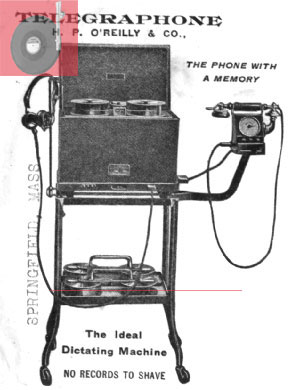
Shortly after inventing the phonograph in 1878, Thomas Edison thought that a possible use would be as a recorder of telephone conversations. However, the first telephone answering machine was probably created by Danish inventor Valdemar Poulsen; he modified his Telegraphone (first patented in 1898) to answer the phone automatically and record a message. The Telegraphone was eventually advertised as "the phone with a memory."
Thomas Edison created the Telescribe in 1914 and marketed the device the following year; the Telescribe could be used to record phone conversations. It was not an automated phone answering machine.
Thanks to the magic of sensible copyright laws, you can read the text of this novel on the Internet for free - see Men Like Gods.
Thanks also to S. Jones for pointing out this item and supplying a quote.
Comment/Join this discussion ( 0 ) | RSS/XML | Blog This |
Additional
resources:
More Ideas
and Technology from Men Like Gods
More Ideas
and Technology by H.G. Wells
Tech news articles related to Men Like Gods
Tech news articles related to works by H.G. Wells
| Birds Learn To Sing Pictures ala Frank Herbert's Distrans |
| Polish Turns Your Nail Into A Stylus |
| Huawei Pura X Folding Phattie Phone |
| Positioned Cybertrucks With Free Starlinks WiFi In LA |
Want to Contribute an
Item?
It's easy:
Get the name of the item, a
quote, the book's name and the author's name, and Add
it here.
| <Previous | Next> |
|
|
|
Technovelgy (that's tech-novel-gee!) is devoted to the creative science inventions and ideas of sf authors. Look for the Invention Category that interests you, the Glossary, the Science Fiction Invention Timeline, or see what's New.
|

Science Fiction
Timeline
1600-1899
1900-1939
1940's 1950's
1960's 1970's
1980's 1990's
2000's 2010's
'Our study of your race has convinced us that you are not fitted to leave your planet in the present state of your civilization.'
'...the spreading beam of the deranging ray struck them, and Then one toppled and fell. Then another.'
'Within seconds the material was spread out over fifty yards, in a matter of hours it might occupy several cubic miles of space...'
'The men are dead, but their acquired wisdom lives on and I am the beneficiary.'
'Young people found the driverless car admirable for petting.'
'After twenty generations of shillyshallying...'

