
Science Fiction
Dictionary
A B C D E F G H I J K L M N O P Q R S T U V W X Y Z
Latest By
Category:
Armor
Artificial
Intelligence
Biology
Clothing
Communication
Computers
Culture
Data Storage
Displays
Engineering
Entertainment
Food
Input Devices
Lifestyle
Living Space
Manufacturing
Material
Media
Medical
Miscellaneous
Robotics
Security
Space Tech
Spacecraft
Surveillance
Transportation
Travel
Vehicle
Virtual
Person
Warfare
Weapon
Work
"I forged a concept which is relatively simple and possibly unique in theology, and that is, the irrational is the primordial stratum of the universe."
- Philip K. Dick

 |
| Memory Vault | ||
| Your personal computer memory, that you can't live without. |

Budrys nails down the problem with our always on computer memories, in our smartphones and computers that we seemingly can't live without.
| Even with a dozen safe places to put it down within easy reach, he still kept his memory vault chained to his wrist. Fay had spent the trip playing his memory on the plane’s excellent equipment, alone in the comfortable but small compartment forward of the ship’s big cargo cabin.
Somewhere in the graceful furniture behind him, a photoelectric relay clicked, and his high-fidelity set began to play the Karinius Missa. The apartment had not forgotten his moods.
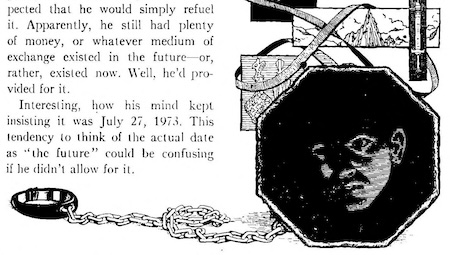 (The memory vault from 'The End of Summer' by Algis Budrys) But his glance had fallen on the memory vault which he had unchained and put on a coffee table. It faced him with the ageless, silent injunction painted on each of its faces; PLAY ME, and underneath this the block of smaller lettering that he, like everyone else, knew by heart: If your surroundings seem unfamiliar, or you have any other reason to suspect that your environment and situation are not usual, request immediate assistance from any other individual. He is obligated by strict law to direct you to the nearest free public playback booth, where you will find further instructions. Do not be alarmed, and follow these directions without anxiety, even if they seem strange to you. In extreme situations, stand still and do not move. Hold this box in front of you with both hands. This is a universally recognized signal of distress. Do not let anyone take this box away from you, no matter what the excuse offered.He laughed at the vault as he kicked it shut on his way to the bathroom. “Not until tonight," he said to PLAY ME, and then teetered for a breathless moment as he struggled to regain his balance. He set his foot down with a laugh, his eyes sparkling... PLAY ME. Like a music tape, the memory vault held his life tightly knit in the nested spindles of bright, imperishable minitape... |
| Technovelgy from The End of Summer,
by Algis Budrys. Published by Astounding Science Fiction in 1954 Additional resources -
|
After the protagonist Fay disdains his automobile's automatics, he runs over a dog out in the country. A small boy is devastated; his parents opt to edit the boy's memory vault:
Thanks to SFFAudio for putting me on the track of this item and this story!
I’ll edit the dog out of his memories tonight. My wife and I’ll clean the place up, and he won’t notice anything.” He paused, reflecting, his eyes dark. “Guess Madge and I’ll cut it out of our own minitapes, too.”
Fay clenched his teeth in sudden annoyance. Nobody ever believed a Dilly. “No,” he said. “I wish you wouldn’t do that. I meant what I said.” He shook his head again. “I don’t like editing. There’s always a slip somewhere, and then you know you’ve got a hole in your memory, but you can never remember what it was.”
The man looked at him curiously. “Funny thing for one of you people to say. I always heard you went for editing in a big way.”
Fay kept his face from showing his thoughts. There it was again — that basic lack of understanding and a complete unwillingness to check secondhand tales. The very essence of his kind of life was that no memory, no experience, not be lived and preserved. Besides, he’d always heard that it was the Homebodies who had to edit whole hectoyears to keep from going mad with boredom.
“No,” he contented himself with saying. “You’re confusing us with the Hoppers. They’ll try anything.”
The man curled his lip at the mention, and Fay reflected that the introduction of a common outsider seemed helpful in circumstances like this.
“Well . . . maybe you’re right,” the man said, still not completely trustful, but willing to take the chance. He gave Fay his name, Arnold Riker, and his address. Fay put the slip of paper carefully in his memor\vault.
“Anytime I lose that. I’ll have lost my memory, too,” he commented.
The man grinned wryly. “More likely, you’ll remember to forget it tonight,” he said, some of his distrust returning at the sight of the spooled tapes.
Comment/Join this discussion ( 0 ) | RSS/XML | Blog This |
Additional
resources:
More Ideas
and Technology from The End of Summer
More Ideas
and Technology by Algis Budrys
Tech news articles related to The End of Summer
Tech news articles related to works by Algis Budrys
| Buy A Galaxy? Maybe Start Smaller |
| Is There A Global Problem With Who Is Having Children? |
| Warfare Goes Underground In Ukraine |
| The Wind Phone Calls Those Who Have Passed On |
Want to Contribute an
Item?
It's easy:
Get the name of the item, a
quote, the book's name and the author's name, and Add
it here.
| <Previous | Next> |
|
|
|
Technovelgy (that's tech-novel-gee!) is devoted to the creative science inventions and ideas of sf authors. Look for the Invention Category that interests you, the Glossary, the Science Fiction Invention Timeline, or see what's New.
|

Science Fiction
Timeline
1600-1899
1900-1939
1940's 1950's
1960's 1970's
1980's 1990's
2000's 2010's
'Our study of your race has convinced us that you are not fitted to leave your planet in the present state of your civilization.'
'...the spreading beam of the deranging ray struck them, and Then one toppled and fell. Then another.'
'Within seconds the material was spread out over fifty yards, in a matter of hours it might occupy several cubic miles of space...'
'The men are dead, but their acquired wisdom lives on and I am the beneficiary.'
'Young people found the driverless car admirable for petting.'
'After twenty generations of shillyshallying...'

