
Science Fiction
Dictionary
A B C D E F G H I J K L M N O P Q R S T U V W X Y Z
Latest By
Category:
Armor
Artificial
Intelligence
Biology
Clothing
Communication
Computers
Culture
Data Storage
Displays
Engineering
Entertainment
Food
Input Devices
Lifestyle
Living Space
Manufacturing
Material
Media
Medical
Miscellaneous
Robotics
Security
Space Tech
Spacecraft
Surveillance
Transportation
Travel
Vehicle
Virtual
Person
Warfare
Weapon
Work
"I just can't be politic. I never learned how to do that and I don't like doing that. I think it's false."
- Harlan Ellison

 |
| Poison Space Cloud (Etheric Poison) | ||
| A deadly cloud of gas large enough to envelop the solar system. |

This is a grand conception, and occasioned the publication of many similar stories.
Again there was silence. It was broken by the high trill of the telephone-bell.
"There is one of our bacilli squeaking for help," said he with a grim smile. "They are beginning to realize that their continued existence is not really one of the necessities of the universe."
He was gone from the room for a minute or two. I remember that none of us spoke in his absence. The situation seemed beyond all words or comments.
"The medical officer of health for Brighton," said he when he returned. "The symptoms are for some reason developing more rapidly upon the sea level. Our seven hundred feet of elevation give us an advantage
Was this just the product of Doyle's prodigious imagination? Or had scientists described a similar phenomenon?
"You will conceive a bunch of grapes," said he, "which are covered by some infinitesimal but noxious bacillus. The gardener passes it through a disinfecting medium. It may be that he desires his grapes to be cleaner. It may be that he needs space to breed some fresh bacillus less noxious than the last. He dips it into the poison and they are gone. Our Gardener is, in my opinion, about to dip the solar system, and the human bacillus will in an instant be sterilized out of existence."
| "Poison!" I cried.
Then, even as I said the word, my mind flashed back over the whole morning's experiences, past Lord John with his buffalo, past my own hysterical tears, past the outrageous conduct of Professor Summerlee, to the queer happenings in London, the row in the park, the driving of the chauffeur, the quarrel at the oxygen warehouse. Everything fitted suddenly into its place. "Of course," I cried again. "It is poison. We are all poisoned." "Exactly," said Challenger, rubbing his hands, "we are all poisoned. Our planet has swum into the poison belt of ether, and is now flying deeper into it at the rate of some millions of miles a minute. Our young friend has expressed the cause of all our troubles and perplexities in a single word, 'poison.'" |
| Technovelgy from The Poison Belt,
by Arthur Conan Doyle. Published by The Strand Magazine in 1913 Additional resources -
|
Where did Doyle get his ideas about enormous gas clouds in local space? It's possible that he read the works of Edward Emerson Barnard (1857-1923), who was an American astronomer renowned for his extensive work in observational astronomy, particularly in the study of dark nebulae, comets, and the Milky Way's structure.
From around 1889, Barnard pioneered deep photography of the sky, finding many 'holes in the Milky Way'. At first he compared them to sunspots, but by 1899 was prepared to write: "One can scarcely conceive a vacancy with holes in it, unless there is nebulous matter covering these apparently vacant places in which holes might occur". These holes are now known as dark nebulae. The first direct detection of cold diffuse matter in interstellar space came in 1904, when Johannes Hartmann observed the binary star Mintaka and deduced that a cloud of interstellar matter must lie in his line of sight to the star.
In 1919, Barnard published "A Photographic Atlas of Selected Regions of the Milky Way," which included 349 dark nebulae, now known as Barnard Objects or B (Barnard) numbers. However, his first significant publication on dark nebulae came in 1913 with his paper titled "Dark Regions in the Sky Suggesting an Obscuration of Light," which appeared in the Astrophysical Journal (read the preface to his Atlas).
There was an earlier news event that might also have prompted his story, about Halley's Comet, which appeared in 1910. French astronomer Camille Flammarion speculated in the media that cyanogen gas in the comet's tail could "impregnate the atmosphere and possibly snuff out all life on the planet" if Earth passed through it. Some newspapers added that maybe acetylene gas might be involved, creating a panic.
I should also point out an even earlier story. In "The Purple Cloud" (1901) MP Shiel describes an arctic explorer who somehow inadvertently releases a vast cloud of toxic cyanide gas that destroys civilization:
What potassic ferrocyanide was doing on board the Boreal I did not know, and I had neither the means, nor the force of mind, alas! to dive then further into the mystery; I understood only that by some extraordinary means the air of the region just south of the Polar environ had been impregnated with a vapour which was either cyanogen, or some product of cyanogen; also, that this deadly vapour, which is very soluble, had by now either been dissolved by the sea, or else dispersed into space (probably the latter), leaving only its faint after-perfume; and seeing this, I let my poor abandoned head drop again on the table, and long hours I sat there staring mad, for I had a suspicion, my God, and a fear, in my breast.
Compare to the galactic damping field from Brain Wave (1953) by Poul Anderson, the more modestly-sized meteoric dust cloud from Secret of the Buried City (1939) by John Russell Fearn and the Concentrated Cosmic Radiation from The Face of the Deep (1942) by Edmond Hamilton.
Similar space clouds have menaced Earth in novels like "Exit Earth" by Martin Caidin and in the short story "Transience" by Arthur C. Clarke. See also The Black Cloud (1957) by Fred Hoyle.
See also The Cosmic Cloud (1931) by Bruno Burgel.
"The dust, though very thin and flighty above-decks, lay thickly deposited below, and after having made a tour of investigation throughout the ship, the first thing which I did was to examine that—though I had tasted nothing all day, and was exhausted to death.
I found my own microscope where I had left it in the box in my berth to starboard, though I had to lift up Egan to get at it, and to step over Lamburn to enter the chart-room; but there, toward evening, I sat at the table and bent to see if I could make anything of the dust, while it seemed to me as if all the myriad spirits of men that have sojourned on the earth, and angel and devil, and all Time and all Eternity, hung silent round for my decision; and such an ague had me, that for a long time my wandering finger-tips, all ataxic with agitation, eluded every delicate effort which I made, and I could nothing do.
Of course, I know that an odour of peach-blossom in the air, resulting in death, could only be associated with some vaporous effluvium of cyanogen, or of hydrocyanic ('prussic') acid, or of both; and when I at last managed to examine some of the dust under the microscope, I was not therefore surprised to find, among the general mass of purplish ash, a number of bright-yellow particles, which could only be minute crystals of potassic ferrocyanide.
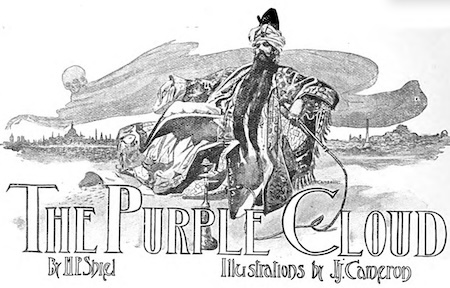
('The Purple Cloud' (1901) by MP Shiel)
Comment/Join this discussion ( 0 ) | RSS/XML | Blog This |
Additional
resources:
More Ideas
and Technology from The Poison Belt
More Ideas
and Technology by Arthur Conan Doyle
Tech news articles related to The Poison Belt
Tech news articles related to works by Arthur Conan Doyle
Poison Space Cloud (Etheric Poison)-related
news articles:
- Did Giant Space Clouds Cause Mass Extinctions?
- We Live In A Space Cloud
- Tunnel Of Magnetized Filaments May Enclose Solar System
| 'If Anyone Is Watching Earth...' |
| Cloud Of Space Rubbish From China's Long March Rocket |
| ESA's Draco To Study Heat Of Reentry |
| The United States Space Academy Is Official |
Want to Contribute an
Item?
It's easy:
Get the name of the item, a
quote, the book's name and the author's name, and Add
it here.
| <Previous | Next> |
|
|
|
Technovelgy (that's tech-novel-gee!) is devoted to the creative science inventions and ideas of sf authors. Look for the Invention Category that interests you, the Glossary, the Science Fiction Invention Timeline, or see what's New.
|

Science Fiction
Timeline
1600-1899
1900-1939
1940's 1950's
1960's 1970's
1980's 1990's
2000's 2010's
'Our study of your race has convinced us that you are not fitted to leave your planet in the present state of your civilization.'
'...the spreading beam of the deranging ray struck them, and Then one toppled and fell. Then another.'
'Within seconds the material was spread out over fifty yards, in a matter of hours it might occupy several cubic miles of space...'
'The men are dead, but their acquired wisdom lives on and I am the beneficiary.'
'Young people found the driverless car admirable for petting.'
'After twenty generations of shillyshallying...'

