
Science Fiction
Dictionary
A B C D E F G H I J K L M N O P Q R S T U V W X Y Z
Latest By
Category:
Armor
Artificial
Intelligence
Biology
Clothing
Communication
Computers
Culture
Data Storage
Displays
Engineering
Entertainment
Food
Input Devices
Lifestyle
Living Space
Manufacturing
Material
Media
Medical
Miscellaneous
Robotics
Security
Space Tech
Spacecraft
Surveillance
Transportation
Travel
Vehicle
Virtual
Person
Warfare
Weapon
Work
"What has allowed so many Psychopathic Personalities to rise so high in corporations and government, is that they are so decisive. Unlike normal people, they are never filled with doubts, for the simple reason that they cannot care what happens next."
- Kurt Vonnegut, Jr.

 |
| Space Laboratory | ||
| A specialized space station, for scientific research. |

| Whereupon Webb, with a shrug of his shoulders, and slightly flattered withal,
returned to his space laboratory. This was famous throughout the system, and
the fruit of years of contriving. Webb Foster required absolute isolation and
profound peace for his researches into the origin of all things, into the fine
structure of space and time and matter. These desiderata could no longer be had on Earth, his native planet. Earth was a vast garden city with a population of ten billion humans... So Webb Foster had built his space laboratory. It took five years and the unremitting labor of a thousand men. But when it was finished, the planets marveled, and his fellow scientists ached with possessive longing. It was a great crystal sphere, a thousand feet in diameter. The material was plani-glass, a transparent composition of Webb's invention. Its tensile strength was that of fine-wrought steel, but its lightness greater than that of aluminium. In its normal state it transmitted all the beating waves of space without let or hindrance; when polarized, however, only the wave lengths of light could slide along the latticed crystals. Neither electricity, magnetism, X rays nor cosmic rays could force their lethal energies through the impenetrable barrier. A special repulsor screen, such as the space ships used, diverted plunging meteors from their destructive paths.
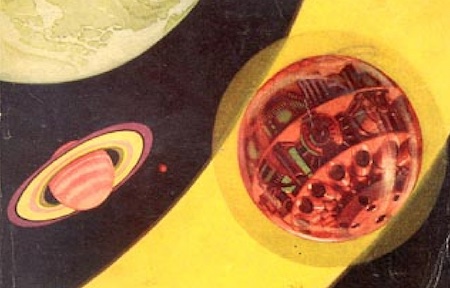 (Space Laboratory from 'Crystallized Thought' by Nat Schachner) Within the vast concavity Webb Foster set up his laboratory. All the normal apparatus was there: huge dynamos powered by solar radiation, giant electrostatic balls, flaring electron tubes high as a building, mass spectrographs, a powerful photo-electric mosaic telescope, delicate immersion baths. But besides this regular equipment were machines that Webb himself had fashioned: infinitely sensitive wave traps that tapped subspace itself, positron segregators, where those flash-vanishing ephemera of nature could be held indefinitely; strange spiral whirligigs in whose light-approaching speeds time itself seemed to have lost its forward march--and a myriad other complexes of ultra-science. Nor did Webb forget the more material bodily comforts. At the very center of his space laboratory he placed his living quarters, wherein he studied and ate and slept and had his controls, like an alert spider at the core of his web. In his storage compartments there was always a sufficient supply of dehydrated food for three years of wandering, a thousand-gallon tank of water, and air-purifying machines whereby the atmosphere could be indefinitely renewed and kept clean and wholesome. WHEN the great globe was completed, and stocked with all its multitudinous machines, twenty rocket tugs towed it from its Earth hangar out into space, set it upon a previously calculated orbit a million miles beyond the Moon, gave it the necessary orbital impetus, and set it free. Whereupon the space laboratory became a second satellite to Earth, revolving majestically around the parent globe in uninhibited gravitational flight, rotating slowly on its own axis to generate an artificial gravitational field within. There, in the depths of space, flashing like a minor planet, the space laboratory went its way, using no power in its interminable orbit, granting to its master that isolation, that abstraction from mundane noise and crowding which no longer existed on any of the inhabited worlds. |
| Technovelgy from Crystalized Thought,
by Nat Schachner. Published by Astounding Stories in 1937 Additional resources -
|
When I read this description, I thought about the science research stations in Star Trek, in particular the Regulus 1 station in the 1982 film Star Trek: The Wrath of Khan:
Compare with Wheelchair space station from Waldo (1942) by Robert Heinlein, Larry Niven's General Products hull from his 1970 novel Ringworld and the teleoperated lab from Cities in Flight (1957) by James Blish.
See also the transparent spherical ship from Schachner's (and Zagat's) own Emperor of the Stars (1931).
Comment/Join this discussion ( 0 ) | RSS/XML | Blog This |
Additional
resources:
More Ideas
and Technology from Crystalized Thought
More Ideas
and Technology by Nat Schachner
Tech news articles related to Crystalized Thought
Tech news articles related to works by Nat Schachner
Space Laboratory-related
news articles:
- Axiom - The World's First Private Space Station?
- Starlab By Nanoracks, A Commercial Space Station
| 'If Anyone Is Watching Earth...' |
| Cloud Of Space Rubbish From China's Long March Rocket |
| ESA's Draco To Study Heat Of Reentry |
| The United States Space Academy Is Official |
Want to Contribute an
Item?
It's easy:
Get the name of the item, a
quote, the book's name and the author's name, and Add
it here.
| <Previous | Next> |
|
|
|
Technovelgy (that's tech-novel-gee!) is devoted to the creative science inventions and ideas of sf authors. Look for the Invention Category that interests you, the Glossary, the Science Fiction Invention Timeline, or see what's New.
|

Science Fiction
Timeline
1600-1899
1900-1939
1940's 1950's
1960's 1970's
1980's 1990's
2000's 2010's
'Our study of your race has convinced us that you are not fitted to leave your planet in the present state of your civilization.'
'...the spreading beam of the deranging ray struck them, and Then one toppled and fell. Then another.'
'Within seconds the material was spread out over fifty yards, in a matter of hours it might occupy several cubic miles of space...'
'The men are dead, but their acquired wisdom lives on and I am the beneficiary.'
'Young people found the driverless car admirable for petting.'
'After twenty generations of shillyshallying...'

