
Science Fiction
Dictionary
A B C D E F G H I J K L M N O P Q R S T U V W X Y Z
Latest By
Category:
Armor
Artificial
Intelligence
Biology
Clothing
Communication
Computers
Culture
Data Storage
Displays
Engineering
Entertainment
Food
Input Devices
Lifestyle
Living Space
Manufacturing
Material
Media
Medical
Miscellaneous
Robotics
Security
Space Tech
Spacecraft
Surveillance
Transportation
Travel
Vehicle
Virtual
Person
Warfare
Weapon
Work
"I don't know why I write science fiction. The voices in my head told me to!"
- Charles Stross

 |
| Jump Harness | ||
| A device small enough to be worn as a backpack, that gave booster power for jumping. |

Heinlein does not give any real details as to how this is accomplished. I think the use of the device serves a literary purpose, though; a simple word like "jump" goes well with the teen "cherubs."
| "Cherub here!" A youngster in his teens came dashing up. He was dressed in short full robe, tights, slippers and pigeon's wings. Boone ordered "Fly up to the Sanctum office and tell the Warden on duty that I want another pilgrim's badge at the Sanctuary gate right away. The word is 'Mars.'" "'Mars,'" the kid repeated, threw Boone a Scout salute and made a sixty-foot leap over the crowd. Jill realized why the robe looked bulky; it concealed a jump harness. |
| Technovelgy from Stranger in a Strange Land,
by Robert Heinlein. Published by Putnam in 1961 Additional resources -
|
Heinlein is not the first author to use the idea; I think that the creators of Buck Rogers also used one in the 1920's.
Here's a nice illustration and quote from Final Command, a 1949 story by AE van Vogt:
Barr descended more slowly. He had come deliberately, seeking atmosphere and impressions. As he stepped to the ground, a flying robot whisked past only a few hundred feet up. Then another, and a dozen more. He stepped to the sidewalk, and watched them, stimulated.
They were hovering now around a tower several hundred yards along the street. Cautiously, weapons visible and ready, they dosed in on the upper reaches of the lower. Across the street, other robots— also wearing their flying attachments— swooped up to the top of a many-storied building. Like most business structures, it bad entrances at each office where robots, going to work could land.
German engineers created the "Himmelstürmer" (Skystormer) towards the end of WWII. This device allowed jumps of up to 180 feet in length, with a height of about fifty feet.
After the war, the device was turned over to Bell Aerosystems. Wendell Moore, an engineer with Bell Aerosystems in 1953, is credited with the first workable rocket belt. Moore then called the device the un-romantic name of Small Rocket Lift Device, or SRLD. This was the type of jetpack used in the James Bond film Thunderball.
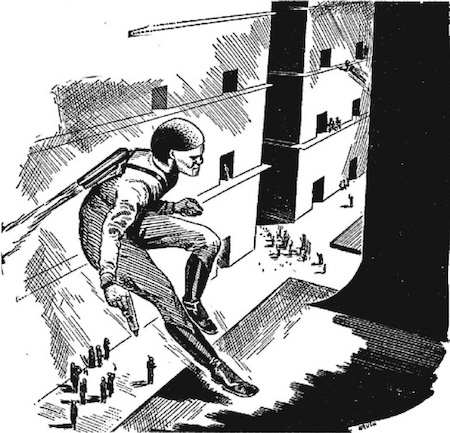
(Flying attachment from 'Final Command' by AE van Vogt)
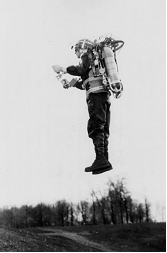
(Bell Aerospace Rocket Belt)
Among the many technical difficulties encountered in real life were a lack of stability in flight and the weight of the propellant.
It's probable that Heinlein took the idea from the Jump Belt, created in 1958 by Garry Burdett and Alexander Bohr of the Thiokol Corporation. Compressed nitrogen gas was used for propulsion; two nozzles at belt level (directed downwards) produced enough thrust to jump higher and run faster. Like Heinlein's jump harness, it was not a true flying device.
For a modern version of a device like this, take a look at Swiss Rocket Man.
Compare to the individual flyer from Asteroid Pirates (1938) by Royal Heckman and the copter harness from The Star Beast (1954) by Robert Heinlein.
Comment/Join this discussion ( 1 ) | RSS/XML | Blog This |
Additional
resources:
More Ideas
and Technology from Stranger in a Strange Land
More Ideas
and Technology by Robert Heinlein
Tech news articles related to Stranger in a Strange Land
Tech news articles related to works by Robert Heinlein
Jump Harness-related
news articles:
- Jetpack From New Zealand Takes Off
- Megachurches Catch Up To Heinlein
| Nifty Folding Electric Bicycles! |
| Boring Company Drills Asimov's Single Vehicle Tunnels |
| Boring Company Vegas Loop Like Asimov Said |
| SpaceX Rocket Shuttle Point-To-Point On Earth |
Want to Contribute an
Item?
It's easy:
Get the name of the item, a
quote, the book's name and the author's name, and Add
it here.
| <Previous | Next> |
|
|
|
Technovelgy (that's tech-novel-gee!) is devoted to the creative science inventions and ideas of sf authors. Look for the Invention Category that interests you, the Glossary, the Science Fiction Invention Timeline, or see what's New.
|

Science Fiction
Timeline
1600-1899
1900-1939
1940's 1950's
1960's 1970's
1980's 1990's
2000's 2010's
'Our study of your race has convinced us that you are not fitted to leave your planet in the present state of your civilization.'
'...the spreading beam of the deranging ray struck them, and Then one toppled and fell. Then another.'
'Within seconds the material was spread out over fifty yards, in a matter of hours it might occupy several cubic miles of space...'
'The men are dead, but their acquired wisdom lives on and I am the beneficiary.'
'Young people found the driverless car admirable for petting.'
'After twenty generations of shillyshallying...'

