
Science Fiction
Dictionary
A B C D E F G H I J K L M N O P Q R S T U V W X Y Z
Latest By
Category:
Armor
Artificial
Intelligence
Biology
Clothing
Communication
Computers
Culture
Data Storage
Displays
Engineering
Entertainment
Food
Input Devices
Lifestyle
Living Space
Manufacturing
Material
Media
Medical
Miscellaneous
Robotics
Security
Space Tech
Spacecraft
Surveillance
Transportation
Travel
Vehicle
Virtual
Person
Warfare
Weapon
Work
"I went [to the top of] Vehicle Assembly Building and looked down, and tears burst from my eyes. The size of this cathedral where the Rockets take off to go to the moon is so amazing."
- Ray Bradbury

 |
| Landing-Cradle | ||
| A supporting structure for a space craft landing on a planetary surface. |

This seems like an early use of this term. The idea is that craft made for space need additional support if landing on a planetary surface, due to the gravity.
| The white-lit opening of the air-lock gaped before them. He took her arm politely, stepped out beside her on the top of the narrow steelite debarking-ladder that led down to the ground. The ship was nestled snugly in the high curving uprights of a landing-cradle. |
| Technovelgy from The Radium World,
by Frank K. Kelly. Published by Wonder Stories in 1932 Additional resources -
|
Arthur Stangland uses the same term in the same year in Crossroads in Space (1932):
Passing between the cradles, he got his first sight of the disturbance through the ribs of the skeleton supports.
E.E. 'Doc' Smith uses the same term in Triplanetary (1934):
Again in Hotel Cosmos (1938) by Raymond Z. Gallun:
Poul Anderson liked it; he put it in The Corkscrew of Space (1956):
There was one arriving now, descending on a tail of fire some four miles away—which put it almost on the horizon. It was a bright gleam against the dark-blue sky, under the shrunken sun. As he watched, it entered its cradle...
Randall Garrett used a variant in Needler in 1957, with a nice illustration by Emsh:
A variation of the same expression, from They Never Came Back (1941) by Fritz Leiber:
Bart Harlan, standing on the cat-walk that circled the upper rim of the docking-cradle, did not immediately answer the shouted question. He clung to the thin hand rail, bracing himself against the sheets of rain which drove across the almost deserted landing field, and stared wearily down into the shadowy interior of the cradle...
Compare to the splashdown from From the Earth to the Moon (1867) by Jules Verne,
landing arms from Creatures of the Comet (1931) by Edmond Hamilton,
landing stage from Atomic Fire (1931) by Raymond Z. Gallun,
landing on an asteroid from Murder on the Asteroid (1933) by Eando Binder,
docking-cradle from They Never Came Back (1941) by Fritz Leiber,
landing-grid from Sand Doom (1955) by Murray Leinster,
landing pit from The Stars My Destination (1956) by Alfred Bester and
launching cradle from Needler (1957) by Gordon Randall Garrett.
He descended to the level of the shop floor by a short ramp, and passed through an airtight door. The huge machine shops, fully a thousand feet long and five hundred feet wide, were able to accommodate four space ships at once. The massive cradles in which the ships lay while being refueled and conditioned for flight, cut off his view of the opposite side of the shops, though he could hear loud voices, and recognized the boasting, bravado bass of Baker.
They came to a stop--paused, weightless--a vast door slid smoothly aside--they were drawn upward through an airlock and floated quietly in the air above a small, but brightly-lighted and orderly city of metallic buildings! Gently the Hyperion was lowered, to come to rest in the embracing arms of a regulation landing cradle.
“Space Liner Ardis coming in from Planet Five of Antares. Landing at 10:19 p.m. in fourth cradle of Civic Space Docks. 4-2-5 on board! 4-2-5 on board! Caution! Caution!
Laslos Magarac threaded past the crowds till he got to the spaceport fence. He had an impulse to pay a dollar to one of the telescope concessionaires for a look at the fifty great ships orbiting around the planet, but decided against it—the line was too long. After all, twice a local year was about once an Earth-year, so it was a capitalized Event—but the shuttle boats blasting down, sheeting flame through clouds of kicked-up red dust, were spectacular enough.
The Killiver was sitting in its launching cradle at the far side of the ten-mile-square Grand Port of Kandoris. Roysland didn't bother to take the tubeway; he flashed his credentials and commandeered a surface jeep. Bilford had already taken charge of the crew, but Roysland wasn't worried about them; he wanted a look at the ship.
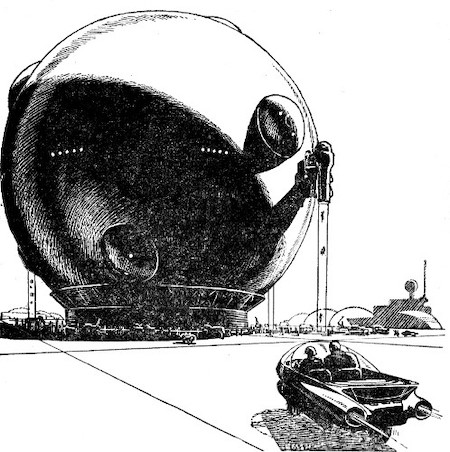
(Landing-Cradle from Needler by Randall Garrett)
HEY, YOU! What’s your business?”
Comment/Join this discussion ( 0 ) | RSS/XML | Blog This |
Additional
resources:
More Ideas
and Technology from The Radium World
More Ideas
and Technology by Frank K. Kelly
Tech news articles related to The Radium World
Tech news articles related to works by Frank K. Kelly
| SETI Suggests Prospecting The Solar System Without Landing |
| Cislunar Space And The Space Lanes of Golden Age Science Fiction |
| NASA Moonbase Update |
| The Solar Oberth Slingshot |
Want to Contribute an
Item?
It's easy:
Get the name of the item, a
quote, the book's name and the author's name, and Add
it here.
| <Previous | Next> |
|
|
|
Technovelgy (that's tech-novel-gee!) is devoted to the creative science inventions and ideas of sf authors. Look for the Invention Category that interests you, the Glossary, the Science Fiction Invention Timeline, or see what's New.
|

Science Fiction
Timeline
1600-1899
1900-1939
1940's 1950's
1960's 1970's
1980's 1990's
2000's 2010's
'Space-sickness is one of the most unpleasant sensations that a human being can experience. Not all are subject to it...'
'...I saw a nice black heavy-looking cloud sailing by just now, and I can get the electrical machine out in five minutes to draw it down.'
'From a distance it could resolve the cosmic rays reflected from various substances.'
'The answer to the dumb student's prayer.'
'He had travelled the space-lanes of the solar system for the greater part of his life...'
'The dinner was excellent. It was completely vegetarian — grown in specially prepared gardens in this Moon base...'
'Telepaths had their sensitiveness enlarged to an immense range by the pin-sets, which were telepathic amplifiers adapted to the mammal mind.'
'It was a relief to enter one of the comfortable autos, whisper a direction down the tube, and just know that you would be taken to your destination in the quickest, safest, and cheapest manner.'
'But he didn't get very far with it before another noise in his ear radio scattered his thoughts. George winced...'

